
 Script Planner Assistant▸
 AI Apps
 AI News
Seedance 2.5: 30-Second Native Video and 4K—What Changed From 2.0?
小编 ·

Seedance 2.5: 30-Second Native Video and 4K—What Changed From 2.0?
Seedance 2.5 is the latest video generation model released by ByteDance on June 23, 2026 at the Volcengine FORCE conference. Compared with Seedance 2.0, the main changes focus on video length, number of reference assets, generation consistency, image quality, and editing control — the core has evolved from "can generate" to "can create."
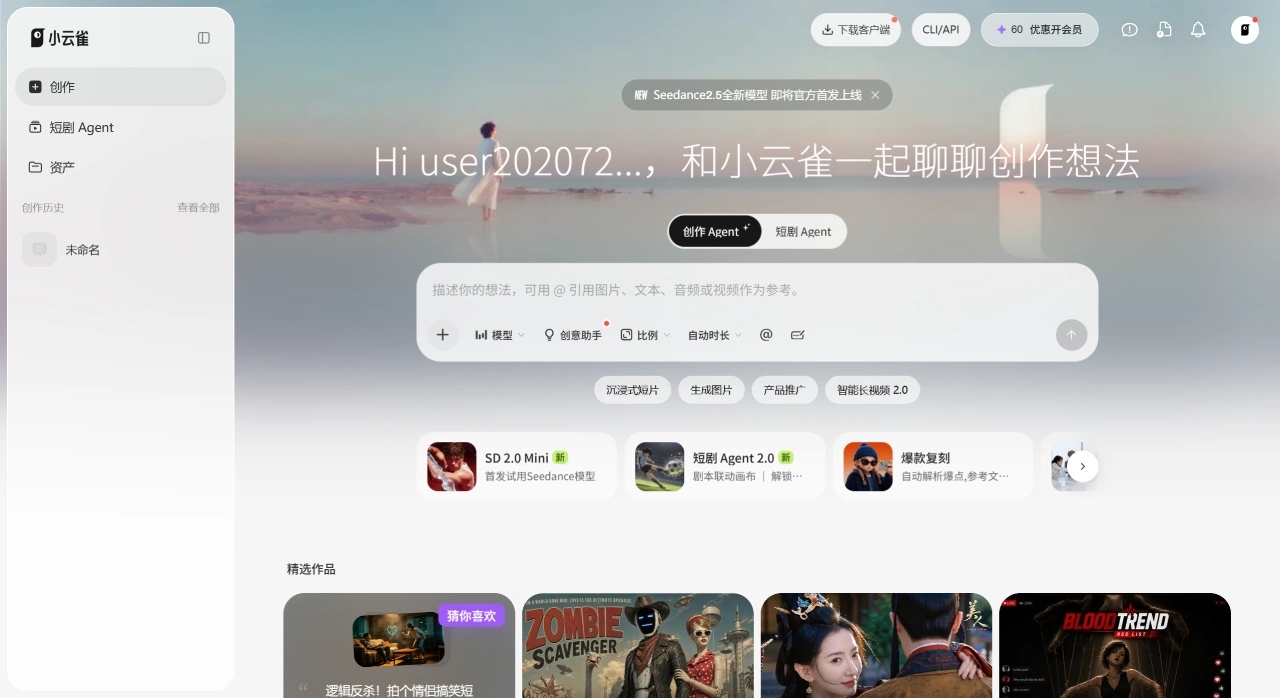
The Seedance 2.5 beta is nearing its end and is expected to officially launch in early July 2026. It can be experienced through channels such as Xiaoyunque Web Version and Jimeng AI.
Core Differences Between the Two
| Comparison Dimension | Seedance 2.0 | Seedance 2.5 |
|---|---|---|
| Single-segment native duration | 4–15 seconds | 30 seconds (generated in one pass, no stitching required) |
| Multimodal reference assets | Around 12 | 50 (images, videos, audio, storyboards, etc.) |
| Local editing | Basic extension/clip editing | Local repainting while keeping the overall picture unchanged |
| Voice support | Limited | Voice generation in 11 languages |
| Physics simulation | Strong, but complex scenes often require retries | Significantly improved; human motion and object interactions are more realistic |
| Resolution | Native 4K (10-bit color depth, added in a later 2.0 update) | 4K-level |
| Prompt adherence | Baseline | Improved by about 20% |
| Scenario coverage | Content creation, advertising and marketing | Expanded to film & TV, manufacturing, and embodied AI |
Specific Changes Between Seedance 2.5 and Seedance 2.0
Duration breakthrough: Seedance 2.5 delivers up to 30 seconds per video, currently the longest single-segment native output among global video generation models. Many models stall at 15–20 seconds. 30 seconds means better shot continuity, so when making narrative shorts or commercials, there is no need to stitch multiple clips together, reducing editing and consistency-fixing work.
Reference asset capacity more than doubled: Increased from about 12 to 50 multimodal assets. Creators can import multiple actors' image assets, product shots, scene references, style references, audio cues, and storyboard drafts in a single batch, and the model automatically handles arrangement and scheduling. This is critical for brand ads, ai short dramas, and other scenarios requiring strong character consistency.
Local repainting: Seedance 2.5 supports fine-tuning specific areas while keeping the overall picture unchanged — for example, changing the background, swapping a product, or replacing a model. Doing similar modifications in 2.0 usually requires regenerating the entire segment, which easily disrupts the timeline and lighting.
Stronger post-production toolchain: On platforms like Dreamina, Seedance 2.5 is paired with 4K enhancement, frame interpolation up to 60fps, automatic background music generation, cross-frame character stability, and multi-scene storyboard control (up to 10 frames, 0–8 seconds per frame). 2.0 does not have such a complete post-production workflow.
3D white-model preview: Seedance 2.5 adds a 3D white-model preview feature, allowing you to test shot composition and camera movement paths before final rendering — essentially integrating the previs stage into the AI workflow. 2.0 does not have this capability.
Audio synchronization and multilingual voice: Seedance 2.5 supports synchronized audio-visual generation and provides voice in 11 languages, making it suitable for localized ads and product demos. 2.0 has relatively limited multilingual support.
How to Choose?
Stick with 2.0: If your clips are short drafts, you're cost-sensitive, your workflow is already stable, or you only need one or two reference images, 2.0 is perfectly sufficient. 2.0 was also later upgraded to native 4K + 10-bit color depth, so the image quality is not bad.
Consider 2.5: If you need 30 seconds of continuous narrative, a large amount of reference assets to control character/brand consistency, frequent local edits, multilingual dubbing, or you're producing film/TV previs and industrial simulation videos, the upgrades in 2.5 will significantly reduce rework.









