
 Script Planner Assistant▸
 AI Apps
 AI News
Voost: A Virtual Try-On and Try-Off Tool
小编 ·

Voost: A Virtual Try-On and Try-Off Tool
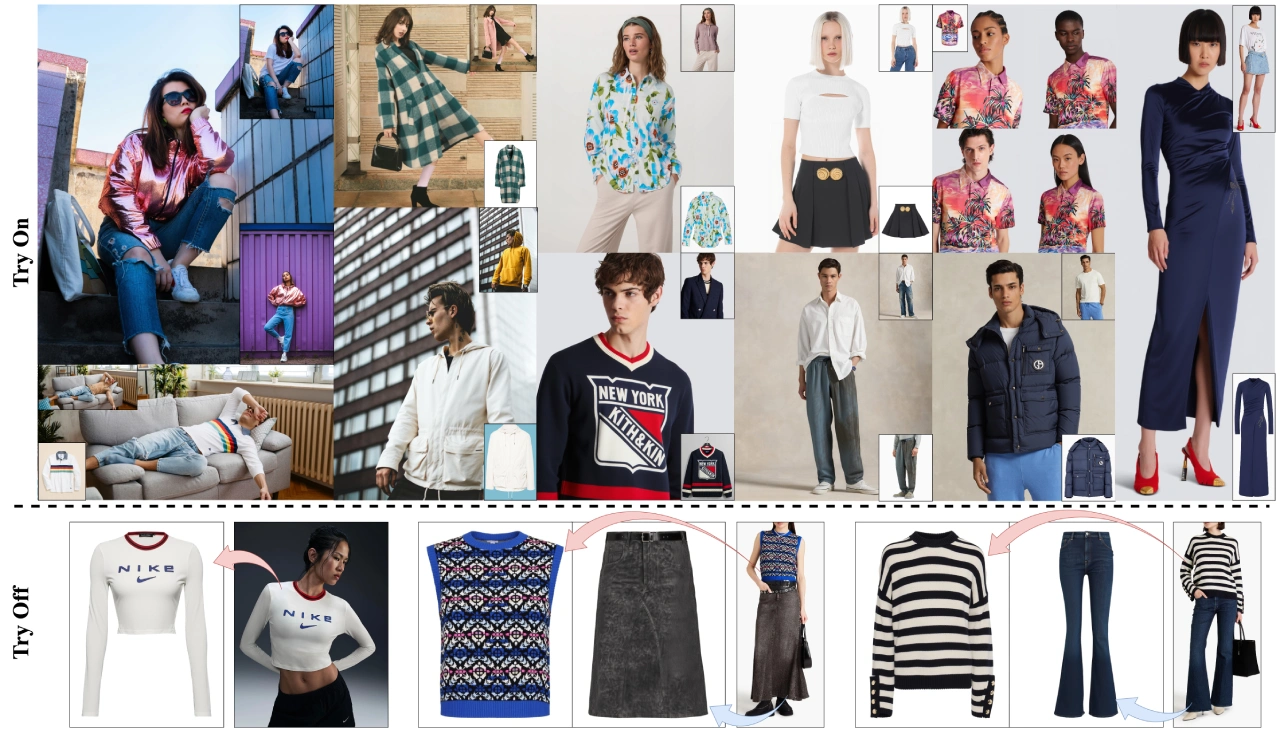
Voost is a virtual try-on and try-off AI tool proposed by Seungyong Lee and Jeong-gi Kwak. Its core idea is to handle both try-on and try-off tasks simultaneously using a Diffusion Transformer (DiT). What makes it stand out is that it doesn't require separate task-specific networks or additional labels, and it enables bidirectional "supervised" learning between each outfit and the person — looking at both the try-on result and the try-off result — so it can more accurately understand the relationship between clothing and the body, such as how fabric conforms to the skin and how wrinkles form. It also incorporates two practical techniques: attention temperature scaling (to make the model more stable across different resolutions) and self-corrective sampling (to reduce errors by having try-on and try-off verify each other). In tests, it achieves top-tier performance on both try-on and try-off benchmarks, with impressive reproduction of clothing details (like texture and wrinkles) and good fit with various body poses. It also adapts well to different clothing types, materials, and poses.
📚 Features
Bidirectional learning for detail restoration: Try-on and try-off are learned together, and through bidirectional supervision the model better understands the interaction between clothing and the body, reproducing details like wrinkles and fabric texture more realistically.
Realistic generation results: It can display try-on effects from multiple angles, and regardless of body type or pose — standing, sitting, or crouching — the clothing looks more true to life.
Strong adaptability with minimal dependencies: No need to specially tune the model for a specific garment or scenario, and no need for large amounts of manual labeling. Ordinary photos or webcam captures work fine.
📚 Technical Principles
Core method: A Diffusion Transformer (DiT) serves as the "brain." Through cross-attention, garment features and body representations are "fused" together, allowing even fine details like a single thread or a single wrinkle to be synthesized precisely.
Optimization techniques:
Attention temperature scaling: Like tuning a "sensitivity switch," it keeps the model's output stable under different resolutions or occlusions (for example, when a hand partially covers the clothing).
Self-corrective sampling: Try-on and try-off "check" each other — for instance, the try-off reverse logic is used to verify the try-on result, reducing generation errors.
Operation flow: The user uploads a clear front/side photo of a person, or simply takes one with a webcam. The system automatically builds a body model and "puts" the clothing on it.
📚 Where can Voost be used?
Online clothing shopping: No need to try things on physically — see directly in the app how an outfit looks on you, avoiding wrong sizes or bad fits after purchase.
Fashion design: When designers tweak silhouettes or mix and match outfits, they can preview results virtually instead of making sample garments over and over.
Social sharing: Use Voost to "try on" clothes in social platforms, making outfit posts more fun and engaging.
Offline retail stores: Combined with AR technology to create a virtual fitting mirror — customers stand in front of it and instantly switch outfits, delivering a high-tech experience.
📚 How to use Voost — Step by Step
The Hugging Face public demo is coming soon.
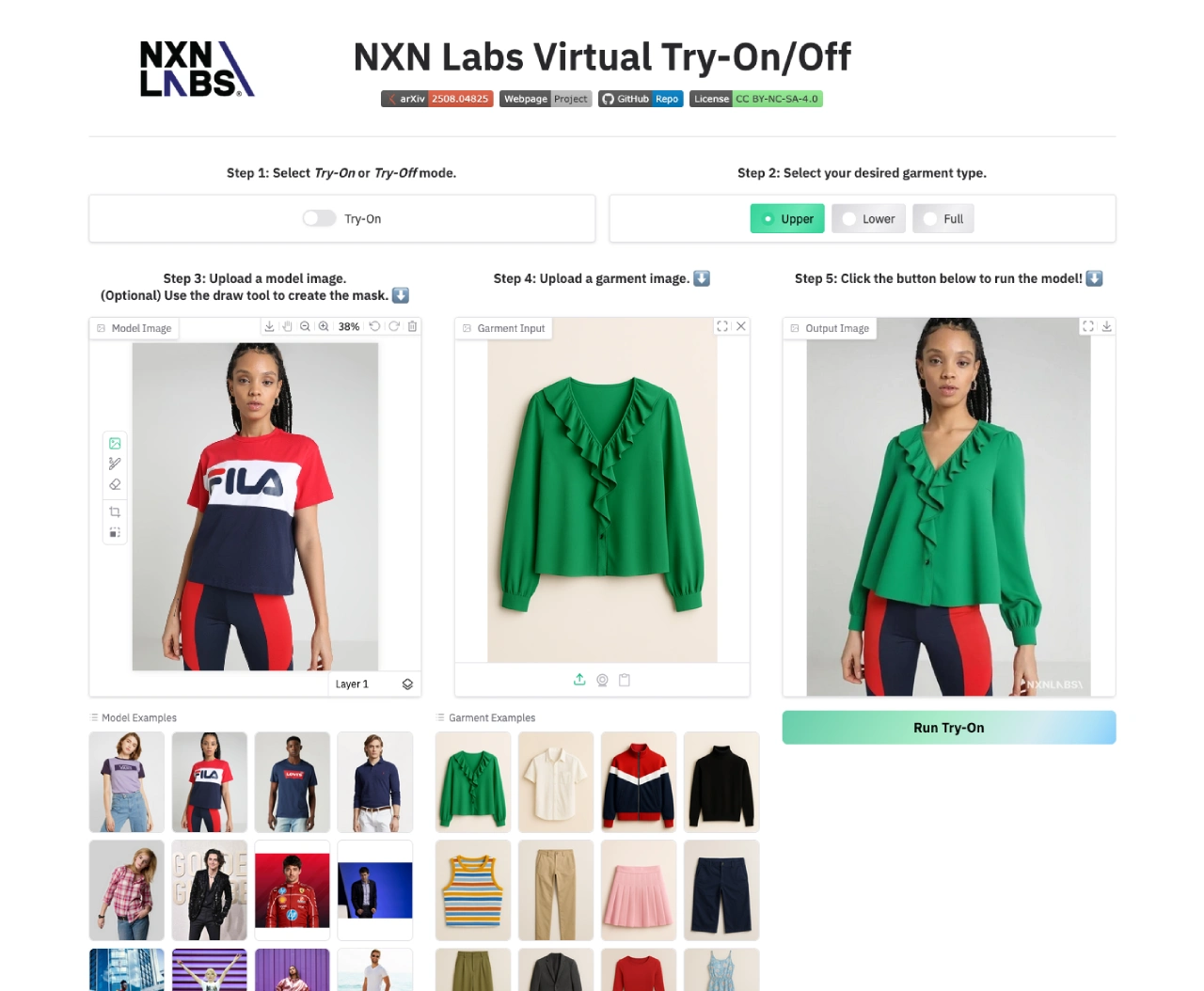
Choose try-on or try-off mode;
Choose the desired garment type (try-on includes upper body, lower body, and full outfit);
Upload a model image (optional: use a drawing tool to create a mask);
Upload a garment image;
Click the button to run the model.
📚 Frequently Asked Questions
❓: Compared with other try-on tools, what is Voost's biggest advantage?
A: It uses a single Diffusion Transformer to learn try-on and try-off at the same time, without separate task-specific networks or extra labels, and it uses bidirectional supervised learning. Combined with attention temperature scaling and self-corrective sampling, the results are more stable and more realistic.
❓: In which tests has Voost been validated?
A: It has been tested on common datasets such as VITON-HD and DressCode, as well as on real-world photos. Both try-on and try-off results are currently state-of-the-art, outperforming tools such as StableVITON and IDM-VTON in accuracy and realism.
❓: What do attention temperature scaling and self-corrective sampling do?
A: Temperature scaling keeps the model stable under different resolutions or occlusions (for instance, when a hand covers part of the clothing). Self-corrective sampling uses try-on and try-off to verify each other, reducing generation errors and making clothing appear more natural.
📚 Github: https://github.com/nxnai/Voost









