
 Script Planner Assistant▸
 AI Apps
 AI News
XVerse: ByteDance's Open-Source Multi-Subject Image Synthesis Tool
小编 ·

XVerse: ByteDance's Open-Source Multi-Subject Image Synthesis Tool
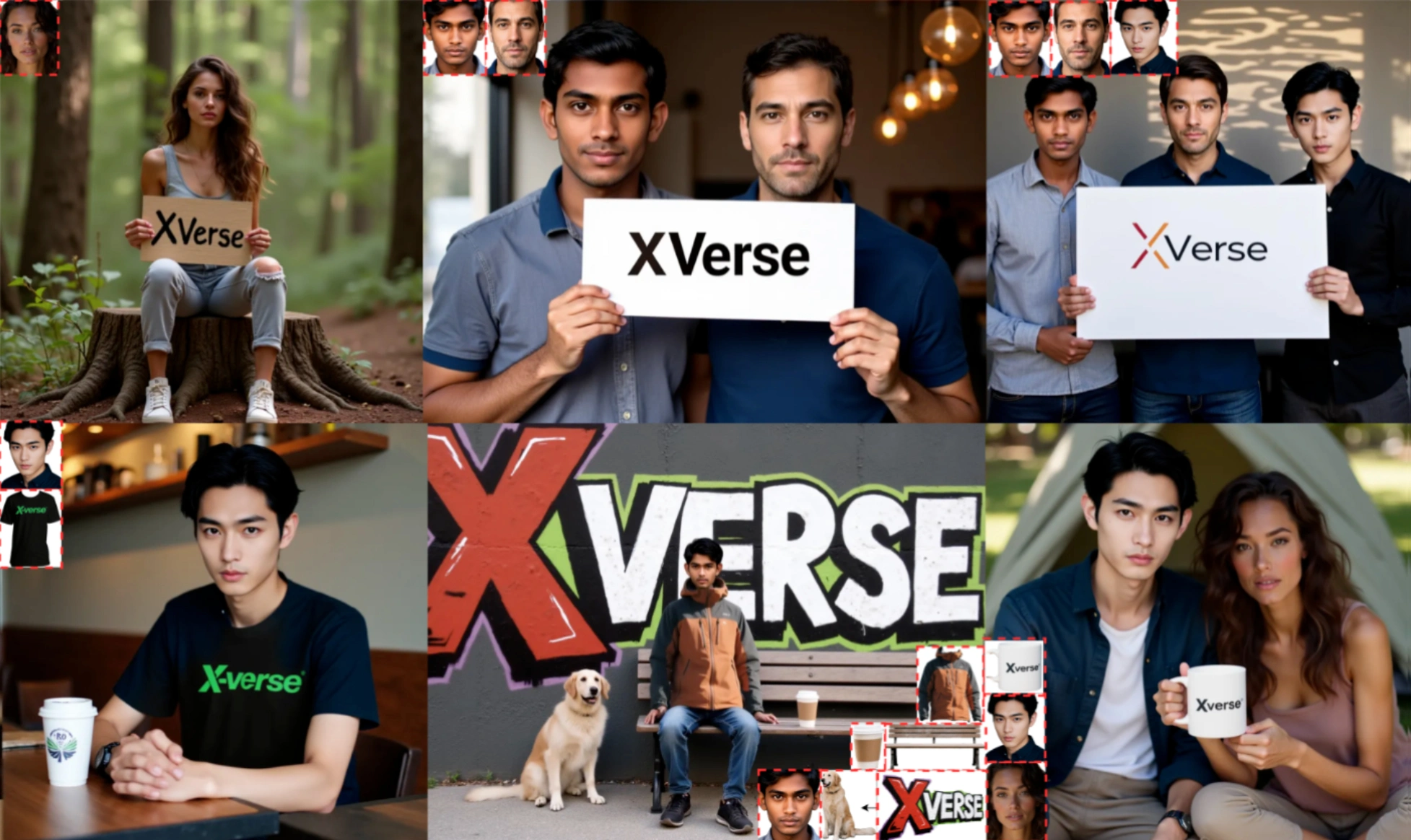
XVerse is a multi-subject image synthesis tool launched by ByteDance, capable of achieving high-precision multi-subject image generation. It significantly enhances the ability to generate complex scenes by allowing users to independently and precisely control multiple subjects.
Core Features
Multi-Subject Control: XVerse converts reference images into text-flow-modulated offsets to precisely control the identity features of each subject and independently adjust semantic attributes (pose, style, lighting, etc.). This solves the common issues of identity confusion and attribute entanglement in traditional models when handling multi-subject scenes, achieving high-fidelity, editable multi-subject image synthesis.
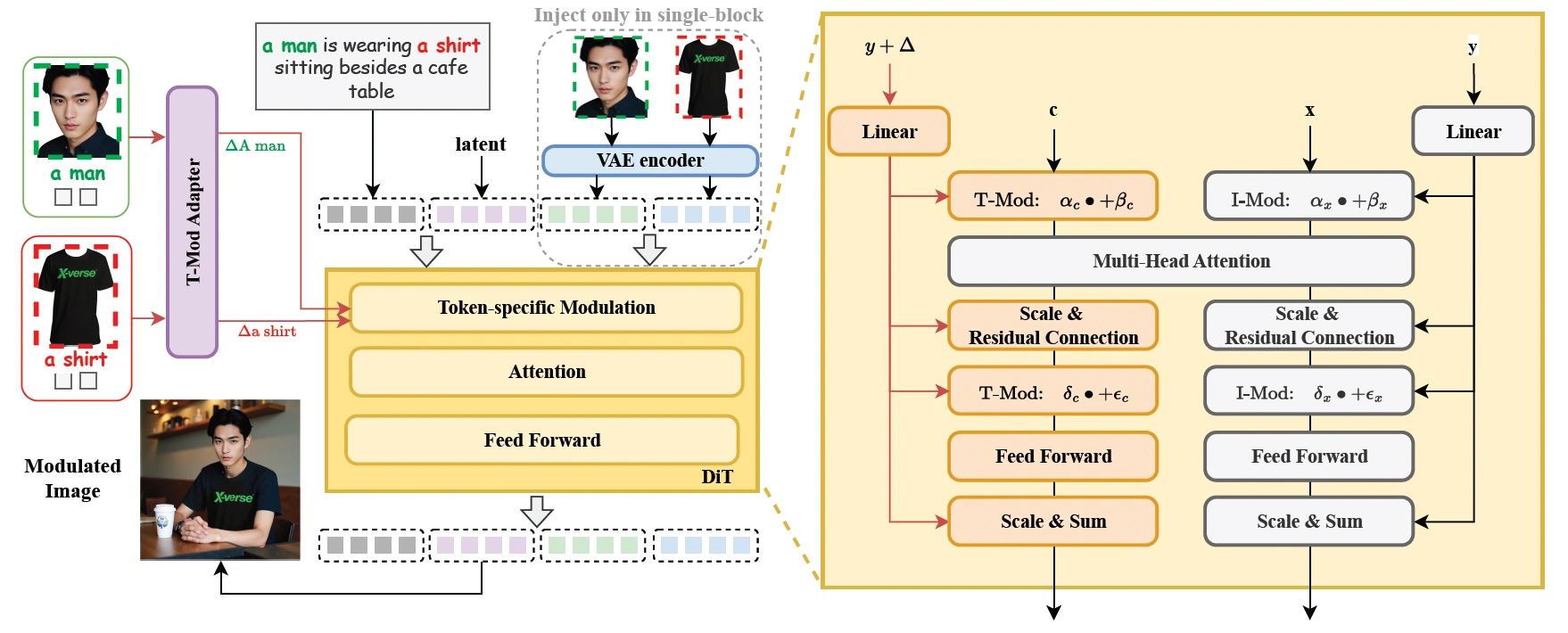
Text-Flow Modulation Enhancement: By combining reference image features with text prompt features to generate offsets and injecting them into the embeddings of specific text tokens, XVerse achieves precise control over each subject while maintaining the overall structure of the generated image and allowing fine-grained detail adjustments.
VAE-Encoded Image Features: XVerse introduces VAE-encoded image features as auxiliary inputs, injecting them into individual blocks of DiTs. This helps capture and reproduce image detail information, avoiding artifacts and quality degradation that may result from directly injecting image features.
Regularization Techniques: A region preservation loss is adopted to force the model to maintain consistency in unmodulated regions, distinguishing and preserving the features of different subjects. Through text-image attention loss, the cross-attention maps between the modulated model and the reference T2I branch are aligned, ensuring consistency and editability of semantic interactions during the modulation process.
XVerse Technical Principles
Text-Flow Modulation Mechanism: XVerse converts reference images into token-specific text-flow modulation offsets, which are added to the model's text embeddings, thereby achieving precise control over specific subjects without interfering with image latent variables or features.
VAE-Encoded Image Feature Module: To enhance the detail preservation capability of generated images, XVerse introduces a VAE-encoded image feature module. This module serves as an auxiliary component, helping the model retain more detail information during generation while reducing artifacts and distortions.
Regularization Techniques: Based on randomly preserving the modulation injection on one side, the model is forced to maintain consistency in non-modulated regions. Subject-specific features are regularized as a data augmentation strategy for multi-subject datasets, improving the model's ability to distinguish and preserve subject features in multi-subject scenes. By computing the L2 loss of the text-image cross-attention maps between the modulated model and the reference T2I branch, it is ensured that the modulated model retains attention patterns consistent with the T2I branch, preserving the consistency and editability of semantic interactions.
Application Scenarios
Digital Content Creation: XVerse helps creators easily achieve precise control over multiple subjects. It can be used for drawing comics, creating story illustrations, building complex virtual scenes, etc., making works more vivid, rich, and imaginative.
Advertising Industry: XVerse can precisely control the attributes of each subject, ensuring high fidelity and consistency in advertising images, making advertisements more eye-catching and enhancing communication effectiveness.
Art Field: Provides artists with a brand-new creative tool, breaking through traditional creative limitations to create unique and expressive artworks.
How to Use XVerse
Users need to create a conda environment with Python 3.10.16, install dependencies, and download the relevant checkpoints and face recognition models. The user interface is friendly, offering rich input setting options, including a "Detection and Segmentation" feature that can analyze uploaded images, automatically crop faces, and generate descriptions. In addition, an interactive Gradio demo is provided, where users can upload images, input descriptions, and generate images in real time, optimizing effects by adjusting parameters.
Project Address
Project Official Website:https://bytedance.github.io/XVerse/
GitHub Repository:https://github.com/bytedance/XVerse
HuggingFace Model Library:https://huggingface.co/ByteDance/XVerse
arXiv Technical Paper:https://arxiv.org/pdf/2506.21416









