
 Script Planner Assistant▸
 AI Apps
 AI News
Biomni: A General-Purpose Biomedical AI Agent
小编 ·

Biomni: A General-Purpose Biomedical AI Agent
Biomni is a biomedical tool developed collaboratively by Stanford University and Genentech. It can autonomously complete complex research tasks in fields such as genetics, genomics, microbiology, pharmacology, and clinical medicine. It combines large language model reasoning with retrieval-augmented planning techniques to extract the necessary tools and data from massive literature and dynamically compose research workflows. Tests show that the system performs exceptionally well across multiple biomedical tasks and is expected to enhance research efficiency and advance clinical applications.
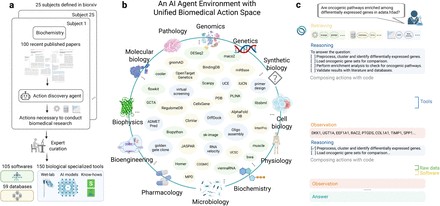
Core Components of Biomni:
Biomni consists of two parts: Biomni-E1 (unified software-data environment) and Biomni-A1 (environment-based agent):
Biomni-E1: Integrates 150 specialized tools, 105 software packages, and 59 databases, with all resources manually verified. For example, it connects to web APIs of databases such as PDB and OpenTarget, while partially downloading data to a local data lake and converting it into structured formats.
Biomni-A1: Employs three key technologies—large language model-driven tool selection, code as a universal execution interface, and adaptive planning strategies. It supports dynamic invocation of customized resources, composition of complex workflows (such as loops and parallel operations), and continuous optimization of research plans based on biomedical knowledge.
Performance
Benchmark tests: On the Human Last Exam (HLE), it achieved an accuracy rate of 17.3%, far exceeding the base large language model's 6.0%; on the LAB-Bench Database Question Answering (DbQA) task, the accuracy rate reached 74.4%, comparable to human expert level (74.7%); on the Sequence Question Answering (SeqQA) task, the accuracy rate reached 81.9%, surpassing the human performance of 78.8%.
Real-world tasks: In 8 types of tasks including variant prioritization and drug repositioning, performance improved by 402.3% compared to the base large language model, significantly outperforming similar tools.
Application Cases
Wearable device data analysis: Analyzed 458 sensor data samples and discovered the phenomenon of an average post-meal body temperature increase of 2.19°C as well as individual metabolic differences.
Multi-omics research: Processed over 330,000 sequencing data points, validated known gene regulatory relationships, and discovered new transcription factors such as AUTS2.
Experimental design: In gene cloning tasks, the generated experimental protocol achieved accuracy comparable to human experts. In actual laboratory operations, cloning was successfully completed according to its protocol, and the sequencing results matched expectations perfectly.
Related Links
https://www.biorxiv.org/content/10.1101/2025.05.30.656746v1.full









