
 Script Planner Assistant▸
 AI Apps
 AI News
OmniGen2: The Open-Source Alternative to Flux.1 Kontext
小编 ·

OmniGen2: The Open-Source Alternative to Flux.1 Kontext
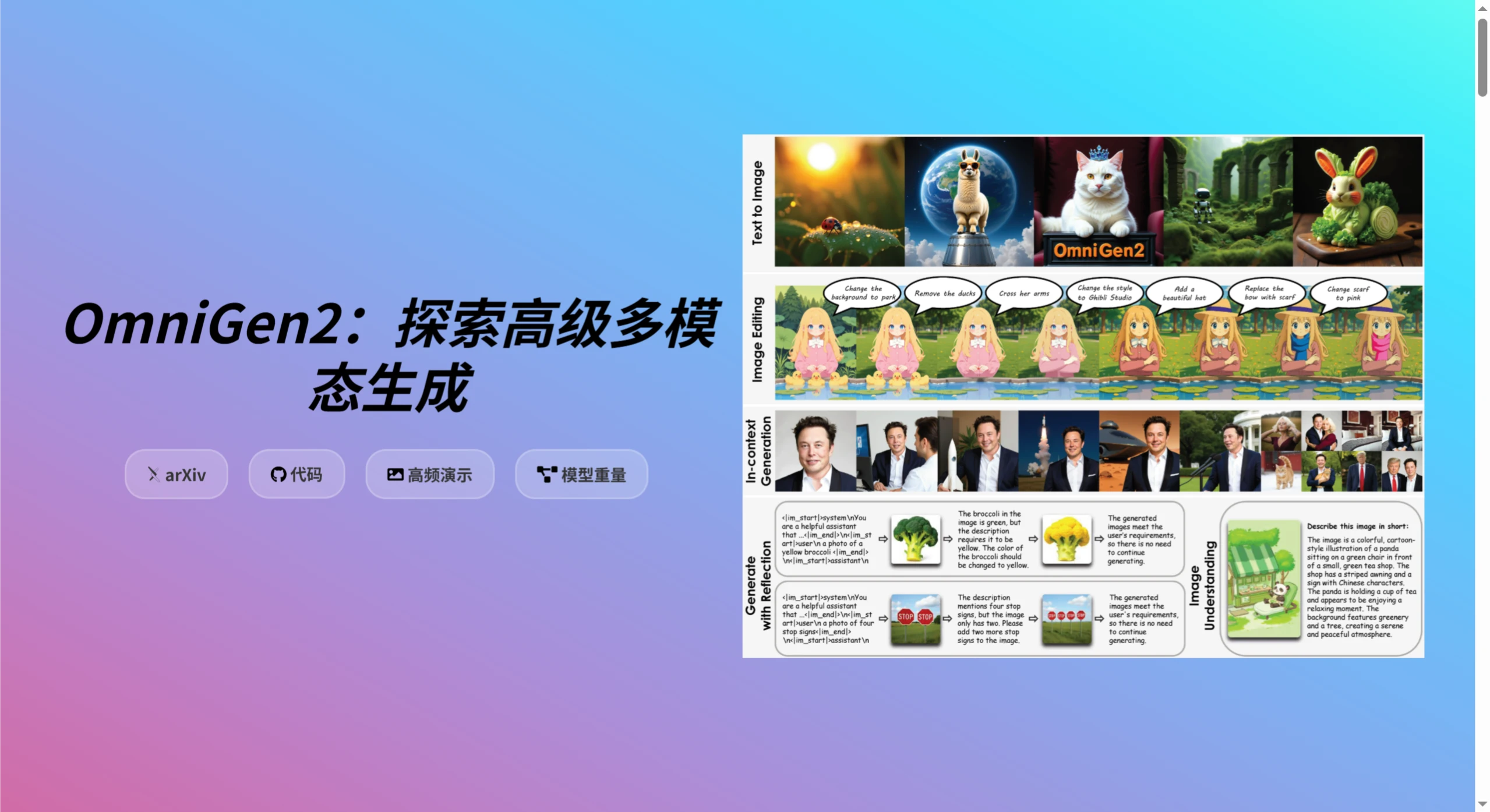
OmniGen2 is a multimodal generation model released by BAAI (Beijing Academy of Artificial Intelligence). Similar to Flux.1 Kontext, it can modify images through text. It integrates visual understanding, text-to-image synthesis, instruction-based image editing, and subject-driven contextual generation into a single unified framework. The model adopts a decoupled architecture, enabling it to output visually detailed and stylistically consistent results while preserving language modeling capabilities. In addition, it introduces a multimodal reflection mechanism that can analyze, review, and iteratively refine generated outputs, integrating reasoning and self-correction into the image generation process. This allows it to perform exceptionally well in both generation and understanding tasks, setting a new benchmark for lightweight open-source models.
Core Features
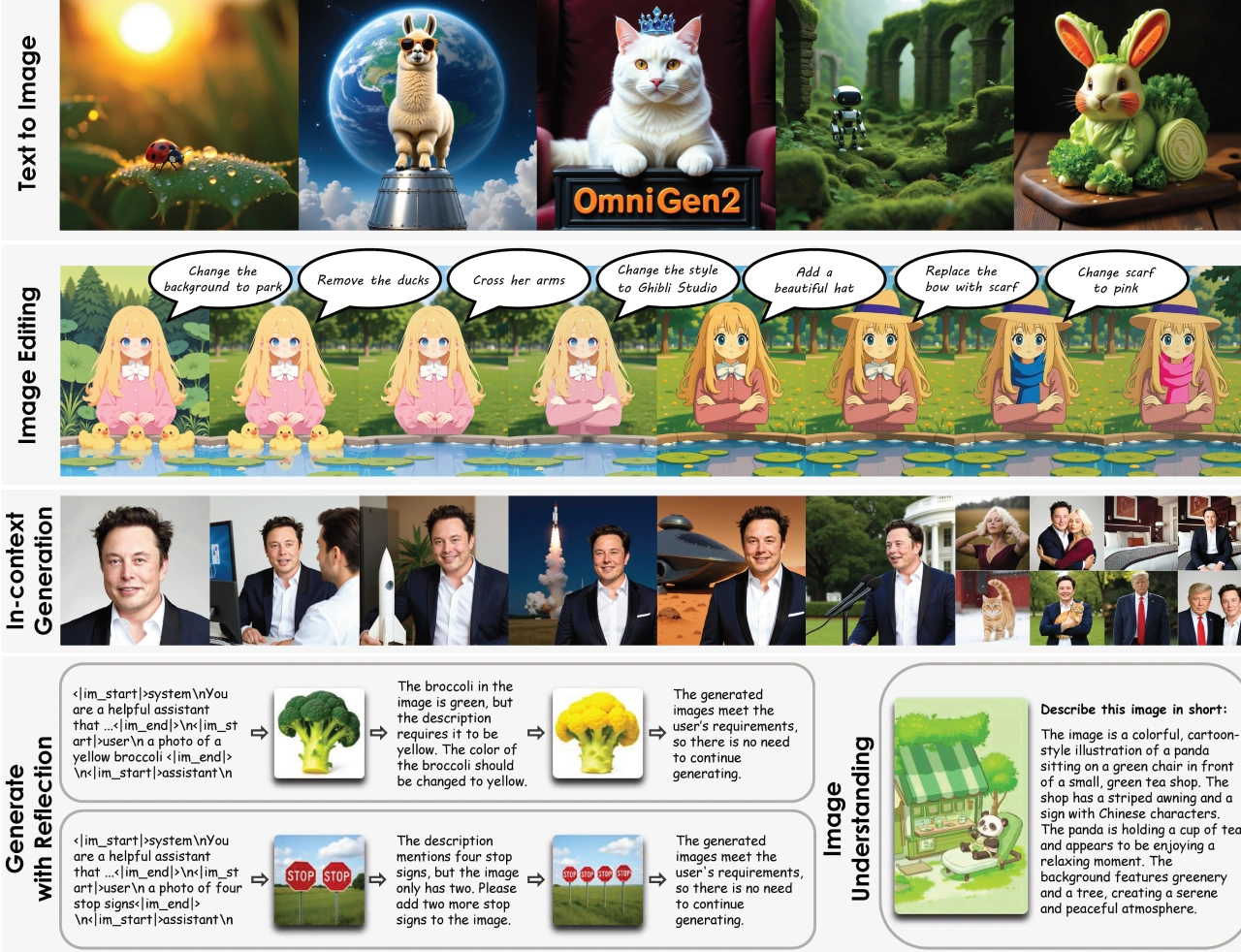
Text-to-Image Generation: Users can generate images of various scenes and characters based on text descriptions, such as "a cat wearing a crown lying on a velvet throne" or "a dark wizard casting magic in an ancient cave".
Image Editing: Supports a variety of modifications to generated images, such as changing clothing colors, replacing backgrounds, or adding and removing elements within the image.
Style Transfer: Images can be converted into different artistic styles, such as anime style or oil painting style.
Character and Scene Composition: Characters or elements from different images can be combined into new scenes. For example, "have the girl from the first image and the boy from the second image hold a wedding in a church".
Features
High-Quality Output: Generated images are rich in detail with outstanding visual effects.
Flexible Editing Capabilities: Provides a variety of editing options, allowing users to customize images according to their needs.
Open-Source Nature: As an open-source project, it provides developers and researchers with more possibilities for exploration and development.
Use Cases
Creative Design: Designers can use OmniGen2 to quickly generate design concepts and sketches.
Content Creation: Content creators can generate images of various scenes and characters for storytelling, video production, and other scenarios.
Education and Research: Educators and researchers can use it as a teaching and research tool to explore the applications of multimodal generation technology.
Application Examples
Image Generation: Generate images of various scenes and characters through text descriptions, such as "a cat wearing a crown lying on a velvet throne".
Image Editing: Modify generated images, such as changing clothing colors, replacing backgrounds, and similar operations.
Image Composition: Combine elements from different images into new scenes, such as "have the girl from the first image marry the boy from the second image in a church".
Key Questions
1. What are the core innovations of OmniGen2?
The core innovation of OmniGen2 lies in its use of a dual-path decoupled architecture to integrate multimodal generation capabilities, the introduction of a multimodal reflection mechanism to achieve self-optimization of outputs, and the design of Omni-RoPE positional embeddings to enhance consistency in image editing and contextual generation. These innovations set a new benchmark among lightweight open-source models.
2. What specific operations can OmniGen2 perform in image editing?
In image editing, OmniGen2 can perform a variety of fine-grained operations, including object handling (such as adding or removing objects, e.g., adding a fisherman's hat to a character or removing a cat from the image), style transformation (such as changing the background to a classroom scene or converting the style to Studio Ghibli style), color adjustment (such as changing a dress color to blue), expression modification (such as making a character smile), and action editing (such as making a character raise their hand). At the same time, it preserves the visual realism and consistency of unedited areas.
3. How does the multimodal reflection mechanism improve OmniGen2's generation quality?
The multimodal reflection mechanism enables OmniGen2 to evaluate its own output, identify situations where the description does not match the image content (e.g., when "three pizzas" are described but only one appears in the image, it prompts adding more), color or position errors (e.g., when yellow broccoli is generated as green, it prompts changing the color; when a dog appears on a chair instead of a yellow dining table, it prompts adjusting the position), and other issues. Through iterative optimization, it generates results that better match the requirements, thereby enhancing the controllability, reliability, and quality of outputs.
Project Homepage: https://vectorspacelab.github.io/OmniGen2/
Technical Paper: https://github.com/VectorSpaceLab/OmniGen2
Online Trial: https://huggingface.co/OmniGen2/OmniGen2
Note: Flux.1 Kontext is an image generation and editing tool developed by Black Forest Labs in Germany. It can generate and edit images based on text and image prompts, including modifying objects, transforming styles, replacing backgrounds, maintaining character consistency, and editing text. Unlike traditional text-to-image models, it supports contextual image generation, combining both text and image prompts to directly extract and modify visual concepts and generate new coherent images.









