
 Script Planner Assistant▸
 AI Apps
 AI News
ImmerseGen: A 3D Scene Generation Framework by ByteDance and Zhejiang University
小编 ·

ImmerseGen: A 3D Scene Generation Framework by ByteDance and Zhejiang University
What is ImmerseGen?
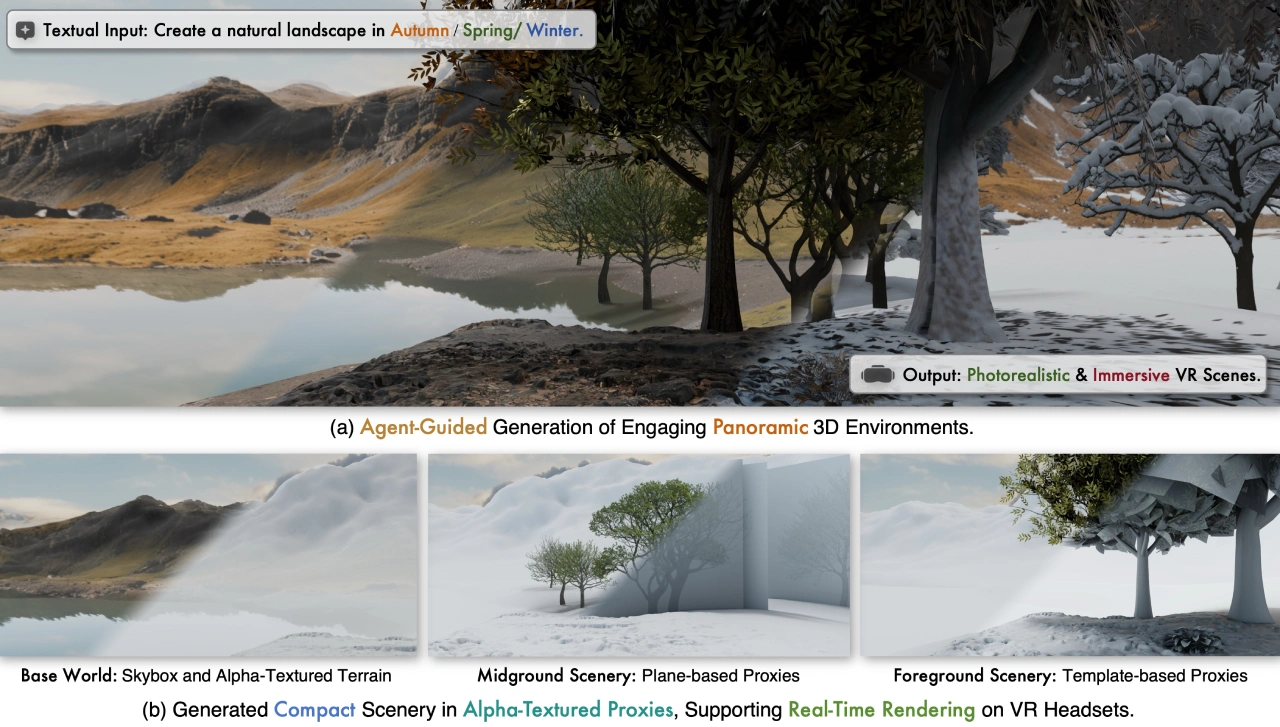
ImmerseGen is a 3D scene generation framework jointly developed by ByteDance and Zhejiang University. It leverages proxy-guided and RGBA texture synthesis techniques to generate highly realistic VR scenes based on user-provided text descriptions, such as "generate an autumn natural landscape." It is especially well-suited for real-time rendering on VR headsets, significantly reducing users' reliance on complex assets while ensuring scene variety and realism.
Feature Highlights
Lightweight and Efficient: Hierarchical geometric proxies and RGBA texture synthesis enable highly efficient scene modeling.
Automatic Generation: Combines terrain-conditioned texturing and vision-language models (VLM) to achieve a high degree of automation in VR scene generation.
Excellent Visual Quality: Leads existing techniques in realism, spatial consistency, and rendering efficiency.
Broad Applicability: Compatible with mobile VR devices, providing high-quality 3D scene generation solutions for related fields.
Method Workflow
Base Terrain: Based on user input, retrieves base terrain, then synthesizes RGBA terrain textures and skyboxes through terrain-conditioned texture synthesis to form a base world.
Lightweight Assets: Uses VLM to select suitable templates, designs asset prompts, and determines asset placement within the scene. Assets are instantiated into alpha-textured assets via the context-rich RaystexturedComposite.
Multimodal Immersion Enhancement: Further enhances immersion based on dynamic visual effects and ambient sound.
Application Examples
VR and AR: Used in game development, virtual tourism, and education training, providing immersive experiences for rapid scene and level generation.
Architecture and Real Estate: Applied to virtual property viewing and architectural design, helping clients understand and provide feedback on 3D models.
Film and Animation: Used for special effects production and scene design, reducing the need for on-location shooting while delivering visual effects.
Social Media and Content Creation: Provides virtual backgrounds and high-quality 3D scenes for virtual video calls, live streaming, and content creation.
Simulation and Training: Used for military training and medical training, developing realistic battlefields and medical environments.
Retail and E-commerce: Generates virtual stores and 3D product models to enhance shopping experiences and product presentation.
Frequently Asked Questions
1. How does ImmerseGen achieve efficient VR scene generation?
Answer: It works in three steps: generating the base world, using proxy-guided techniques for asset design and layout, and finally enhancing immersion through dynamic effects and ambient sound. The key is using alpha-textured proxies to replace complex assets, reducing computational complexity and supporting real-time rendering on VR headsets.
2. What is the purpose of asset proxies?
Answer: Asset proxies are based on vision-language models (VLM), selecting suitable templates to generate prompts for assets and determine their horizontal profiles, ensuring contextual coherence of assets and automating asset design and arrangement.
3. What advantages does ImmerseGen have over traditional VR scene generation techniques?
Answer: Traditional techniques rely on complex 3D assets, while ImmerseGen uses proxy-guided alpha-textured proxies, greatly reducing the dependence on complex assets. At the same time, techniques such as terrain-conditioned texture synthesis ensure scene realism and variety, support real-time rendering on VR headsets, and improve user experience smoothness.
Project Address
https://immersegen.github.io/









