
 Script Planner Assistant▸
 AI Apps
 AI News
TableRAG: A Retrieval-Augmented Generation Framework Designed for Table Understanding
小编 ·

TableRAG: A Retrieval-Augmented Generation Framework Designed for Table Understanding
TableRAG is a framework designed to address the problems of structural information loss and lack of a global view in heterogeneous document question answering. It combines SQL execution with text retrieval, enabling unified understanding of tabular data and complex operations. The framework consists of offline database construction and a four-step online iterative reasoning process. On the new benchmark HeteQA and other public benchmarks, TableRAG performs excellently, surpassing existing RAG and programmatic methods, and stands as an advanced solution for handling complex heterogeneous document reasoning.
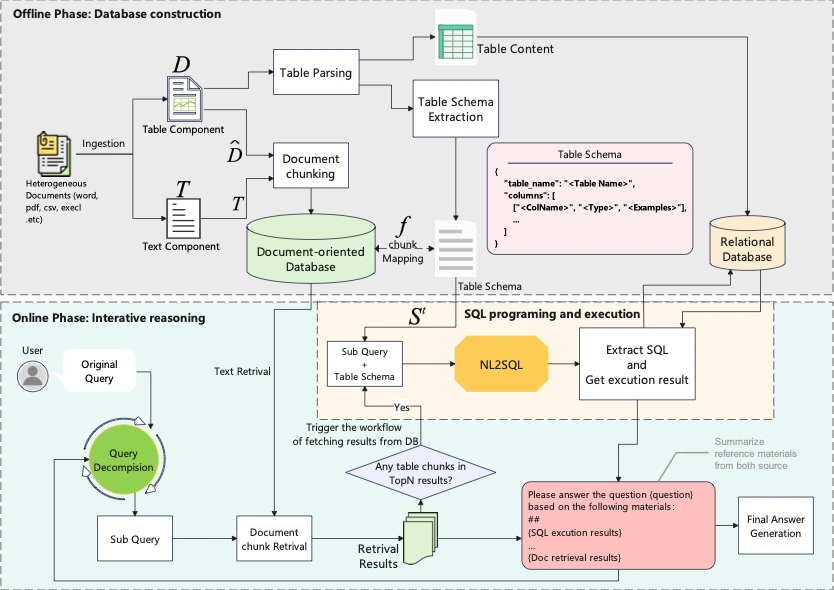
Core Principles
Query Expansion and Retrieval: TableRAG locates key information in tables through query expansion, schema retrieval, and cell retrieval. It generates separate queries for schemas and cell values, avoiding the redundant information that a single query would bring.
Schema Retrieval: The AI language model can identify key columns and their data types through column names, without encoding entire columns. For example, for the question "What is the average price of wallets?", the language model generates column name queries such as "Product" and "Price".
Cell Retrieval: Based on the queries generated by the language model, it retrieves column names and cells related to the question. For instance, retrieving cell values related to "wallet".
Frequency-Aware Truncation: A cell encoding budget B is introduced. If the number of distinct values exceeds B, only the top B values with the highest occurrence frequency are encoded.
TableRAG Main Modules
online_inference/main.py: The core inference code of TableRAG, containing the TableRAG class, which implements the main logic for online inference.
offline_data_ingestion_and_query_interface/src/interface.py: Uses the Flask framework to provide SQL query interfaces.
online_inference/tools/sql_tool.py: Contains the tool functions for SQL generation and execution, with retry mechanism support.
offline_data_ingestion_and_query_interface/src/sql_alchemy_helper.py: Provides a helper class for SQLAlchemy database operations, supporting data insertion and querying.
offline_data_ingestion_and_query_interface/src/service.py: The core logic for handling TableRAG requests, including obtaining SQL statements from the LLM and executing them.
online_inference/chat_utils.py: Contains utility functions for obtaining results generated by the LLM, supporting different API backends.
offline_data_ingestion_and_query_interface/src/data_persistent.py: Utility functions for cleaning DataFrame column names.
offline_data_ingestion_and_query_interface/src/handle_requests.py: Invokes the large model inference interface, including exception capturing and exponential backoff retry mechanism.
online_inference/tools/retriever.py: Implements semantic retrieval and hybrid document retrieval functions, including recall and re-ranking.
Advantages
Efficient Data Encoding: Through schema retrieval and cell retrieval, TableRAG reduces the input length of the language model, making it independent of table size, improving encoding efficiency, and reducing computational costs.
Reduced Information Loss: By providing only the retrieved schemas and cells to the language model, it avoids the loss of key information that would result from processing entire tables.
Enhanced Reasoning Capability: By providing key information, TableRAG enhances the table reasoning capabilities of the language model.
TableRAG Application Scenarios
Data Analysis and Report Generation: Suitable for scenarios that require processing large-scale tabular data, such as data analysis, report generation, and financial report processing.
Cross-Table Question Answering: Capable of handling tasks such as fact verification based on tables, as well as single-hop and multi-hop table question answering.
Experimental Validation
The researchers developed a million-token-scale benchmark based on the Arcade and BIRD-SQL datasets to evaluate the performance of TableRAG in large-scale table understanding tasks. Experimental results show that TableRAG outperforms existing methods in retrieval quality and large-scale table understanding performance.
Project Link
Github:https://github.com/yxh-y/TableRAG









