
 Script Planner Assistant▸
 AI Apps
 AI News
TradingAgents: A Multi-Agent Trading System
小编 ·

TradingAgents: A Multi-Agent Trading System
What is TradingAgents?
TradingAgents is a financial trading framework developed by UCLA and MIT that determines the timing of stock buying and selling through analysis, discussion, and decision-making. The system includes roles such as analysts, researchers, traders, and risk managers, and comprehensively considers multiple sources of information including financial data, market sentiment, and news reports. The various roles form thorough and rational decisions through dynamic discussion. For example, some roles may believe a stock is worth buying, while others see risk; they debate to reach the best decision.
Users can customize strategies based on their own trading style and goals, adjust the behavior of each role, or even add new roles or functional modules. The system supports real-time acquisition of the latest market data and is also compatible with cached data. TradingAgents is built on LangGraph, and experiments use the o1-preview and gpt-4o models for deep-thinking and fast-thinking tasks respectively.
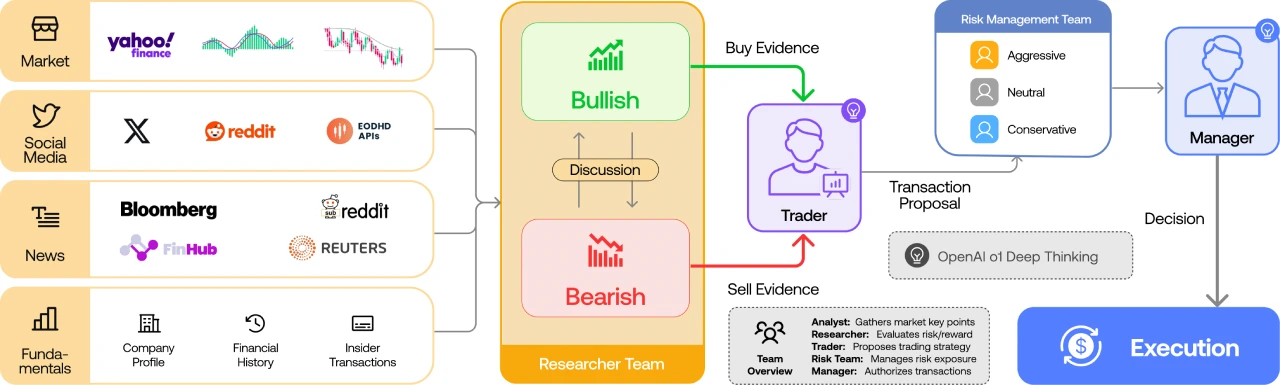
Core Features of TradingAgents
Multi-role Division of Labor: This framework has various roles, such as fundamental analysts, sentiment analysts, news analysts, technical analysts, researchers, traders, and risk managers. Each role has its own tasks and tools, and they work together to complete trades.
Fundamental Analyst: Examines the company's financial statements and industry trends to identify undervalued or overvalued stocks and assess long-term investment value.
Sentiment Analyst: Analyzes news, social media, and market sentiment to predict the short-term impact of investor behavior on stock prices.
News Analyst: Focuses on news and macroeconomic indicators to identify major events that may affect the market.
Technical Analyst: Studies historical prices and technical indicators to forecast future price trends and determine trading timing.
Researchers: The team includes bullish and bearish members who debate to assess investment risks and returns.
Trader: Executes trading decisions based on analysis results and risk preference.
Risk Manager: Monitors risk in real time, adjusts strategies, and ensures trades stay within the set risk range.
Communication Method: Combines structured output with natural language dialogue to avoid information loss and improve decision-making efficiency.
Technical Principles of TradingAgents
Multi-agent Collaboration: Multiple intelligent agents each perform their own duties while cooperating with one another.
Task Decomposition: Break down complex trading tasks into multiple smaller tasks, with each role responsible for a portion.
Natural Language Processing: Uses LLMs to process text data and support communication and decision explanations between agents.
Data Fusion: Combines structured and unstructured data to mine more valuable information.
Dynamic Decision-making: Adjusts strategies in real time based on market changes to optimize performance.
Main Functions of TradingAgents
Data Collection and Analysis: Collects various market data to support trading decisions.
Role Specialization: Different roles handle different tasks, improving the scientific rigor of decisions.
Agent Debate and Decision-making: Forms comprehensive trading strategies through debate.
Risk Control and Management: Monitors risk in real time to ensure trades comply with risk settings.
Interpretability and Transparency: Records the decision-making process in natural language for easy understanding and optimization.
Experimental Results
TradingAgents performs excellently on metrics such as cumulative return and Sharpe ratio, with cumulative returns at least 6.1% higher than traditional strategies, maximum drawdown controlled at around 2%, and very good risk control.
Application Scenarios of TradingAgents
Quantitative Trading: Generates buy and sell signals in real time, helping quantitative traders make quick decisions.
Asset Management: Provides dynamic asset allocation recommendations to optimize investment portfolios.
Personal Investing: Provides investment advice for individual investors, helping identify opportunities and risks.
Financial Research: Provides analysts with market insights to support the writing of research reports.
Venture Capital: Helps evaluate a company's financial health and growth potential, reducing investment risk.
Project Links
Official Website: https://tradingagents-ai.github.io/
GitHub Repository: https://github.com/TradingAgents
Technical Paper: https://arxiv.org/pdf/2412.20138









