
 Script Planner Assistant▸
 AI Apps
 AI News
Paper2Code: Turn Research Papers into Working Code
小编 ·

Paper2Code: Turn Research Papers into Working Code
What is Paper2Code?
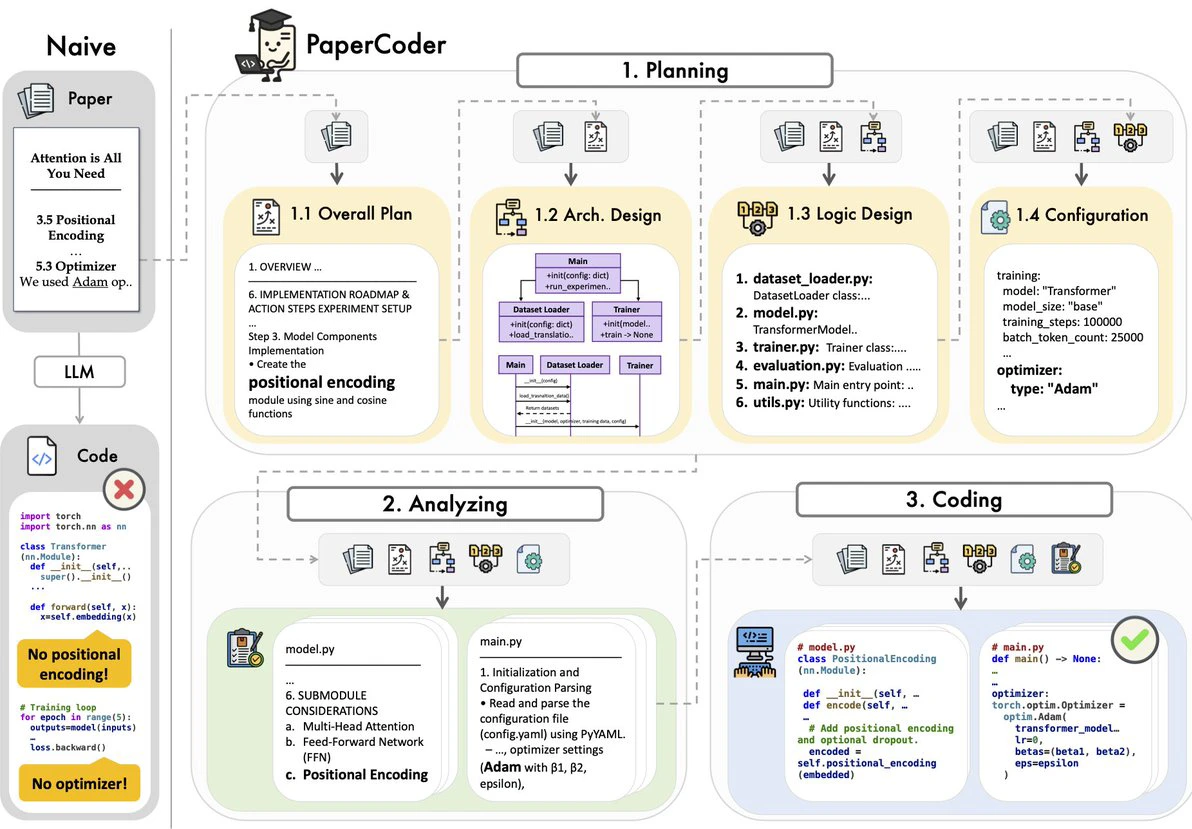
Paper2Code is a tool that turns machine learning papers into usable code frameworks. It was jointly developed by KAIST (Korea Advanced Institute of Science and Technology) and DeepAuto.ai, and it generates code through three stages—planning, analysis, and coding—just like how humans develop software.
How Paper2Code Works
In the planning stage, it first builds a rough framework, designs the system architecture, such as drawing UML diagrams and defining file structures, then plans how files and modules work together, and finally generates configuration files.
In the analysis stage, it carefully examines the function of each file, its inputs and outputs, and how it connects with other files.
In the generation stage, it produces modular code with dependencies based on the prior planning and analysis.
Core Features of Paper2Code
Automated code generation: it can turn machine learning papers directly into complete code repositories, including system architecture, dependency files, and configuration files.
Multi-format input: it supports PDF and LaTeX papers, and can also convert PDF papers into JSON format.
Three-stage processing pipeline: each stage is handled by dedicated agents, ensuring clear code structure that faithfully reflects the paper.
Planning stage: draws a high-level roadmap, identifies core components, models the structural relationships between modules, recognizes file dependencies and execution order, and generates configuration files to let researchers customize experiments.
Analysis stage: thoroughly parses every file and function, clarifying functionality, interactions, and constraints from the algorithm architecture.
Code generation stage: synthesizes the entire codebase based on previous outputs, ensuring consistent module calls, reducing bugs, and maintaining logical coherence.
Code quality evaluation: supports both reference-based and reference-free evaluation, rated on a 1–5 scale.
Advantages:
High-quality code generation: on the PaperBench benchmark, Paper2Code outperforms existing code generation frameworks and simple baseline methods.
Multi-agent collaboration: a multi-agent framework helps each stage perform better and improves the quality of generated code.
Structured output: the generated codebase has a clear structure, including files, modules, architecture diagrams, and configuration files.
High executability: the generated code can basically run without modification.
Limitations:
Currently only supports papers in the machine learning field.
Some edge cases still require manual debugging.
It does not yet support fields such as biology, physics, or economics.
Use Cases for Paper2Code
Research reproduction: helps researchers reproduce results from papers that come with no code.
Education: gives students a learning path from theory to practice.
Accelerating research: lets researchers build on others' work more quickly.
Experiment tuning: makes it easy for researchers to adjust configurations, architecture, and datasets.
Experimental evaluation shows that PaperCoder generates high-quality code from machine learning papers, close to the authors' implementation, and outperforms other baseline models.
Open Source Link
Github:https://github.com/going-doer/Paper2Code









