
 Script Planner Assistant▸
 AI Apps
 AI News
Memvid: A Video-Based AI Memory Library to Solve AI Memory Limitations
小编 ·

Memvid: A Video-Based AI Memory Library to Solve AI Memory Limitations
What is Memvid?
Memvid is a video-based video AI memory library that encodes text data into video for fast semantic search and retrieval. It offers advantages such as storing millions of text chunks in a single MP4 file, sub-second retrieval, 10x storage efficiency, no infrastructure required, and offline availability. It supports Python 3.8 and above and uses the MIT license. Installation requires the zbar dependency first, and it provides encoding, chat, and retrieval features. In terms of performance, encoding time increases as the dataset grows, while search time and storage usage remain reasonable. It also supports advanced configurations such as custom embeddings and video optimization.
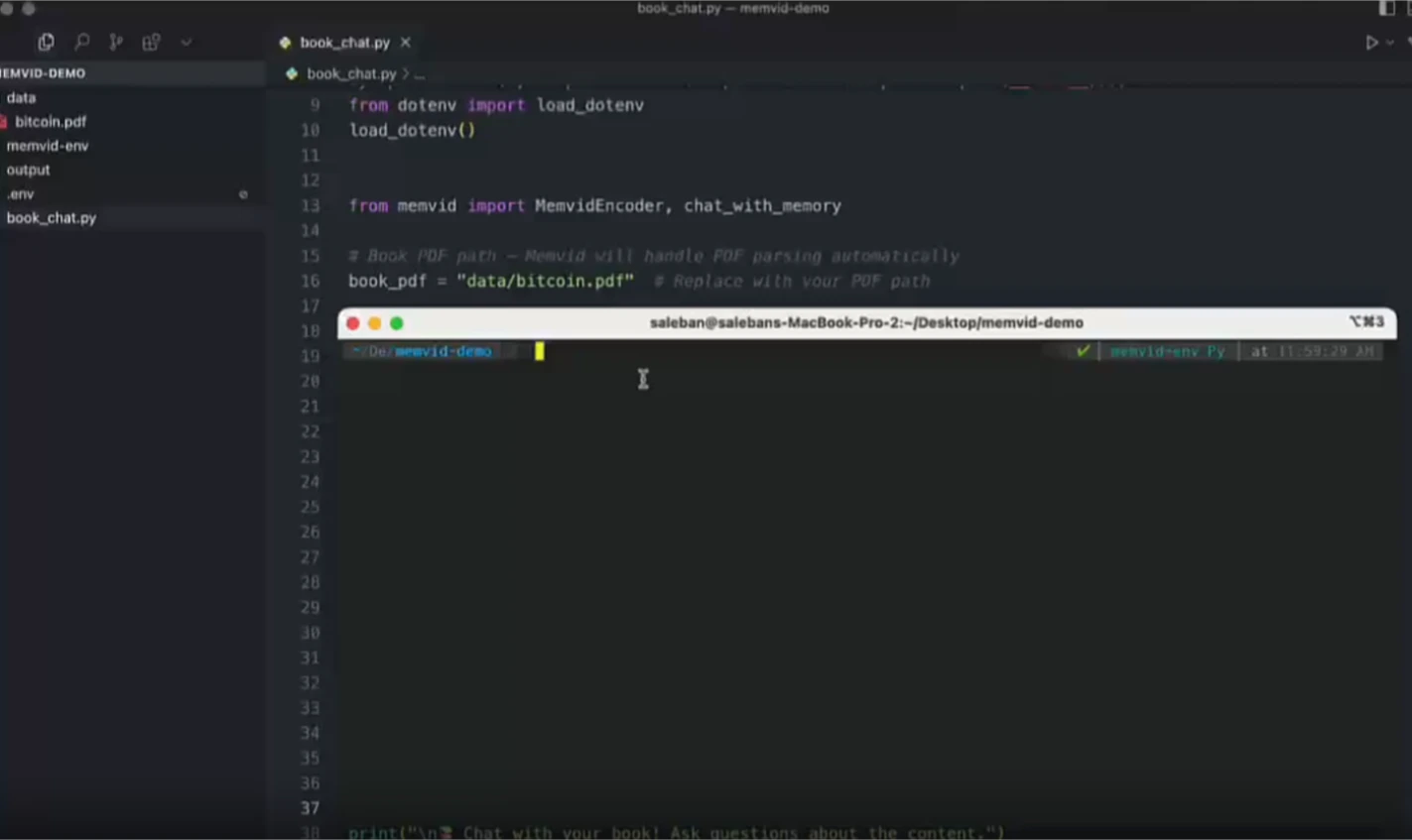
Core Advantages of Memvid
Video as a database: Store millions of text chunks in a single MP4 file.
Semantic search: Supports natural language queries, capable of searching large-scale datasets within seconds.
Efficient storage: 10x improvement in storage efficiency compared to traditional databases.
Offline-first: After video generation, it can be used without an internet connection.
Built-in chat functionality: Provides a conversational interface that delivers context-aware responses.
PDF support: Allows direct import and indexing of PDF documents.
Technical Principles of Memvid
Encoding video information: Encodes the entire video information into a structured memory, capturing long-range dependencies and contextual retrieval cues.
Reasoning task requirements: Reasons about the information requirements of a question based on memory.
Retrieving key moments: Retrieves key moments from the video that are relevant to the information need.
Generating answers: Generates the final answer based on the retrieval results.
Memvid Functional Modules
Encoding Module (MemvidEncoder)
Supports chunked processing of text, with a default chunk size of 512 characters and an overlap of 50 characters.
Batch import data from text files, with attached metadata (such as source file).
Generates video files (.mp4) and index files (.json), and supports adjusting FPS (default 30), frame size (default 512), and video codec (such as H265).
Retrieval Module (MemvidRetriever)
Semantic search returns relevant text chunks, with support for specifying the number of results to return (top_k).
Obtain context windows (max_tokens up to 2000), and retrieve chunks by ID.
Chat Module (MemvidChat)
Integrates LLMs (OpenAI, Anthropic, local models), and supports conversation history management and export.
Interactive interface (MemvidInteractive): Launches a web interface (http://localhost:7860) for chatting.
Application Scenarios of Memvid
Digital libraries: Index thousands of books into a single video file.
Educational resources: Create searchable video memories to preserve course materials.
News archives: Compress years of articles into a manageable video database.
Enterprise knowledge base: Build a company-wide searchable knowledge base.
Research papers: Perform rapid semantic search on scientific literature.
Personal notes: Convert personal notes into a searchable AI assistant.
Project Links
https://pypi.org/project/memvid/
https://github.com/Olow304/memvid









