
 Script Planner Assistant▸
 AI Apps
 AI News
Qlib: An Open-Source AI Platform for Quantitative Investment
小编 ·

Qlib: An Open-Source AI Platform for Quantitative Investment
What is Qlib?
Qlib is a complete quantitative investment platform open-sourced by Microsoft on GitHub, currently with over 20,000 stars. Built on top of a high-performance data processing engine, Qlib integrates more than 30 quantitative models and supports various machine learning approaches such as supervised learning and reinforcement learning. It features efficient data processing, automated research tools, and adaptability to market dynamics, making it well-suited for developers conducting research in the financial domain.
Qlib Features
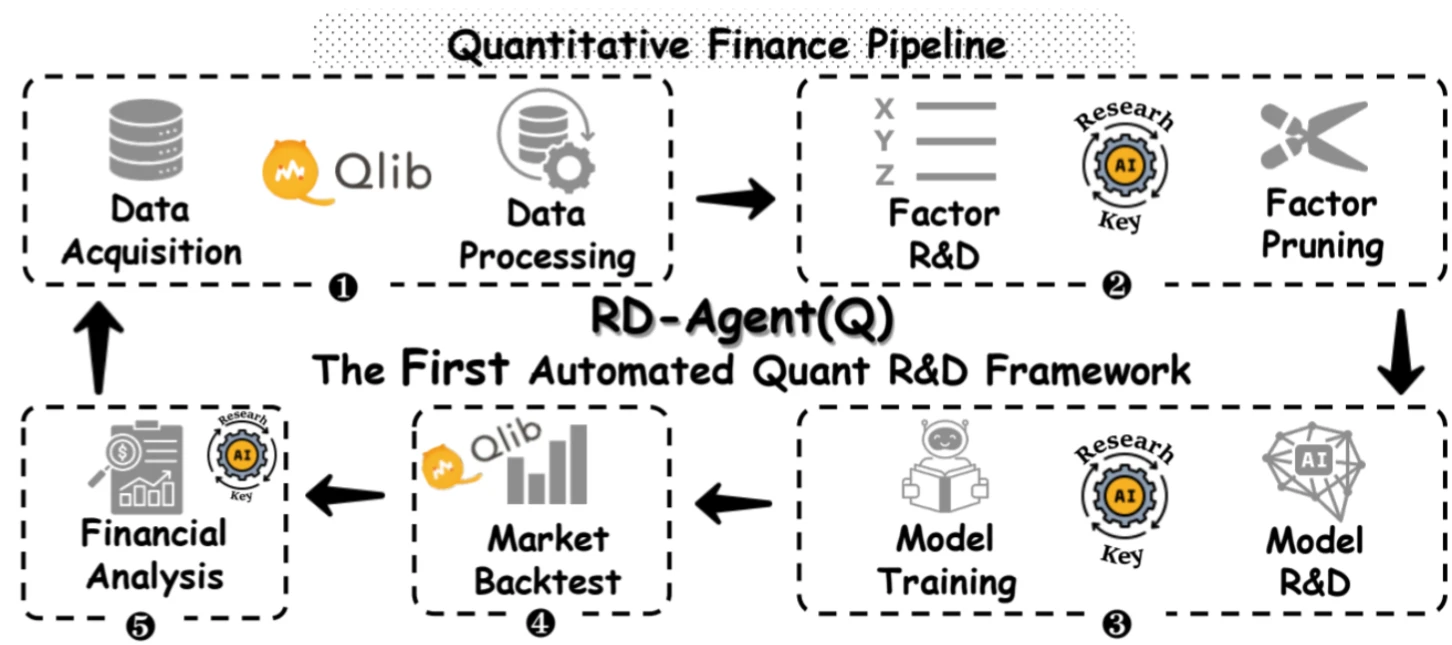
End-to-End Support: Covers the entire quantitative investment chain, including data preprocessing, model training, and backtesting—from alpha factor mining, risk modeling to portfolio optimization and order execution.
Diverse Machine Learning Modeling Paradigms: Supports multiple modeling paradigms such as supervised learning, market dynamics modeling, and reinforcement learning.
Rich Model Library: Comes with a variety of built-in machine learning models such as GBDT, MLP, LSTM, GRU, ALSTM, GATs, and more.
Automated Quantitative Research Workflow: Provides a tool called qrun that can automatically run the entire workflow, including building datasets, training models, backtesting, and evaluation.
Customizable Quantitative Research Workflow: A modular interface design allows researchers to build their own workflows through code.
Adapting to Market Dynamics: Offers solutions such as rolling retraining and DDG-DA to adapt to market dynamics.
Dataset Zoo: Includes multiple built-in datasets such as Alpha360 and Alpha158.
High-Performance Data Infrastructure: Uses binary data storage and in-memory caching for highly efficient data processing.
Qlib Use Cases
Stock Prediction Model Building and Backtesting: Conveniently build stock prediction models and perform backtesting, output various strategy metrics such as annualized return, information ratio, maximum drawdown, and provide rich visualization and analysis tools.
High-Frequency Trading Strategy Development: Supports the development and optimization of high-frequency trading strategies, improving trading efficiency.
Portfolio Management: Evaluate and optimize portfolios, balancing risk and return.
Strategy Analysis and Experiment Management: Record the experiment process, analyze strategy performance, and assist in investment decisions.
Advantages
Open-Source and Free: Fully open-source with an active community and continuous updates.
Balance of Technical Depth and Usability: Both technically powerful and easy to get started with, suitable for both academic research and real-world applications.
Limitations
High Hardware Requirements: Running complex models and processing large-scale data requires significant computing resources.
Strategy Performance Depends on Data Quality: If the input data is imprecise or incomplete, it will affect strategy performance and decision accuracy.
Installing and Using Qlib
Installation: Can be installed via pip using the command pip install pyqlib.
Data Acquisition: Provides convenient data acquisition tools that can directly download processed Chinese stock market data.
Build Prediction Models and Backtest: Workflows can be built through configuration files or code.
Project Link
https://github.com/microsoft/qlib









