
 Script Planner Assistant▸
 AI Apps
 AI News
MergeKit: An Open-Source Toolkit for Merging Pretrained Language Models
小编 ·

MergeKit: An Open-Source Toolkit for Merging Pretrained Language Models
What is Mergekit?
Mergekit is a Python tool that can merge multiple large models into a single one, combining the strengths of each. For example, if model A excels at writing and model B excels at coding, mergekit can combine them into a stronger model. It can also perform merging on CPU or GPU. It's recommended to first merge using high-precision models, then quantize and calibrate afterward. This ai project is very popular among developers—for instance, some people have used it to transform educational content into game-themed material, making creation more efficient and fun.
Main Features of Mergekit
Model Merging: Merge multiple pre-trained language models into a single versatile model, with no additional training or integration computational overhead.
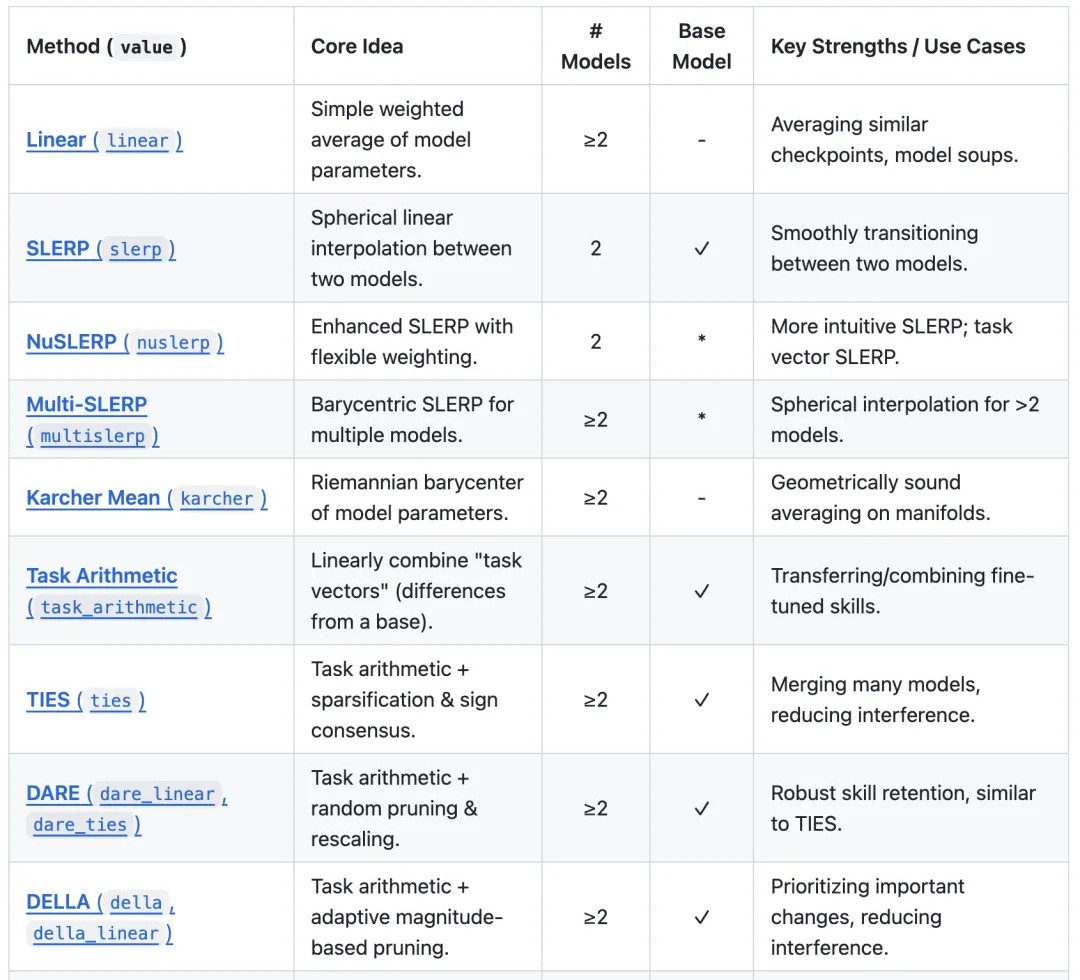
Multiple Merging Algorithms: Supports various merging methods, such as Linear Interpolation, Spherical Linear Interpolation (SLERP), Task Arithmetic, TIES, DARE, etc.
Hardware-Friendly: Supports running on CPU or GPU, with a minimum of 8GB VRAM.
Low Memory Usage: Uses lazy tensor loading techniques to reduce memory consumption.
Parameter Interpolation: Supports interpolation gradients of parameter values, providing finer-grained control.
Layered Assembly: Supports splicing and assembling language models from layer fragments of different models ("Frankenmerging").
Mixture of Experts Merging: Merge multiple dense models into a Mixture of Experts (MoE) model.
LoRA Extraction: Extract PEFT-compatible low-rank approximations from fine-tuned models.
Evolutionary Merging Methods: Includes some experimental evolutionary merging methods.
Main Characteristics of Mergekit
Cross-Platform Execution: Supports GPU and CPU execution, with acceleration available at a minimum of 8GB VRAM.
Low Memory Usage: Achieved through lazy tensor loading.
Multiple Merging Algorithms: Includes Linear Interpolation, SLERP, Task Arithmetic, etc., with more algorithms to be added in the future.
Graphical User Interface (GUI): Provides a GUI based on Arcee, simplifying the merging process.
Installation and Usage
Installation
git clone https://github.com/arcee-ai/mergekit.git
cd mergekit
pip install -e .
Usage
mergekit-yaml config.yml ./output-dir --cuda
Application Scenarios of Mergekit
Model Capability Fusion: Merge models from different specialized domains into a single versatile model.
Performance Optimization: Combine the strengths of different models to enhance overall performance.
Optimization in Resource-Constrained Environments: Create smaller yet powerful models when computing resources are limited.
Personalized Model Customization: Customize models according to specific needs.
Model Research and Experimentation: Provides researchers with a flexible platform to explore different merging strategies.
Github:https://github.com/arcee-ai/mergekit









