
 Script Planner Assistant▸
 AI Apps
 AI News
SurfSense: Open-Source AI Research Agent – Open Alternative to NotebookLM and Perplexity
小编 ·

SurfSense: Open-Source AI Research Agent – Open Alternative to NotebookLM and Perplexity
What is SurfSense?
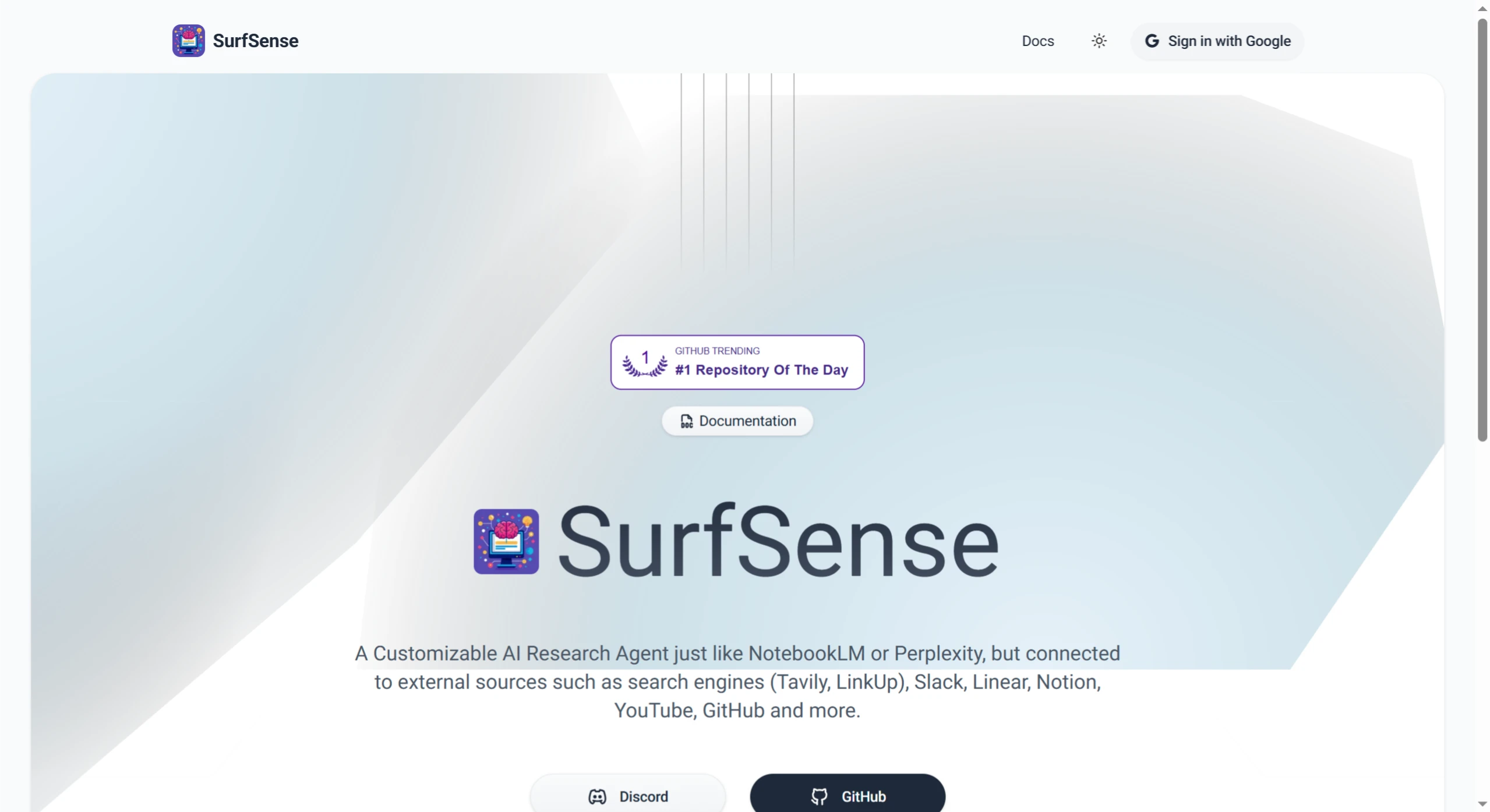
SurfSense is an open-source AI research assistant that not only offers powerful research capabilities but also deeply integrates a personal knowledge base, making it a strong alternative to tools like NotebookLM, Perplexity, and Glean. The core advantage of SurfSense lies in its deep integration of a personal knowledge base, supporting uploads of 27 file formats including documents and images to the personal knowledge base, allowing users to build their own knowledge systems. In addition, SurfSense supports semantic search, Q&A, summarization, and analysis functions, enabling users to interact with the knowledge base through natural language and obtain cited answers.
Another highlight of SurfSense is its powerful ability to connect external data sources. It can connect to multiple external platforms such as search engines (Tavily, LinkUp), Slack, Linear, Notion, YouTube, and GitHub. This connectivity allows users to unify information sources from their daily workflows into SurfSense, further enhancing the efficiency of research and knowledge management.
Furthermore, SurfSense supports converting chat conversations or research content into podcasts, providing users with a brand-new way to share and consume knowledge. The open-source nature of SurfSense also means users can customize and extend it according to their own needs, further enhancing its functionality and applicability.
Core Features of SurfSense
Integrated Personal Knowledge Base: Users can upload personal files in 27 file formats to a dedicated knowledge base. Through the "Knowledge Graph Brain," saved content is automatically organized into a structured knowledge network, allowing users to query in natural language and quickly obtain precise answers.
Natural Language Interaction: Designed with natural language conversation, users can interact with the knowledge base as if chatting. It not only draws on the personal knowledge base but also combines external data sources to provide comprehensive answers with references.
Open Source and Privacy Protection: Open source and supports local deployment, allowing users to run it locally and work with local LLMs. Its core data storage is based on the neo4j graph database, ensuring data privacy and security.
Advanced RAG Technology: Supports over 150 LLMs and more than 6000 embedding models, leveraging advanced ranking techniques to improve search relevance. It uses hierarchical indexing and hybrid search techniques, combining semantic search and full-text search to deliver the optimal search experience.
Browser Extension: Its browser extension helps users save any web page, including those protected by authentication, to the knowledge base.
Technical Architecture of SurfSense
Backend: Built on FastAPI, using PostgreSQL (with pgvector support), SQLAlchemy, FastAPI Users, and other technologies, capable of handling complex API requirements and processing large volumes of data quickly.
Frontend: Built with Next.js, React, and TypeScript, combined with technologies like Tailwind CSS, providing a smooth and personalized UI experience. The extension uses Manifest v3 technology, integrating well with modern browsers.
Use Cases of SurfSense
Academic Research: Scholars can build literature repositories across projects and quickly retrieve historical notes or related concepts.
Content Creation: Journalists or bloggers can store interview records and web page snapshots in the knowledge base, and generate article drafts or podcast content with references.
Enterprise Knowledge Management: Teams can create internal knowledge bases by self-hosting SurfSense, integrating Slack discussions and Notion documents.
Developer Workflow: Programmers can save code snippets, API documentation, or Stack Overflow answers, and query technical details at any time.
Project Address
Official Website:https://www.surfsense.net/
Github:https://github.com/MODSetter/SurfSense









