
 Script Planner Assistant▸
 AI Apps
 AI News
URM: Alimama's New E-Commerce Recommendation Model
小编 ·

URM: Alimama's New E-Commerce Recommendation Model
What is URM?
URM (Universal Recommendation Model) is an e-commerce recommendation model released by Alimama. It is a large world-knowledge model. Alimama aims to build a large model based on an LLM that integrates both world knowledge and e-commerce knowledge, in order to address the shortcomings of traditional LLMs in e-commerce recommendation scenarios: first, large models lack domain expertise in e-commerce; second, the input of users' historical behavior information is lengthy and low-density. URM combines the world knowledge of LLMs with e-commerce domain expertise to achieve deep understanding of user interests and accurate recommendations.
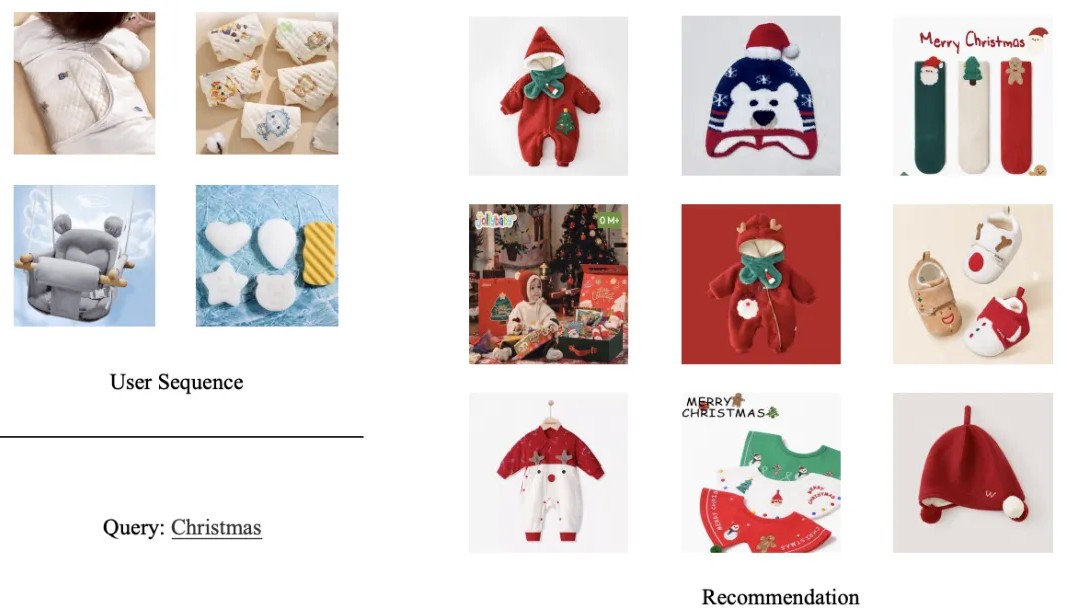
Core Features of URM
Knowledge Injection and Information Alignment: URM combines the general knowledge of LLMs with e-commerce domain expertise through knowledge injection and information alignment.
Multimodal Fusion: It introduces multimodal fused item representations, combining ID representations and semantic representations (such as text, images, etc.) to enhance item expressiveness and recommendation accuracy.
Efficient Sequence-In-Set-Out Generation: Through a user modeling head (hUM) and a language model head (hLM), it generates user representations and text outputs respectively, enabling the generation of high-quality recommendation sets in a single forward pass.
Multi-task Processing Capability: It supports multiple tasks including multi-scenario recommendation, multi-objective recommendation, long-tail recommendation, and discovery-oriented recommendation.
Zero-shot Learning Capability: It can quickly adapt to new tasks and new scenarios, providing effective recommendations even without large amounts of labeled data.
Technical Principles of URM
Multimodal Fused Representations: Through the alignment and fusion of ID representations and semantic representations, multimodal item embedding vectors are generated.
Task Definition and Prompt Engineering: Different recommendation tasks are defined based on text, and the distribution of recommendation results is adjusted by designing different prompt templates.
Training Method: Combining the Noise Contrastive Estimation (NCE) loss for the item recommendation task and the negative log-likelihood loss for the text generation task, full-parameter supervised fine-tuning (SFT) is adopted, with only the original item representations frozen.
Application Effects of URM
URM has been deployed in Alimama's display advertising scenario, significantly improving the effectiveness of merchants' ad placements and consumers' shopping experience. For example, for a user with historical behavior related to embedded home appliances and storage products, URM can infer that the user may be focusing on home renovation and is in the early stage of hard decoration, and recommend whole-house custom products and high-quality home appliances. In addition, URM can combine users' historical interests with specific textual guidance to generate recommendation results that better fit the current context.
Performance of URM
In offline experiments, URM was trained using a multi-task fused dataset and achieved an average Recall improvement of 11.0% on the production dataset, outperforming the traditional recommendation model with the Target-Attention structure used online in 6 out of 9 subtasks.
Application Scenarios of URM
Personalized Product Recommendation: When users browse an e-commerce platform, the system recommends products that match their interests based on their historical behavior and preferences. For example, for a user who frequently purchases sports equipment, URM can recommend the latest running shoes, sportswear, and fitness gear.
Multi-scenario Recommendation: URM supports multi-scenario recommendation tasks and can generate scenario-related recommendations based on the user's current page and behavioral context. For example, recommending popular products on the homepage, recommending products in related categories on category pages, and providing products highly relevant to search terms on search result pages.
Search Enhancement: URM can treat search queries as a recommendation task, combining users' historical behavior and search terms through prompt templates to generate more accurate search results. For example, when a user searches for "summer dresses," URM can recommend summer dress styles based on the user's historical preferences.
Interest-based Recommendation: URM can capture users' long-term interests through prompt templates and the multimodal fusion module, and generate recommendations related to those long-term interests. For example, for a user who frequently purchases tech products, URM can recommend upcoming new electronic products.
Long-tail Product Recommendation: URM can generate recommendation lists containing long-tail products through specific prompt templates. For example, for a user who likes niche music, URM can recommend products related to niche music, such as limited-edition records or music merchandise.
ArXiv Technical Paper:https://arxiv.org/pdf/2502.03041









