
 Script Planner Assistant▸
 AI Apps
 AI News
Alibaba Releases Qwen3: Dual Thinking Modes and Multilingual Capabilities
小编 ·

Alibaba Releases Qwen3: Dual Thinking Modes and Multilingual Capabilities
On April 29, 2025, Alibaba officially released the Qwen3 series models. This is the newest member of the Qwen family of large language models. The flagship model Qwen3-235B-A22B and the smaller MoE model Qwen3-30B-A3B, along with several other models, have demonstrated outstanding performance in benchmarks for coding, math, and general capabilities. Qwen3 has open-sourced multiple model weights and is available across multiple platforms.
Qwen3 supports two thinking modes, offers multilingual capabilities, and features optimized Agent and coding abilities. Its pretraining data reaches approximately 36 trillion tokens, with pretraining conducted in three stages, followed by a four-stage post-training process.
Model Highlights
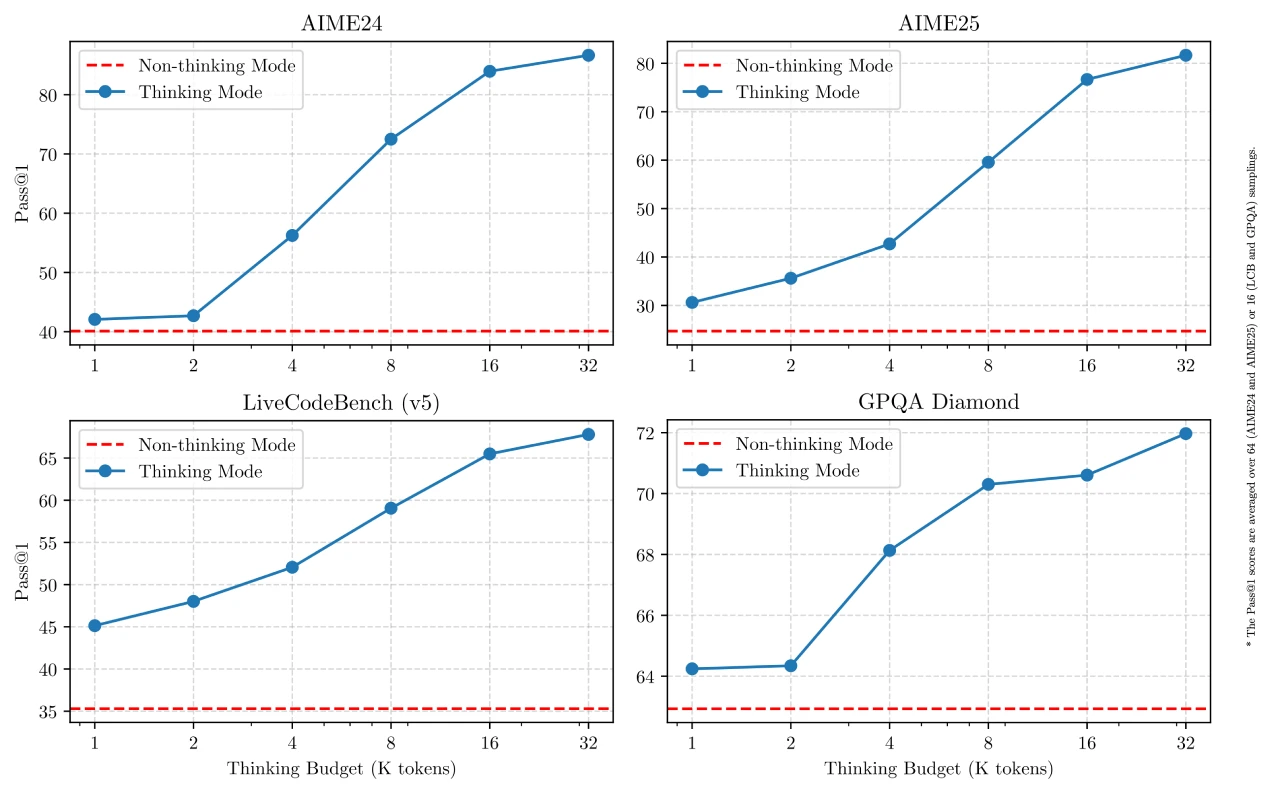
Multiple thinking modes: Supports both thinking and non-thinking modes. Thinking mode is suited for complex problems, where the model reasons step by step; non-thinking mode is suited for simple problems and delivers fast responses. The combination of the two enhances "thinking budget" control, allowing users to configure it as needed.
Multilingual capabilities: Supports 119 languages and dialects, spanning multiple language families such as Indo-European and Sino-Tibetan, opening up possibilities for international applications.
Enhanced Agent capabilities: Optimized Agent and coding abilities, with stronger support for MCP. Through Qwen - Agent, the coding complexity of tool invocation can be reduced.
Qwen3 Performance
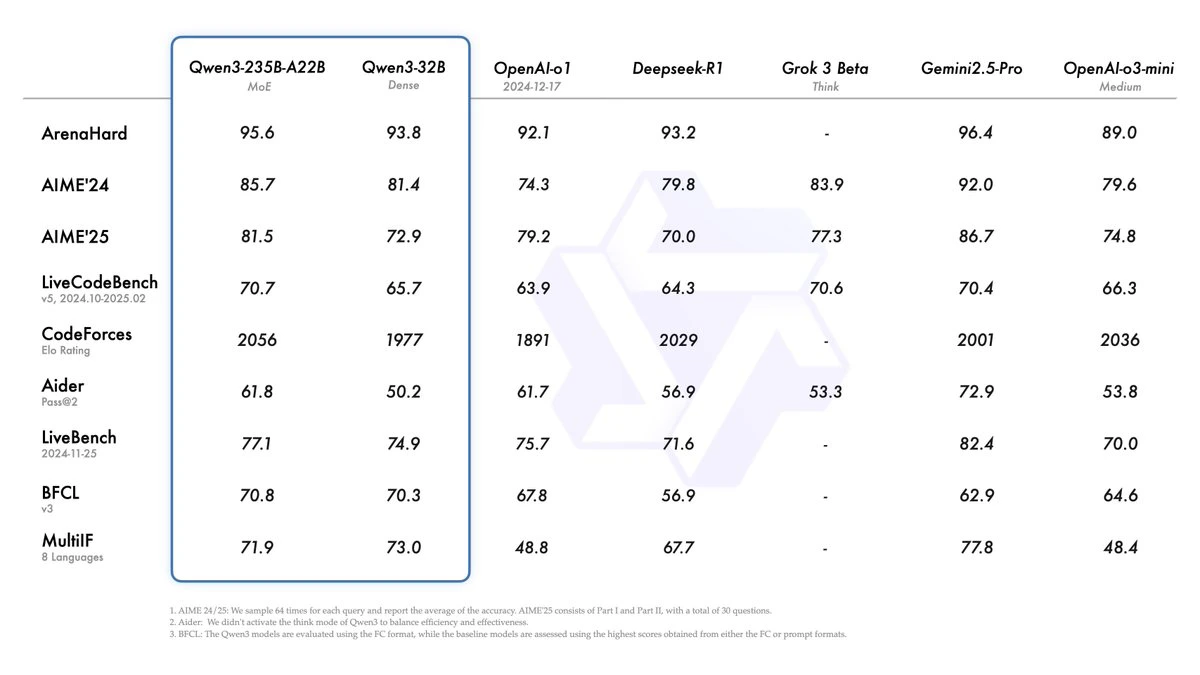
Flagship model: Qwen3-235B-A22B is the flagship model of the series, with over 235 billion total parameters and over 22 billion activated parameters. In benchmarks for coding, math, and general capabilities, this model shows highly competitive results compared with top-tier models such as DeepSeek-R1, Openai's o1 and o3-mini, Elon Musk's Grok-3, and Google's Gemini-2.5-Pro.
Smaller model: The small MoE model Qwen3-30B-A3B has only 10% of the activated parameters of QwQ-32B, yet delivers better performance. In addition, a small model like Qwen3-4B can match the performance of Qwen2.5-72B-Instruct.
Qwen3 Technical Features
Hybrid reasoning model: Qwen3 is China's first "hybrid reasoning model," integrating "fast thinking" and "slow thinking" within a single model. This design allows the model to perform deep reasoning for complex problems while responding quickly to simple requests.
Multilingual support: Qwen3 supports 119 languages and is trained on nearly 36 trillion tokens, with the training data volume being twice that of Qwen2.5.
Context length: Qwen3 supports a context length of up to 256K, enabling it to handle complex tasks such as long-document analysis, code generation, and multi-turn dialogue.
Qwen3 Model Performance and Cost
Flagship Qwen3-235B-A22B: Total parameters of 235 billion, with 22 billion activated parameters. Compared with DeepSeek-R1, its total parameter count is only one-third of the latter, and deployment costs are expected to be reduced by more than half. In addition, the model supports enabling "deep thinking" mode on demand, and local deployment can be achieved with just 4 H20 GPUs.
Qwen3-30B-A3B: Total parameters of 30 billion, with 3 billion activated parameters, and overall performance comparable to Qwen2.5-32B.
Qwen3 Features
Native MCP protocol support: The Qwen3 series has tool-calling capabilities and, combined with its own Qwen-Agent framework, greatly reduces programming complexity. It supports Agent operations on phones and computers, propelling AI from conversation to execution.
Multilingual support: Supports 119 languages, including Chinese, English, French, Spanish, Russian, Arabic, and more.
Open-source models: The Qwen3 series has open-sourced 8 models in total, including:
6 Dense models: 0.6B, 1.7B, 4B, 8B, 14B, 32B
2 MoE models: Qwen3-30B-A3B and the flagship Qwen3-235B-A22B
Smallest model Qwen3-0.6B: Lightweight in size, ideal for deployment on edge devices such as mobile phones, while maintaining strong understanding and generation capabilities—well-suited for on-device intelligent applications.
Training Process
Pretraining: The dataset has been significantly expanded compared with Qwen2.5, reaching approximately 36 trillion tokens—double that of Qwen2.5. Data sources include the web and PDF documents, with mathematical and code data synthesized using expert models. Pretraining is conducted in three stages: from basic language skill training, to the addition of knowledge-intensive data training, and finally extending the context length to 32K tokens.
Post-training: Adopts a four-stage training process, including long chain-of-thought cold start, long chain-of-thought reinforcement learning, thinking mode fusion, and general reinforcement learning, to develop a hybrid model capable of both deliberate reasoning and fast response.
How to Use
Basic usage: Standard example code is available for using Qwen3-30B-A3B with transformers on Hugging Face. The thinking mode can be switched by modifying the enable_thinking parameter.
Deployment: An OpenAI API-compatible API endpoint can be created using sglang>=0.4.6.post1 or vllm>=0.8.4; removing specific parameters disables thinking mode.
Local development: Tools such as ollama, LMStudio, llama.cpp, and ktransformers can be used for local development.
Advanced usage: A soft-switching mechanism is provided, allowing per-turn switching of thinking modes by adding /think and /no_think in user prompts or system messages.
Related Links
Blog:https://qwenlm.github.io/zh/blog/qwen3/
HF:https://huggingface.co/collections/Qwen/qwen3-67dd247413f0e2e4f653967f
github:https://github.com/QwenLM/Qwen3
Demo:https://huggingface.co/spaces/Qwen/Qwen3-Demo
Qwen Chat:https://chat.qwenlm.ai









