
 Script Planner Assistant▸
 AI Apps
 AI News
PaperCoder: A Multi-Agent LLM System that Converts Research Papers into Code Repositories
小编 ·

PaperCoder: A Multi-Agent LLM System that Converts Research Papers into Code Repositories
What is PaperCoder?
PaperCoder is a multi-agent LLM system that automatically converts academic papers into code repositories. Through automated code generation, researchers and developers can implement the algorithms and models described in papers more quickly, reducing the time and errors associated with manual coding. The PaperCoder system adopts a three-stage workflow—Planning, Analysis, and Code Generation—each handled by specialized agents. With this system, researchers and developers can more efficiently transform theoretical results into practical programming projects, providing convenience for driving technological advancement and innovation.
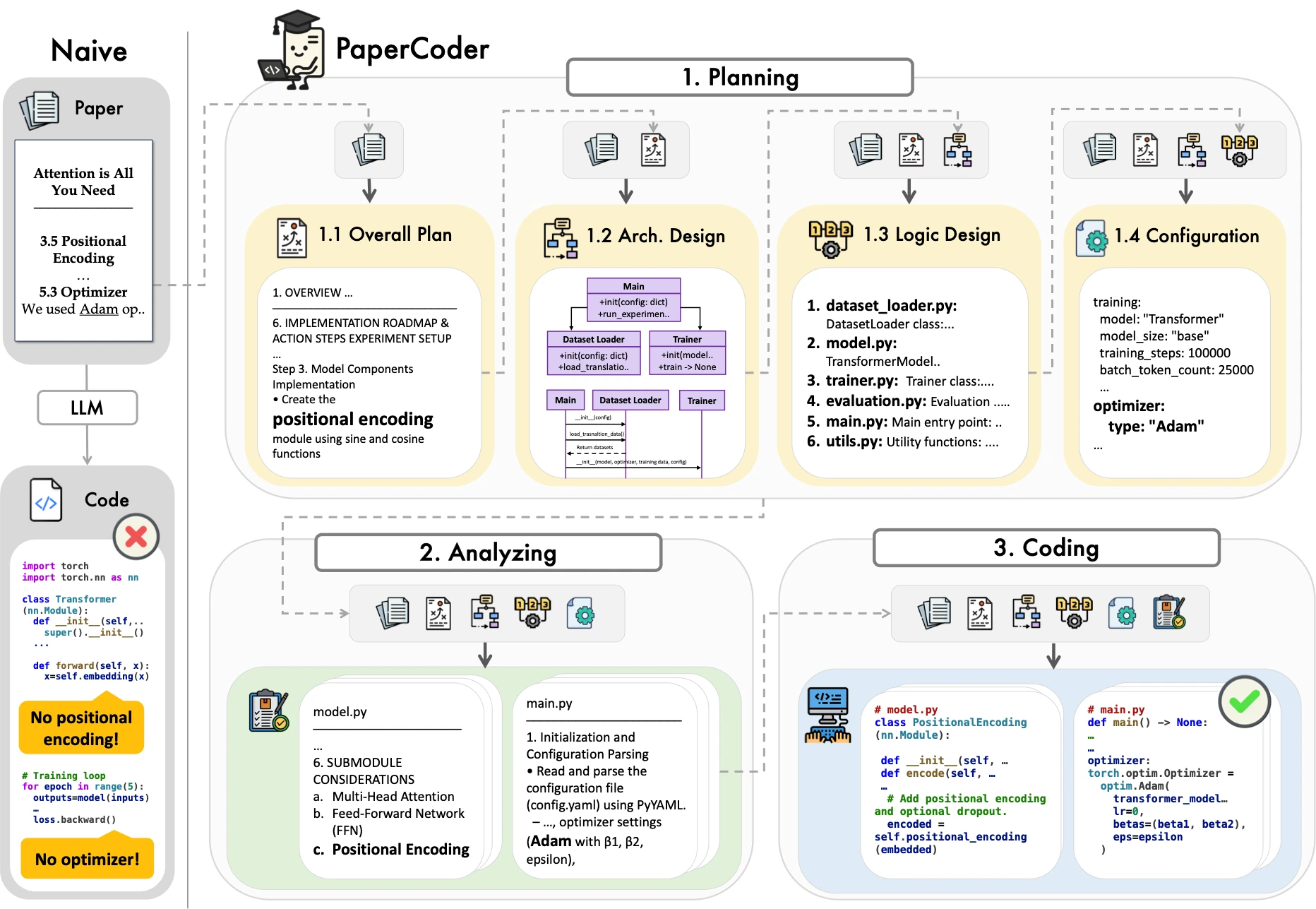
Paper2Code Core Features
Multi-Agent Framework: Paper2Code adopts a multi-agent Large Language Model (LLM) framework that simulates the human software development lifecycle, divided into three stages: "Planning – Analysis – Coding".
Planning Stage: Build a high-level roadmap, design the system architecture, determine file dependencies, and generate configuration files.
Analysis Stage: Interpret the specific implementation details of each file or function, focusing on its purpose, inputs/outputs, interactions, and constraints.
Coding Stage: Based on the outputs of the previous stages, generate modular, dependency-aware code file by file.
Code Generation & Optimization: Capable of automatically generating complete, functional code repositories from machine learning research papers, supporting multiple deep learning frameworks (such as TensorFlow and PyTorch), and generating a requirements.txt file listing the required dependencies.
High-Quality Code Output: The generated code is not only syntactically correct but also functionally close to runnable, requiring only minimal modifications.
Advantages
High Degree of Automation: For the first time, it enables the automatic generation of complete, executable code repositories directly from scientific papers, without relying on existing code or snippets.
Outstanding Performance: In multiple benchmark tests and human evaluations, Paper2Code significantly outperforms existing code generation frameworks and naive baselines.
Strong Practicality: Human evaluations show that the generated code is highly valuable for researchers to actually reproduce their work, with 85% of evaluators considering it useful.
Disadvantages
Domain Limitations: It is currently focused primarily on machine learning papers, and its ability to generalize to other scientific domains remains to be verified.
Dependency on the Underlying LLM: The framework's performance is limited by the capabilities of the underlying LLM being used.
Possible Omissions and Misinterpretations: Even in the best cases, the generated code may still omit or misinterpret details from the paper.
How to Use Paper2Code
Environment Setup:
Install the necessary software packages, such as the Openai API package.
Configure the API key to access OpenAI's services.
PDF Conversion:
Convert the paper's PDF file into a structured JSON format.
Use the s2orc-doc2json tool for the conversion.
Running Code Generation:
Modify the configuration file to specify the paper path and other parameters.
Run the provided scripts to launch the code generation process.
Github:https://github.com/going-doer/Paper2Code









