
 Script Planner Assistant▸
 AI Apps
 AI News
Langgraph-Mcp-Agents: An MCP-Integrated AI Agent System Built on LangGraph
小编 ·

Langgraph-Mcp-Agents: An MCP-Integrated AI Agent System Built on LangGraph
What is Langgraph-MCP-Agents?
Langgraph-Mcp-Agents is an AI agent system built on LangGraph. By integrating MCP, it enables AI assistants to easily access various data sources and APIs. The system comes with a Streamlit web interface, allowing users to interact with LangGraph and MCP tools. Users can dynamically add, remove, or configure MCP tools through the interface without restarting the application, and it supports the Smithery JSON format. In addition, the system also supports streaming responses, allowing users to view the agent's responses and tool call status in real time.
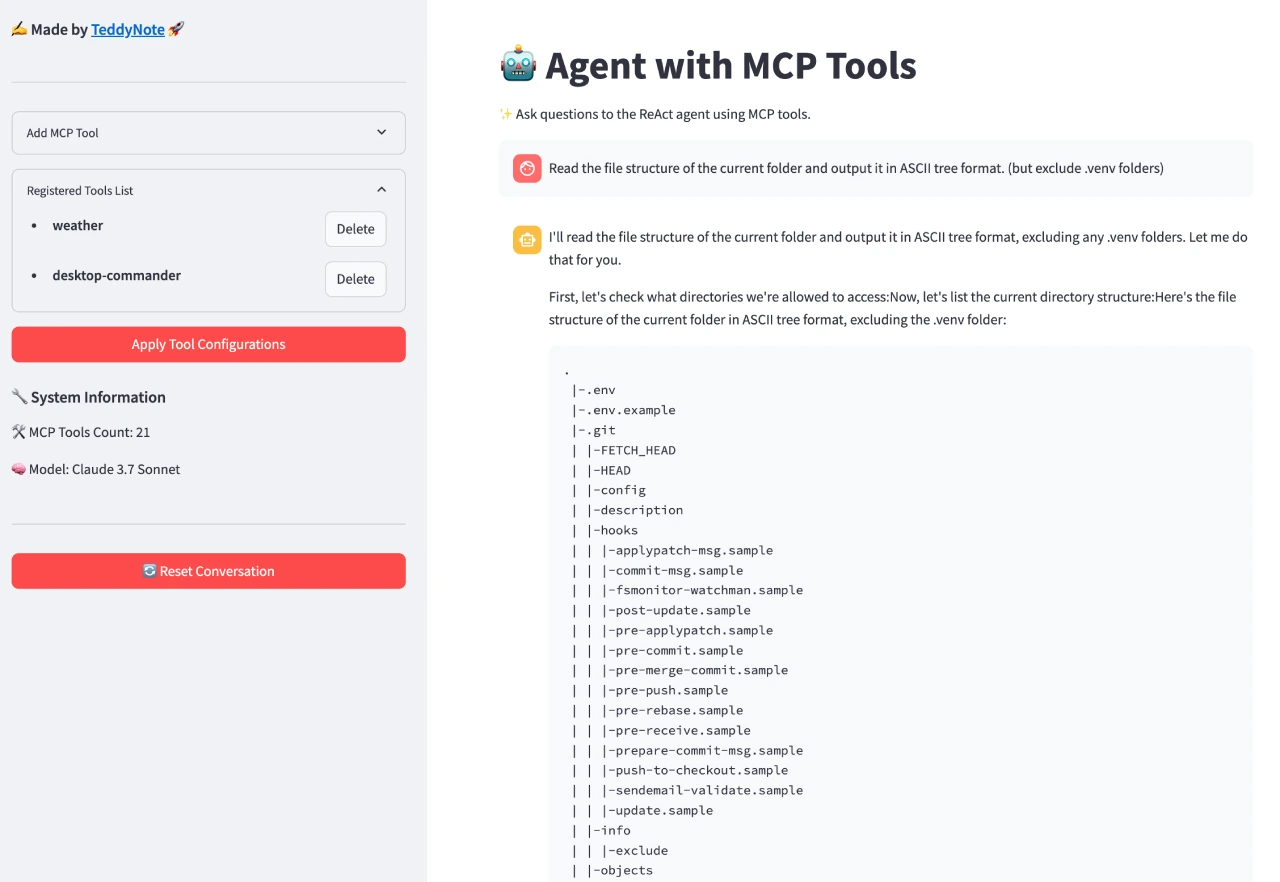
Langgraph-Mcp-Agents Features
Decoupling task logic from tool implementation: Developers can independently extend the tool library without affecting the agent core.
Long-term context support: Through LangGraph's persistence capabilities, achieve task continuity across sessions.
Multi-agent collaboration: Supports building multi-agent systems where different agents can divide labor to complete complex tasks.
Dynamic configuration and deployment: Dynamically configure and deploy AI Agents through the Streamlit interface.
Tool integration: Easily connect to multiple data sources and external tools.
State management: Manage state across each step of the workflow.
Flexible deployment: Supports both single-machine and multi-server deployment to meet application needs of different scales.
Technical Architecture and Core Components
LangGraph Framework
LangGraph is an extension library of LangChain, focused on building stateful, multi-role agent workflows.
State management: Maintains conversational context through StateGraph, supporting long-term memory and task continuity.
Dynamic flow control: Supports loops, branches, and conditional logic, suitable for tasks that require self-correction or iteration (such as code generation).
Multi-tool integration: Converts MCP tools into LangChain tools through langchain-mcp-adapters, enabling interaction with external services (such as search and databases).
MCP Protocol
MCP is an open standard that defines the interaction protocol between models and external tools.
Loosely coupled design: Allows AI to dynamically discover and call tools, enhancing flexibility.
Multi-server support: Connects to multiple MCP servers through MultiServerMCPClient, expanding tool call capabilities.
Use Cases
Complex Task Handling
Multi-step workflows: For example, in data analysis tasks, LangGraph can coordinate steps such as data acquisition, cleaning, and visualization, while MCP tools provide specific execution capabilities (such as calling Python libraries or database queries).
Cross-system collaboration: Connect services like GitHub and Slack through MCP to achieve cross-platform information integration.
Agent Collaboration
Role division of labor: Different agents can focus on specific tasks (such as code generation, chart drawing), sharing intermediate results through MCP.
Dynamic decision-making: LangGraph's state graph supports adjusting execution paths based on task progress, such as triggering a debugging flow when code generation fails.
Development Efficiency Improvement
Tools as a service: MCP encapsulates tools as standardized interfaces, allowing developers to extend functionality without modifying the agent's core logic.
Async support: async_tool_executor handles synchronous and asynchronous tool calls (such as generating code and real-time search), optimizing execution efficiency.
Project Implementation
Client-server architecture: MCP uses a client-server model, where LangGraph acts as the client connecting to the MCP server.
Tool node integration: Converts tools from the MCP server into tool nodes for LangGraph.
Multi-server support: Supports connecting to multiple MCP servers, flexibly using tools on different servers.









