
 Script Planner Assistant▸
 AI Apps
 AI News
Hyper-RAG: Hypergraph-Driven Retrieval-Augmented Generation from Tsinghua and Xi'an Jiaotong Universities
小编 ·

Hyper-RAG: Hypergraph-Driven Retrieval-Augmented Generation from Tsinghua and Xi'an Jiaotong Universities
What is Hyper-RAG?
Hyper-RAG is a hypergraph-driven Retrieval-Augmented Generation method proposed by Tsinghua University and Xi'an Jiaotong University. It leverages hypergraph technology to improve the accuracy of large language models (LLMs) in specialized-domain knowledge modeling and reduce the "hallucination" phenomenon in model-generated content. Experiments show that Hyper-RAG improves the average accuracy by 12.3% over traditional graph-based methods across multiple datasets, while maintaining stable performance under complex queries, making it suitable for high-reliability domains such as healthcare and finance.
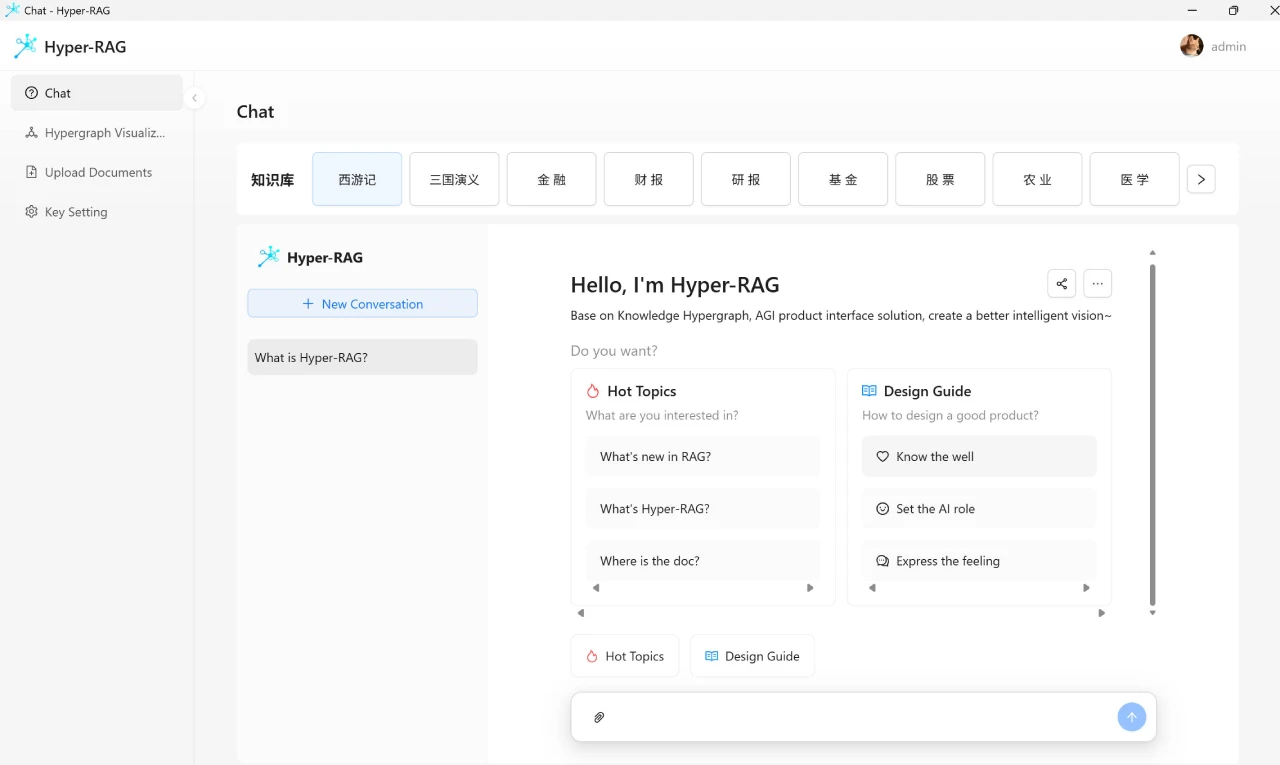
Core Principles of Hyper-RAG
The core of Hyper-RAG lies in leveraging hypergraphs to simultaneously capture both low-order associations (pairwise relationships) and high-order associations (multi-entity relationships) in raw data. Traditional graph-based RAG methods (such as Graph RAG and Light RAG) can only represent pairwise relationships and cannot effectively handle complex multi-entity relationships, which leads to information loss and consequently affects the accuracy of LLM outputs. In contrast, hypergraphs can represent complex relationships among multiple entities through hyperedges, thereby providing a more comprehensive knowledge representation.
Key Features of Hyper-RAG:
Hypergraph Knowledge Representation: Captures complex multi-entity relationships through hypergraph structures, reducing information loss and achieving more complete and accurate knowledge representation.
Retrieval-Augmented Generation: Combines hypergraph retrieval to precisely extract relevant knowledge, optimize generated answers, reduce hallucination phenomena, and improve answer credibility.
Complex Query Handling: Efficiently processes queries involving multiple entities and complex relationships, with stable performance, well-suited for solving complex problems.
Efficient Retrieval: Lightweight retrieval with high speed while maintaining accuracy, suitable for scenarios with high real-time requirements.
Strong Domain Adaptability: Applicable to multiple domains such as healthcare, finance, and law, with high customizability and generality.
Reduced Hallucination: Mitigates erroneous outputs caused by insufficient model knowledge through knowledge calibration.
High Scalability: Supports dynamic knowledge base updates and can be combined with language models of different scales, offering strong adaptability.
How Hyper-RAG Works
Knowledge Base Construction: Extract entities and relationships from domain-specific corpora to build a hypergraph knowledge base.
Retrieval Augmentation: Use hypergraph retrieval techniques to extract query-relevant knowledge from the knowledge base.
Answer Generation: Feed the retrieved knowledge together with the user's question into the LLM to generate more accurate answers.
Experimental Results
On neuroscience tasks, Hyper-RAG's accuracy is on average 12.3% higher than using LLMs directly, and outperforms Graph RAG and Light RAG by 6.3% and 6.0%, respectively.
As query complexity increases, Hyper-RAG's performance remains stable, while other methods degrade.
Across nine datasets from different domains, Hyper-RAG achieves a 35.5% performance improvement over Light RAG.
In addition, Hyper-RAG's lightweight variant, Hyper-RAG-Lite, achieves twice the retrieval speed of Light RAG and delivers a 3.3% performance improvement.
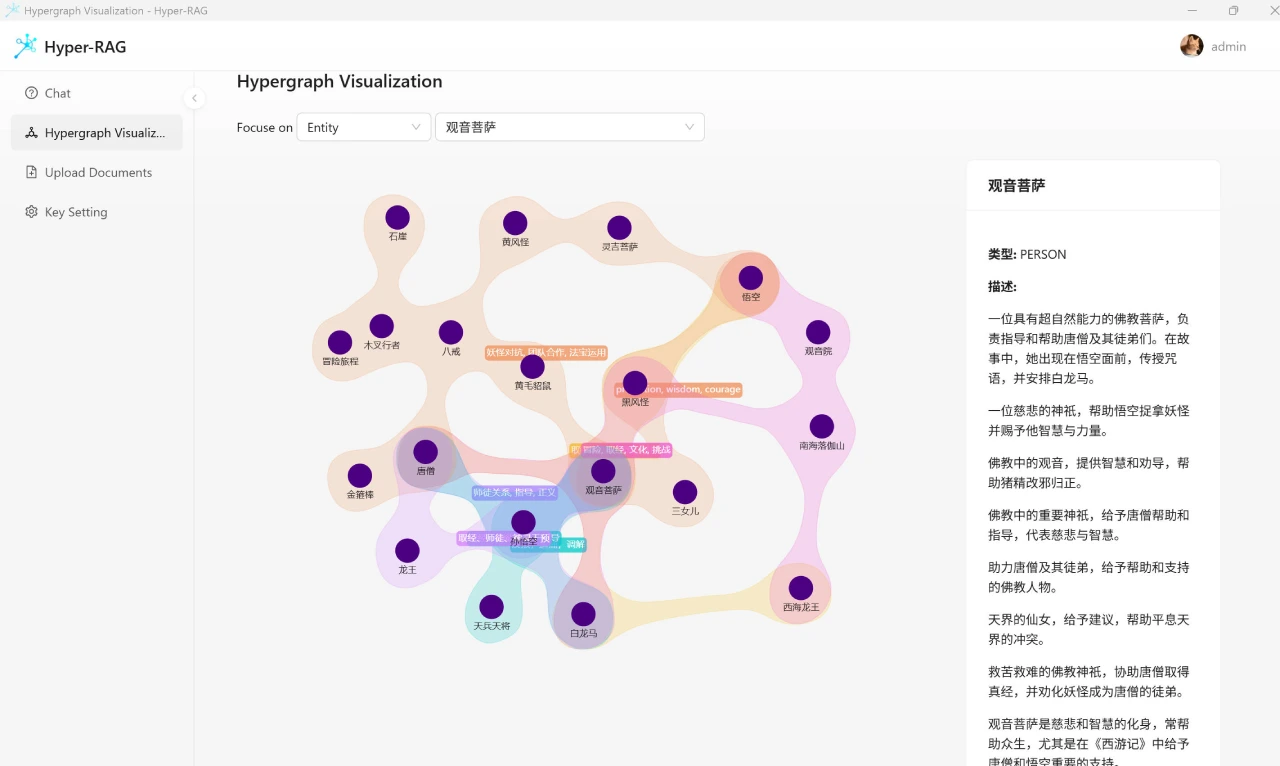
Application Scenarios of Hyper-RAG
Assisted Diagnosis: Hyper-RAG can be combined with medical knowledge bases to help doctors quickly and accurately analyze medical records, symptoms, and test results, providing diagnostic recommendations and reducing misdiagnosis rates.
Risk Assessment: By capturing complex relationships in financial data (such as inter-corporate connections and market dynamics) through hypergraph structures, Hyper-RAG can more precisely assess financial risks and support investment decisions.
The advantage of Hyper-RAG lies in its ability to handle complex multi-entity relationships and reduce information loss through hypergraph structures, offering great potential in domains that require precise knowledge support and highly reliable outputs.
Paper:https://arxiv.org/abs/2504.08758
Github:https://github.com/iMoonLab/Hyper-RAG









