
 Script Planner Assistant▸
 AI Apps
 AI News
The Naming Story & Timeline Behind Every OpenAI Model
小编 ·

The Naming Story & Timeline Behind Every OpenAI Model
Openai Model Naming Conventions
All models in the GPT series are foundational large language models (LLMs). Among them, model variants with a numeric suffix containing an "o" (such as GPT-4o) represent multimodal versions, supporting multiple forms of input and output including text, images, and audio; while the standalone model series starting with "o" (such as o1, o3) focus on enhanced reasoning capabilities, specializing in logical analysis and complex problem-solving. In addition, suffixes like mini/nano/pro typically indicate parameter scale or resource consumption levels, corresponding to lightweight, ultra-small, and professional enhanced versions respectively.
I. Iteration of Foundational Large Models (2023-2024)
GPT-4 (March 14, 2023)
As the next-generation model after ChatGPT 3.5, GPT-4 was the first to support multimodal input (text + images), with significant improvements in logical reasoning, coding, and complex task handling. Its release marked the transition of large models from single-text generation to multimodal interaction.
GPT-4o (May 14, 2024)
The "o" stands for "Omni." GPT-4o integrates input and output capabilities across three modalities—text, images, and audio—without requiring intermediate conversion. For example, users can directly input voice commands and receive image generation results, with a 200% improvement in response speed and a 50% reduction in cost. The GPT-4o mini released in July 2024 further optimized cost, replacing GPT-3.5 Turbo.
II. The Rise of Reasoning Models (2024-2025)
OpenAI o1 Series (September - December 2024)
The "o" stands for "Orion." The o1 series is OpenAI's first model focused on reasoning capabilities.
o1 Preview (September 12, 2024): Supports long chains of thought, solving complex math and programming problems.
o1 Full Version (December 5, 2024): API costs reduced by 60%, adds advanced vision capabilities, and supports unlimited usage (for ChatGPT Pro subscribers).
o1-mini: Optimized for mobile, accessible to free users.
o3 mini (January 31, 2025)
Driven by competitive pressure from DeepSeek R1 (released January 20, 2025), OpenAI skipped "o2" (trademark issue) and launched the lightweight version of the o3 series. o3 mini focuses on STEM domain reasoning, with performance on par with o1 but faster response and lower cost.
III. Parameter Model Adjustments (February - April 2025)
GPT-4.5 (February 28, 2025)
As a "parameter-inflated version" of GPT-4, GPT-4.5 is more reliable on math and physics tasks, but was criticized by developers due to its high cost ($75 per million input tokens). Just 2 months after its release, OpenAI announced it would phase out this model in July 2025.
GPT-4.1 (April 14, 2025)
GPT-4.1 is a "compressed and optimized version" of GPT-4.5, with the context window expanded to 1 million tokens, significantly improved coding capabilities (SWE-bench score of 54.6% vs GPT-4o's 33%), and a 26% cost reduction. Its nano version became the cheapest model in OpenAI's history ($0.1 per million input tokens).
IV. Release of the Latest Models (April 16, 2025)
o3 and o4-mini (April 16, 2025)
o3: OpenAI's most powerful reasoning model, supporting long chains of thought and complex vision tasks. API pricing has not yet been announced.
o4-mini: Positioned for "edge inference," with a smaller footprint, suitable for mobile and low-latency scenarios, creating naming confusion with GPT-4o.
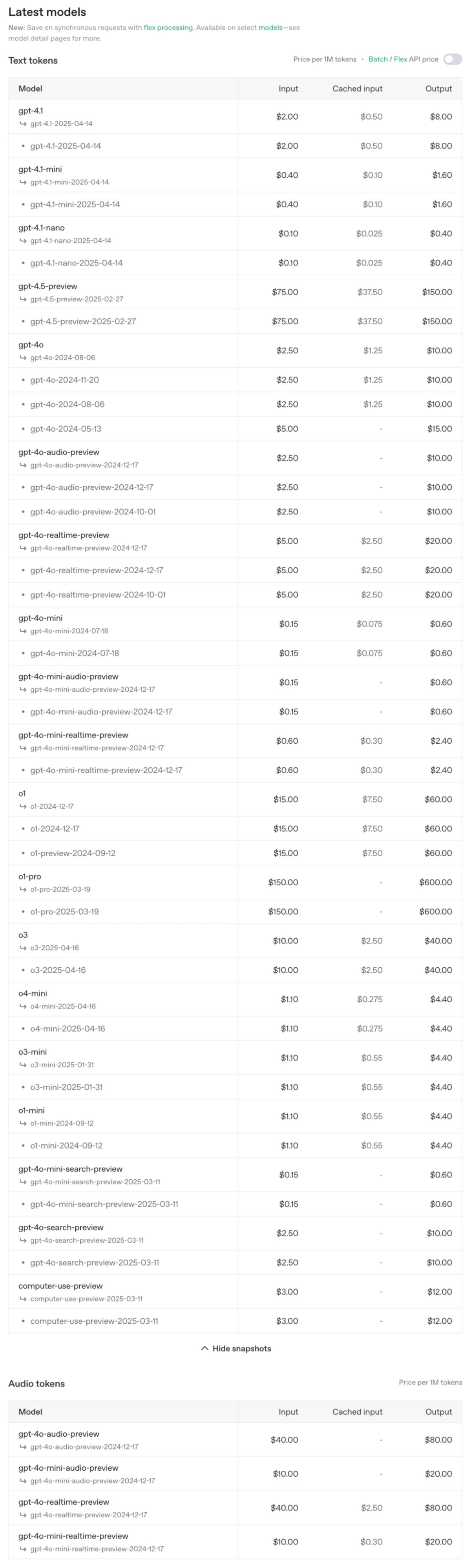
OpenAI's Model Development Features Multiple Parallel Tracks:
GPT Series: Centered on multimodal interaction, iterating through parameter adjustments and feature expansion (e.g., GPT-4o → GPT-4.1).
o Series: Breakthrough in reasoning capabilities, building long chains of thought through reinforcement learning (e.g., o1 → o3 → o4).
Lightweight Models: Responding to open-source competition, launching low-cost, high-value edge computing versions (e.g., o3 mini, GPT-4.1 nano).









