
 Script Planner Assistant▸
 AI Apps
 AI News
UniCombine: Flexible Multi-Condition Controllable Generation Framework
小编 ·

UniCombine: Flexible Multi-Condition Controllable Generation Framework
What is UniCombine?
UniCombine is a multi-condition controllable generation framework jointly released by Fudan University, Tencent Youtu Lab, and other institutions. Built on the Diffusion Transformer (DiT) architecture, it can handle composite generation tasks involving any combination of control conditions such as text prompts, spatial maps, and subject images.
Core Features of UniCombine
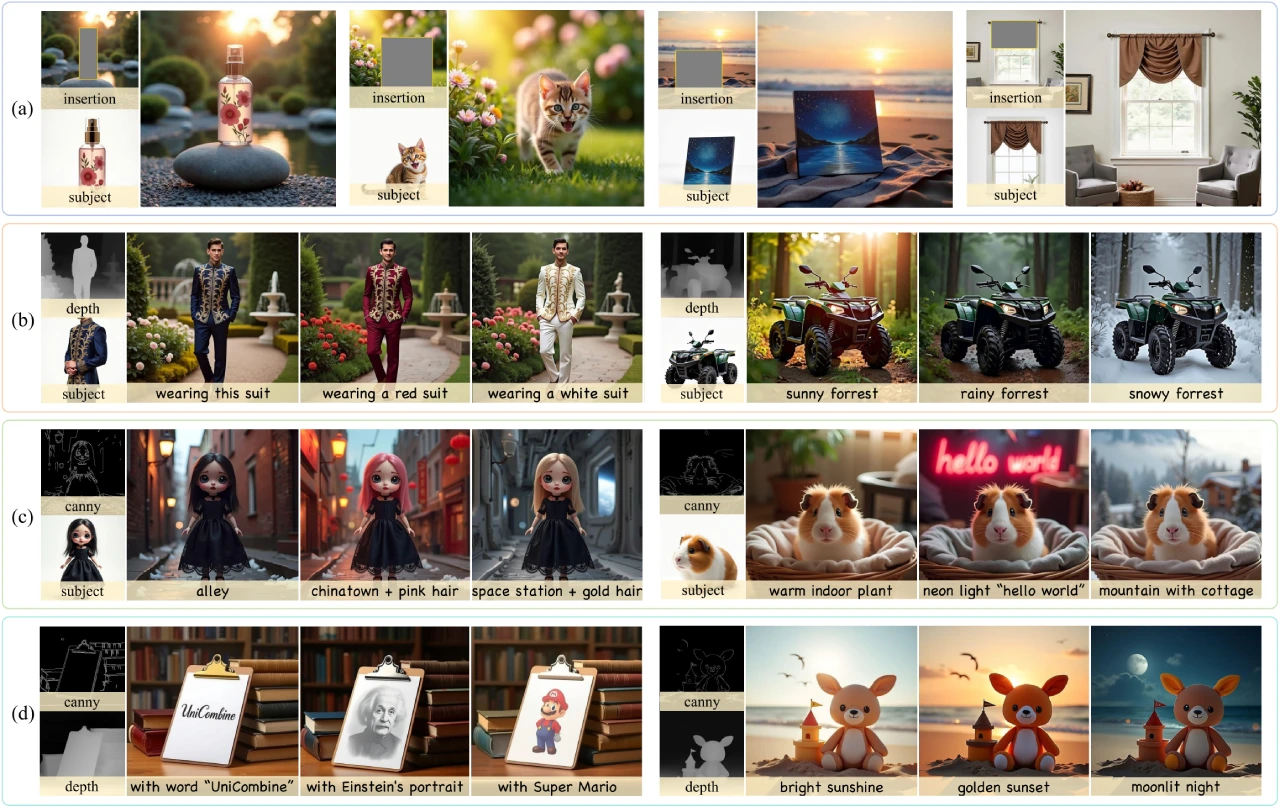
UniCombine can handle any combination of conditions, including text prompts, spatial maps, and subject images, while ensuring that the generated results remain consistent with all input conditions. For example, it can perform the following tasks:
Subject-Insertion: Insert a specified subject into a background image.
Subject-Spatial: Adjust the layout of subjects based on spatial maps.
Multi-Spatial: Generate images by combining multiple spatial conditions.
Technical Architecture of UniCombine
UniCombine's architecture is based on MMDiT (Masked Multi-Modal Diffusion Transformer) and introduces the following mechanisms:
Conditional MMDiT Attention: Used to process multi-condition input sequences and effectively fuse features from different conditions.
LoRA Switching Module: Manages multiple condition branches and dynamically activates pre-trained conditional LoRA modules based on condition type.
Trainable Denoising-LoRA Module: In the training-based version, this module is trained to further enhance performance.
Features and Advantages of UniCombine
Versatility: Capable of handling any combination of conditions, suitable for various generation tasks.
Flexibility: Offers both training-free and training-based versions.
High Performance: Achieves state-of-the-art performance in multi-condition generation tasks.
Installation and Usage of UniCombine
The code for UniCombine is open-source, and the installation steps are as follows:
conda create -n unicombine python=3.12
conda activate unicombine
pip install -r requirements.txt
In addition, due to limitations of the diffusers library, the code needs to be manually updated.
Application Scenarios of UniCombine
Product Display and Copywriting Generation: Generate multi-style product images and matching copy based on text and subject images.
Personalized Recommendations: Generate customized product display pages based on user preferences.
Virtual Try-On: Combine user avatars to generate try-on effects, enhancing the shopping experience.
Advertising and Recommendation Content: Generate images, text, and video scripts to enrich content.
Multimodal Search: Combine product features to optimize search result accuracy.
GitHub Repository:https://github.com/Xuan-World/UniCombinearXiv
Paper:https://arxiv.org/html/2503.09277v1









