
 Script Planner Assistant▸
 AI Apps
 AI News
The Official GPT-4.1 Prompt Engineering Guide from OpenAI
小编 ·

The Official GPT-4.1 Prompt Engineering Guide from OpenAI
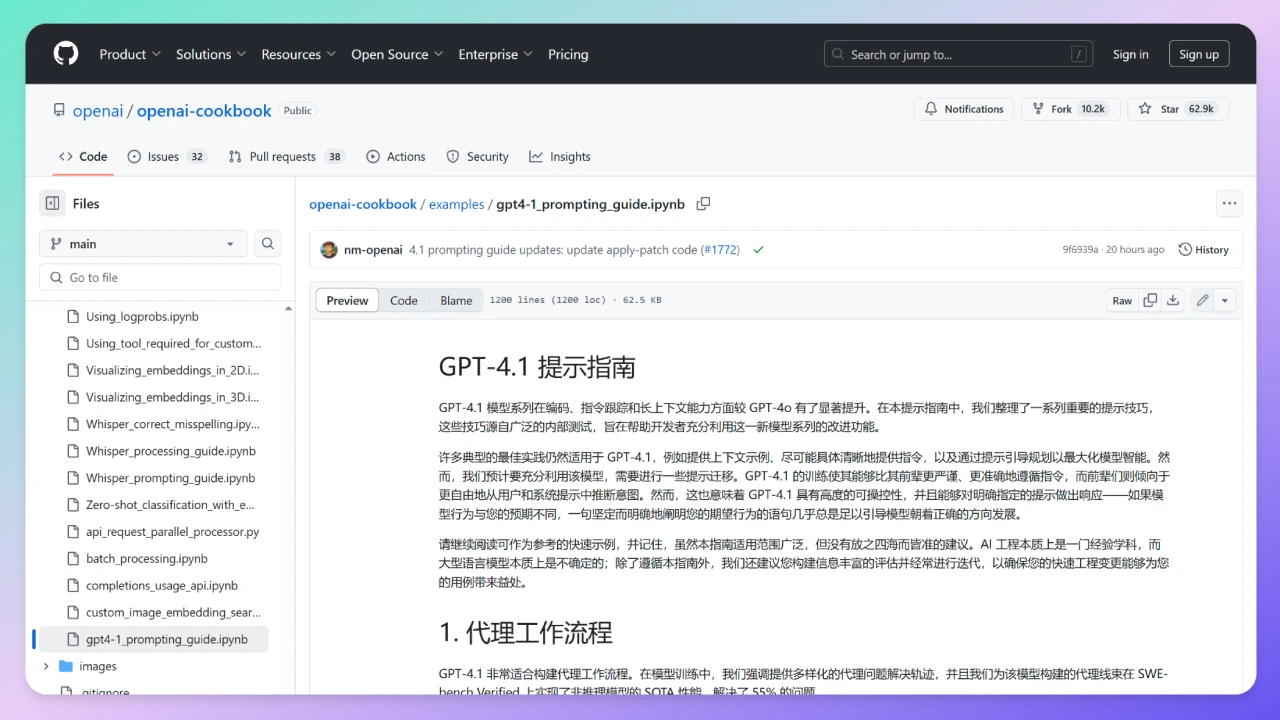
Openai has released the GPT-4.1 model, accompanied by a detailed prompt engineering guide, available at: https://github.com/openai/openai-cookbook/blob/main/examples/gpt4-1_prompting_guide.ipynb. The purpose is to help users utilize the GPT-4.1 model more efficiently by optimizing prompt design to improve task execution effectiveness.
GPT-4.1 is more powerful than the previous GPT-4o, with significant improvements in coding, instruction understanding, and processing extremely long texts. It can better understand your instructions and, as long as you express them clearly, it will strictly follow your requirements.
General Basic Techniques for the GPT-4.1 Model
Provide context examples: Help the model understand task requirements through concrete examples.
Clear and specific instructions: Avoid vague instructions to ensure the model knows exactly what to do.
Guide planning: Have the model think through steps before acting, rather than executing directly.
Leverage literalness: GPT-4.1 will strictly follow instructions, which can be used for precise control.
Correct deviations: If the model's behavior does not meet expectations, state the desired behavior directly and firmly.
Iterative optimization: Prompt engineering requires continuous experimentation and optimization.
Agent Workflow Techniques
Multi-turn dialogue reminder: Explicitly tell the model in the system prompt that it needs to keep the conversation going until the problem is resolved. Example:
You are an agent - please keep going until the user’s query is completely resolved, before ending your turn and yielding back to the user. Only terminate your turn when you are sure that the problem is solved.
Tool usage reminder: Encourage the model to fully use tools to reduce guessing and hallucinations.
If you are not sure about file content or codebase structure pertaining to the user’s request, use your tools to read files and gather the relevant information: do NOT guess or make up an answer.
Planning reminder: Force the model to perform explicit planning and reflection before and after tool calls.
Prefer the tools field: Avoid manually injecting tool descriptions to reduce errors.
Clear tool and parameter names: Ensure tool names and parameter names are clear and easy to understand.
Detailed tool descriptions: Provide detailed explanations in the tool's "description" field.
Example placement: Place examples for complex tools in the # Examples section of the system prompt.
Guide explicit planning: Use prompts to encourage the model to do step-by-step planning and reflection in its output.
Long Context Techniques for the GPT-4.1 Model
Adjust context dependency: Explicitly indicate whether the model should only use the provided context or can combine it with its own knowledge to answer.
Optimize instruction placement: In long contexts, it is best to place instructions at the beginning and end. If placed only once, putting them at the top is more effective.
Chain of Thought Techniques
Basic chain of thought instruction: Add an instruction like "First, think carefully step by step..." at the end of the prompt.
Audit failure cases: Analyze the steps where the model makes mistakes and add more explicit instructions to correct them.
Solidify effective strategies: Write effective thinking strategies explicitly into the prompt.
Structured reasoning strategy: Require the model to execute a series of reasoning steps in order.
Instruction Following Techniques
Start with high-level rules: Use "Response Rules" or "Instructions" to summarize the main requirements.
Add sub-categories: Provide example phrases for specific behaviors.
Use ordered lists for process rules: If the model needs to follow specific steps, use an ordered list.
Check for conflicting or unclear instructions: Avoid conflicting instructions and ensure clarity.
Add examples: Demonstrate desired behavior and ensure key behaviors are reflected in the rules.
Use emphasis carefully: Such as all caps, though usually not necessary.
Handle side effects of forced behavior: Avoid the model randomly calling tools due to forced requirements.
Instruct the model to vary example phrases: Avoid repetitive output.
Control redundant explanations and formatting: Constrain the model's output through instructions and examples.
General Recommendations
Use structured prompt templates: Recommend a template that includes role, goal, instructions, reasoning steps, output format, and examples.
Choose appropriate delimiters: Select formats like Markdown, XML, or JSON based on needs.
Be aware of resistance to long repetitive outputs: If you need to generate long and repetitive content, strong instructions or task decomposition may be required.
Test parallel tool calls: If parallel calls have issues, you can set parallel_tool_calls=false.
Code Diff Generation Techniques
Clear instructions and examples: Provide clear instructions and examples for the Diff format.
Recommend V4A format: The model has been extensively trained on this format.
Characteristics of an effective Diff format: No line numbers used, precise old and new code provided, with clear separators between them.
Other effective formats: Such as Aider's SEARCH/replace format and pseudo-XML format.
The GPT-4.1 prompt engineering guide provides users with a wealth of prompt engineering techniques. By reasonably applying these techniques, the performance of GPT-4.1 across various tasks—whether dialogue, reasoning, code generation, or other complex tasks—can be significantly improved.
OpenAI GPT-4.1 Official Prompt Engineering Guide address:https://github.com/openai/openai-cookbook/blob/main/examples/gpt4-1_prompting_guide.ipynb









