
 Script Planner Assistant▸
 AI Apps
 AI News
How Does the GPT-4.1 Series Improve Over GPT-4o? Key Differences Explained
小编 ·

How Does the GPT-4.1 Series Improve Over GPT-4o? Key Differences Explained
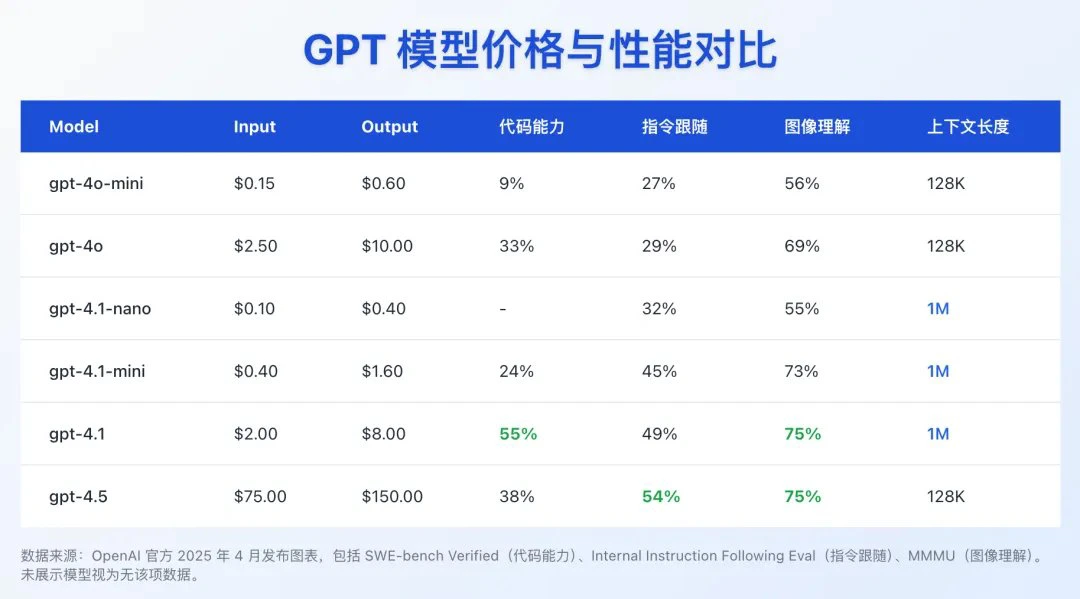
Openai released the GPT-4.1 series last night. GPT-4.1 has replaced 4o and offers excellent value (within the OpenAI lineup). It features a 1M ultra-long context window and outstanding performance. The 4.1 nano and mini versions are affordably priced and well-suited for handling large volumes of long-text tasks. Its coding capabilities surpass those of GPT-4.5, but fall short of reasoning models such as o1. GPT-4.1 shows significant improvements over GPT-4o in several aspects. Here are the main differences between them:
1. Performance Improvements
Coding Capabilities:
GPT-4.1: Scores 54.6% on the SWE-bench Verified coding benchmark, a 21.4% improvement over GPT-4o.
GPT-4o: Scores 33.2% on the same test.
Improvement: GPT-4.1 excels at handling code repositories, completing tasks, and generating runnable code that passes tests.
Instruction Following:
GPT-4.1: Scores 38.3% on Scale's MultiChallenge benchmark, a 10.5% improvement over GPT-4o.
GPT-4o: Scores 27.8% on the same test.
Improvement: GPT-4.1 performs better at following complex instructions, formatting output, and avoiding erroneous behavior.
Long-Text Understanding:
GPT-4.1: Scores 72.0% on the Video-MME long-text understanding benchmark, a 6.7% improvement over GPT-4o.
GPT-4o: Scores 65.3% on the same test.
Improvement: GPT-4.1 can better understand and extract key information when processing long videos (without subtitles) and long documents.
2. Context Window
GPT-4.1: Supports a context window of 1 million tokens, a substantial increase over GPT-4o's 128,000 tokens.
GPT-4o: Supports a context window of 128,000 tokens.
Improvement: GPT-4.1 can handle larger codebases, multi-document tasks, and long texts, making it applicable across fields such as legal, programming, and customer support.
3. Model Efficiency
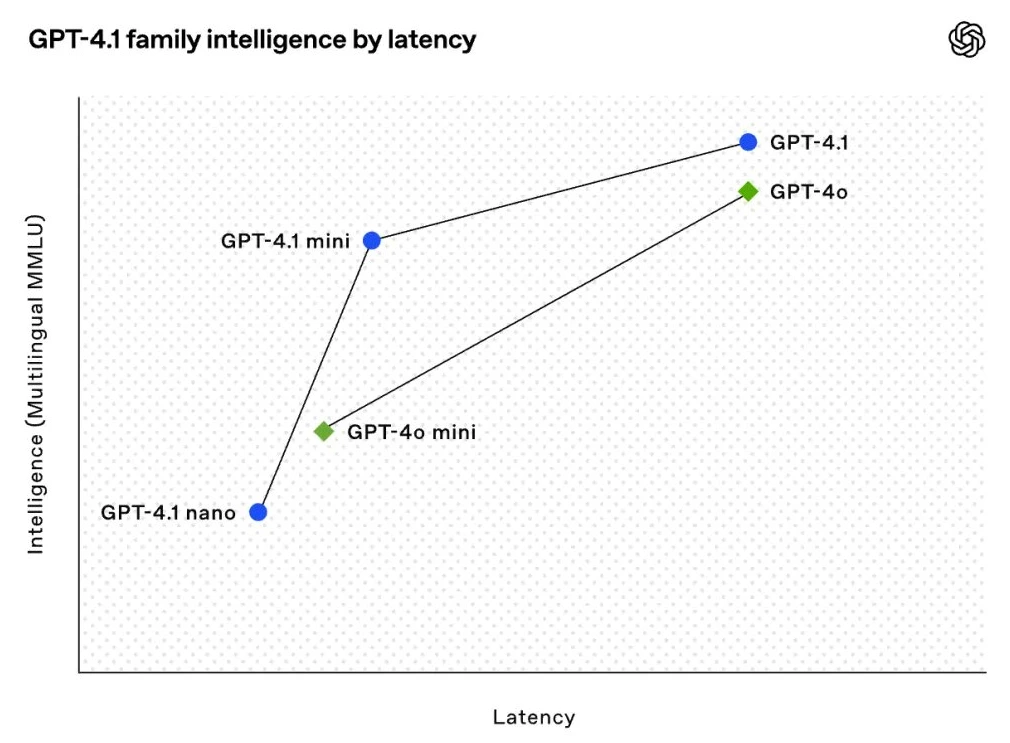
GPT-4.1: Significant improvements in inference efficiency, with lower latency and lower cost.
GPT-4.1 mini: Latency reduced by nearly half, with cost reduced by 83%.
GPT-4.1 nano: The fastest model, with extremely low latency, suitable for tasks with low-latency requirements.
GPT-4o: Relatively lower inference efficiency, particularly when handling large-scale context.
4. Image Understanding
GPT-4.1: Performs excellently in image understanding, particularly on multimodal tasks.
GPT-4.1 mini: Scores 72.7% on the MMMU image understanding benchmark, outperforming GPT-4o's 68.7%.
GPT-4o: Weaker performance on image understanding tasks.
5. Cost
GPT-4.1: Charges $2.00 per million input tokens and $8.00 per million output tokens.
GPT-4.1 mini: Charges $0.40 per million input tokens and $1.60 per million output tokens.
GPT-4.1 nano: Charges $0.10 per million input tokens and $0.40 per million output tokens.
GPT-4o: Charges higher fees per million input tokens. Specific figures are not clearly stated, but the GPT-4.1 series has a more advantageous cost structure.
6. Application Scenarios
GPT-4.1: Suitable for scenarios that require strong computational power and complex task processing, such as professional software development, legal document analysis, and large-scale data processing.
GPT-4.1 mini: Suitable for use in resource-constrained environments, such as ordinary personal computers and small servers.
GPT-4.1 nano: Primarily targets mobile and embedded devices, suitable for scenarios with high response speed requirements and limited resources, such as rapid text classification and auto-completion.
GPT-4o: Suitable for general purposes, but performs weaker when handling large-scale context and complex tasks.
For more benchmark details, please see the OpenAI blog post: https://openai.com/index/gpt-4-1/.









