
 Script Planner Assistant▸
 AI Apps
 AI News
GPT-4.1 vs GPT-4.1 mini vs GPT-4.1 nano: What's the Difference?
小编 ·

GPT-4.1 vs GPT-4.1 mini vs GPT-4.1 nano: What's the Difference?
Open ai has launched three new models via its API: GPT-4.1, GPT-4.1 mini, and GPT-4.1 nano. These models comprehensively outperform GPT-4o and GPT-4o mini, with notable improvements in coding and instruction following. They also feature a larger context window—supporting up to 1 million context tokens—and can better leverage this context through improved long-context understanding. Let's take a look at the differences between them.
Positioning
GPT-4.1: As an upgraded version of GPT-4o, GPT-4.1 further optimizes multimodal capabilities (text, image, audio), with faster response times and deeper reasoning. It performs more naturally especially in writing, programming, and complex Q&A scenarios, reducing "off-topic" responses. Its context window supports 1M tokens, with a maximum output of 32,768 tokens, and it is planned to be available across all Copilot tiers.
GPT-4.1 mini: Positioned as a mid-tier lightweight model, designed for edge devices (such as mobile apps, mini-programs) and lightweight tasks. It sacrifices some performance to reduce resource consumption, making it suitable for scenarios with high real-time requirements but limited computing power. Similar to GPT-4o mini, it has a smaller parameter scale (approximately 8B), but retains core multimodal functionality.
GPT-4.1 nano: The ultimate lightweight version, built for mobile and embedded AI, with even smaller parameter scale (speculated to be potentially lower than the mini version), emphasizing low latency and offline running capability—for example, being able to use basic AI functions on older phones or without network connectivity.
1. Model Size and Parameters
GPT-4.1: The complete large model with the most parameters, suitable for complex tasks and scenarios requiring powerful computing capability.
GPT-4.1 mini: A medium-sized model with fewer parameters, suitable for use in resource-constrained environments, such as ordinary personal computers or servers.
GPT-4.1 nano: The smallest model with the fewest parameters, primarily targeting scenarios with extremely limited resources such as mobile and embedded devices.
2. Performance and Efficiency
GPT-4.1:
Performs excellently in tasks such as coding, instruction following, and long-text understanding.
Achieved a score of 54.6% on the SWE-bench Verified coding benchmark, a 21.4% improvement over GPT-4o.
Achieved a score of 72.0% on the Video-MME long-text understanding benchmark, a 6.7% improvement over GPT-4o.
GPT-4.1 mini:
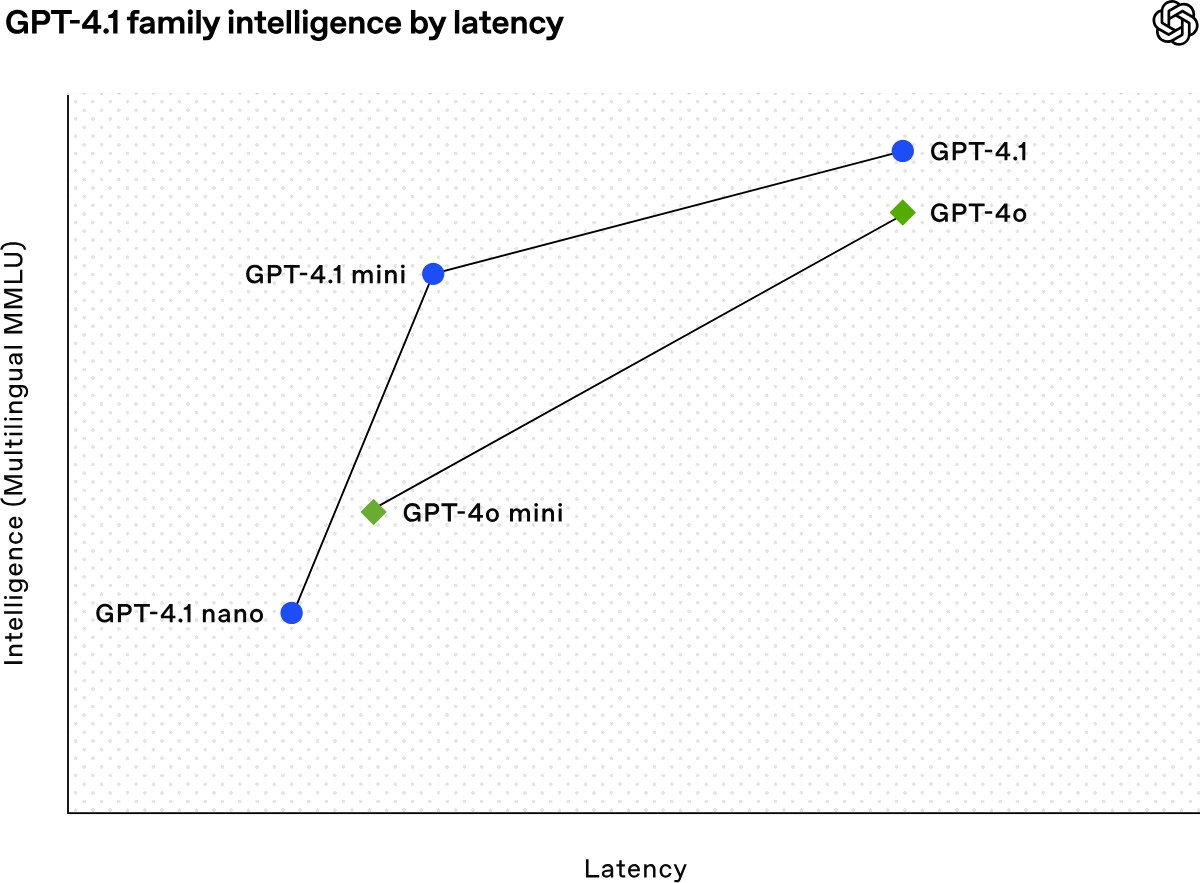
Performs close to or even surpasses GPT-4o in many benchmarks, with nearly halved latency and 83% lower cost.
Performs excellently on the MMMU image understanding benchmark.
GPT-4.1 nano:
The fastest model with extremely low latency, typically returning the first token in less than five seconds for queries with 128,000 input tokens.
Outperforms GPT-4o mini on tasks such as MMLU, GPQA, and Aider polyglot coding.
3. Applicable Scenarios
GPT-4.1: Suitable for scenarios requiring powerful computing capability and complex task processing, such as professional software development, complex legal document analysis, and large-scale data processing.
GPT-4.1 mini: Suitable for running on mid-tier devices, such as ordinary personal computers, small servers, etc. It can handle moderately complex tasks, such as daily text generation, simple programming assistance, and image understanding.
GPT-4.1 nano: Primarily targets mobile and embedded devices, such as smartphones, tablets, and smart home devices, suitable for scenarios with high response speed requirements and limited resources, such as fast text classification and auto-completion.
4. Cost
| Model | Input (per million tokens) | Cached Input (per million tokens) | Output (per million tokens) | Blended Pricing\* (per million tokens) |
|---|---|---|---|---|
| GPT-4.1 | $2.00 | $0.50 | $8.00 | $1.84 |
| GPT-4.1 mini | $0.40 | $0.10 | $1.60 | $0.42 |
| GPT-4.1 nano | $0.10 | $0.025 | $0.40 | $0.12 |
*Based on typical input/output and caching ratios.
5. Other Features
Long-Text Processing Capability:
All three models support a context window of 1 million tokens, a substantial increase from the previous GPT-4o model (128,000 tokens).
GPT-4.1 performs excellently in long-text understanding and is better able to handle complex multi-document tasks.
Instruction Following Capability:
GPT-4.1 shows significant improvement in instruction following, particularly performing better in complex multi-turn conversations.
Image Understanding:
GPT-4.1 mini performs outstandingly in image understanding, typically outperforming GPT-4o.
Official Introduction:https://openai.com/index/gpt-4-1/









