
 Script Planner Assistant▸
 AI Apps
 AI News
Piece it Together (PiT): Combine Partial Components into a Complete Concept and Generate the Missing Parts
小编 ·

Piece it Together (PiT): Combine Partial Components into a Complete Concept and Generate the Missing Parts
What is Piece it Together (PiT)?
Piece it Together (PiT) is a visual concept generation framework developed by researchers at Tel Aviv University and Bria ai. It can seamlessly integrate user-provided partial visual components into a coherent whole concept while simultaneously generating the missing parts, thereby producing a complete and plausible concept. In other words, you only need to randomly input a few images—such as a wing, a tuft of hair, an eye—and it will automatically generate a complete image for you. This approach is particularly well suited for creative design fields, such as character design, product design, and toy design.
PiT Features
Part-to-whole generation: Integrates user-provided partial visual components (such as a part of an object, a sketch, etc.) into a complete concept.
Missing part completion: Automatically infers and generates the missing parts, making the final concept reasonable and complete within the target domain.
Semantic manipulation: Performs semantic editing and manipulation on the generated concept, such as adjusting a character's style, mood, etc.
Text-conditioned restoration: Through IP-LoRA technology, restores the ability to control the generated concept with text conditions, enabling the generated images to better adapt to different scenes or styles.
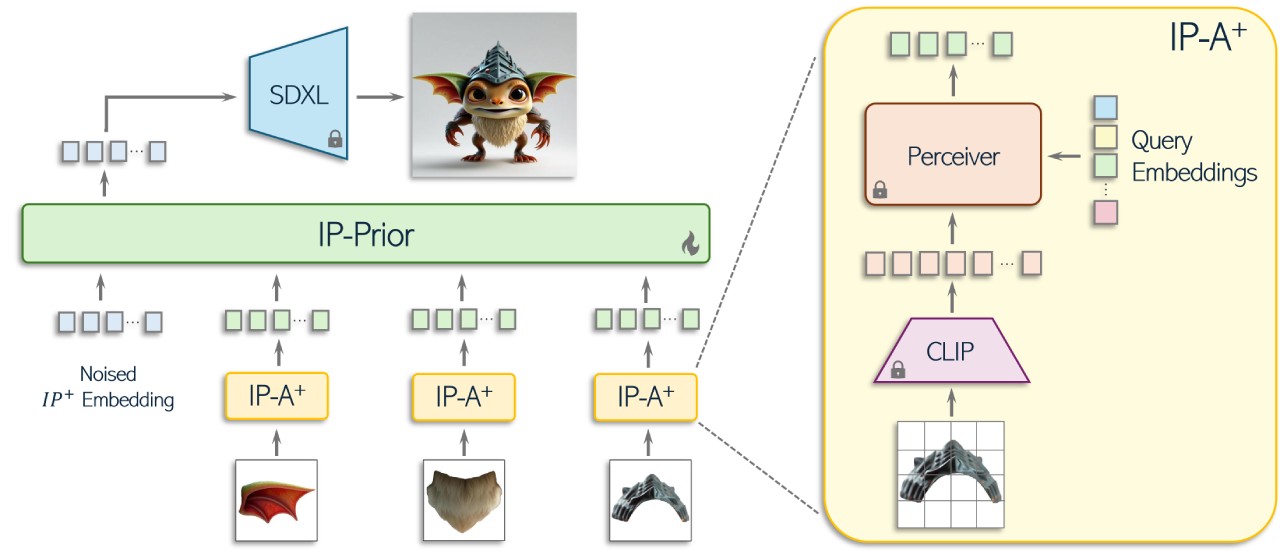
Representation based on IP+ space: Uses the internal representation space of IP-Adapter+, which preserves visual details better than the CLIP space while supporting semantic manipulation.
Lightweight flow matching model: By training a lightweight flow matching model (IP-Prior), it can generate coherent compositions based on domain-specific prior knowledge.
Flexible input forms: Supports multiple input forms, including image fragments, sketches, etc., providing users with greater flexibility.
Diverse output results: For the same input, the model can generate multiple plausible outputs, helping designers explore different creative directions.
PiT Use Cases
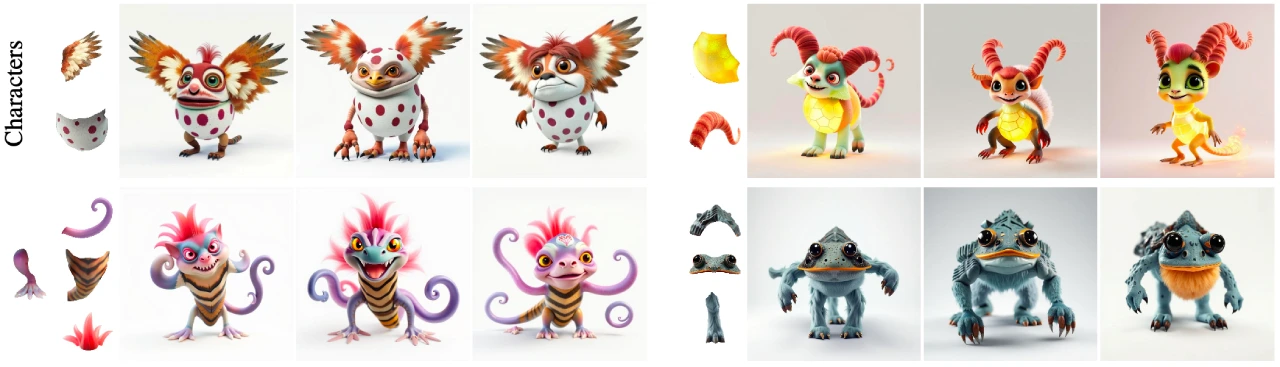
Character design: Designers can input partial features of a character (such as wings, eyes, etc.), and the model generates a complete character design while supporting further semantic editing, such as adjusting the character's mood or style.
Product design: Input partial design elements of a product (such as shape, material, etc.), and the model generates a complete product design with style adjustment support.
Toy conceptualization: Input partial features of a toy (such as an animal's head, clothing, etc.), and the model generates a complete toy design.
Creative painting: Input sketches or partial painting elements, and the model generates a complete painting with style adjustment support.
How to Use PiT
Prepare input: Users need to prepare some visual components, such as image fragments, sketches, etc. These components can be parts of a concept.
Input the model: Feed these components into the PiT model.
Generate concept: The model automatically integrates these components and generates a complete concept, while completing the missing parts.
Semantic editing (optional): Users can perform semantic editing on the generated concept, such as adjusting style or mood.
Text-conditioned control (optional): Through IP-LoRA technology, users can add text conditions to the generated concept to adapt it to different scenes or styles.
Project page:https://eladrich.github.io/PiT/
Paper:https://arxiv.org/html/2503.10365v1









