
 Script Planner Assistant▸
 AI Apps
 AI News
What Are MCP, RAG, and Agent? Their Differences and Relationships
小编 ·

What Are MCP, RAG, and Agent? Their Differences and Relationships
In recent years, AI has gradually integrated into our learning, life, and work. From intelligent voice assistants to complex data analysis systems, AI application scenarios are becoming more and more widespread. Behind this, there are three important concepts—MCP (Model Context Protocol), RAG (Retrieval-Augmented Generation), and Agent (Intelligent Agent)—which form the core architecture of modern intelligent systems. This article will take an in-depth look at what these three concepts mean, how they relate to each other, and how they work together to make AI applications more powerful and efficient.
MCP, RAG, and Agent Concepts
RAG (Retrieval-Augmented Generation)
Function: Combines information retrieval with text generation, retrieving relevant documents from a knowledge base to enhance the generation process.
Advantage: Reduces AI hallucinations, making responses based on factual information.
Components: Knowledge base, retrieval component (embedding model and vector database), generation model (language model).
Agent (Intelligent Agent)
Function: Takes actions in an environment based on observations and goals to achieve specific objectives.
Core Components: Perception module, reasoning/decision-making module, tool usage capabilities.
Examples: Customer service agents, data analysis agents, complex task handling agents.
MCP (Model Context Protocol)
Function: Connects AI assistants with external systems, enabling standardized communication.
Advantage: Provides a unified interface, simplifying the integration of AI with external systems.
Components: Client-server architecture, standardized communication protocol, tool invocation interface.
In simple terms, the definitions above can be summarized as follows:
RAG: AI's "research" capability, allowing AI to look up information before answering questions for more accurate responses—just like a student going to the library to look up materials when writing a paper.
Agent: AI's "thinking and decision-making" capability, enabling it to think on its own and take actions to complete tasks—like a personal assistant who independently handles tasks based on your needs.
MCP: AI's "tool usage" capability, a universal language that allows AI to communicate with external tools—like a universal adapter that lets AI connect to and use various external tools and data sources.
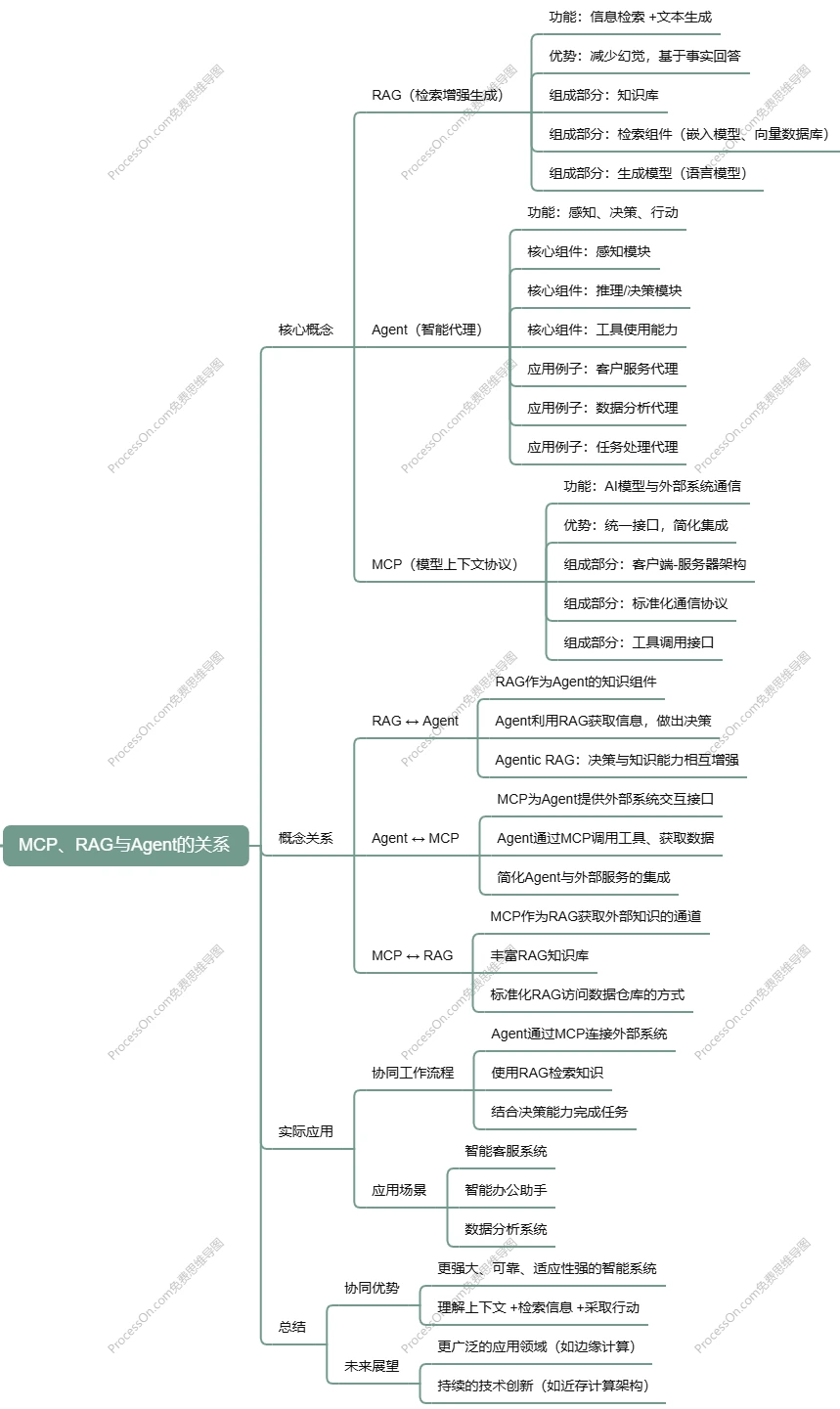
The Relationship Between MCP, RAG, and Agent
The Relationship Between RAG and Agent
RAG often serves as the knowledge component within an Agent, providing a factual foundation.
Agents leverage RAG to access relevant information and make more informed decisions.
When combined (Agentic RAG), the Agent's decision-making capabilities and RAG's knowledge capabilities mutually reinforce each other.
The Relationship Between Agent and MCP
MCP provides Agents with a standardized interface for interacting with external systems.
Agents can invoke tools and retrieve data through MCP, extending their action capabilities.
MCP simplifies the integration of Agents with various external services, improving development efficiency.
The Relationship Between MCP and RAG
MCP can serve as a channel for RAG systems to acquire external knowledge.
Data sources connected through MCP can enrich the RAG knowledge base.
MCP standardizes the way RAG systems access various data repositories.
How MCP, RAG, and Agent Work Together
In a complete AI system, these elements work together as follows:
The Agent establishes connections with external systems through MCP.
The Agent uses RAG to retrieve and integrate relevant knowledge.
The system combines decision-making capabilities with factual information to handle complex tasks.
This integrated approach creates AI systems that are more powerful, reliable, and adaptable than any single component alone—capable of understanding context, retrieving relevant information, and taking appropriate actions to complete tasks.









