
 Script Planner Assistant▸
 AI Apps
 AI News
RF-DETR: A SOTA Real-Time Object Detection Model by Roboflow Based on Transformers
小编 ·

RF-DETR: A SOTA Real-Time Object Detection Model by Roboflow Based on Transformers
What is RF-DETR?
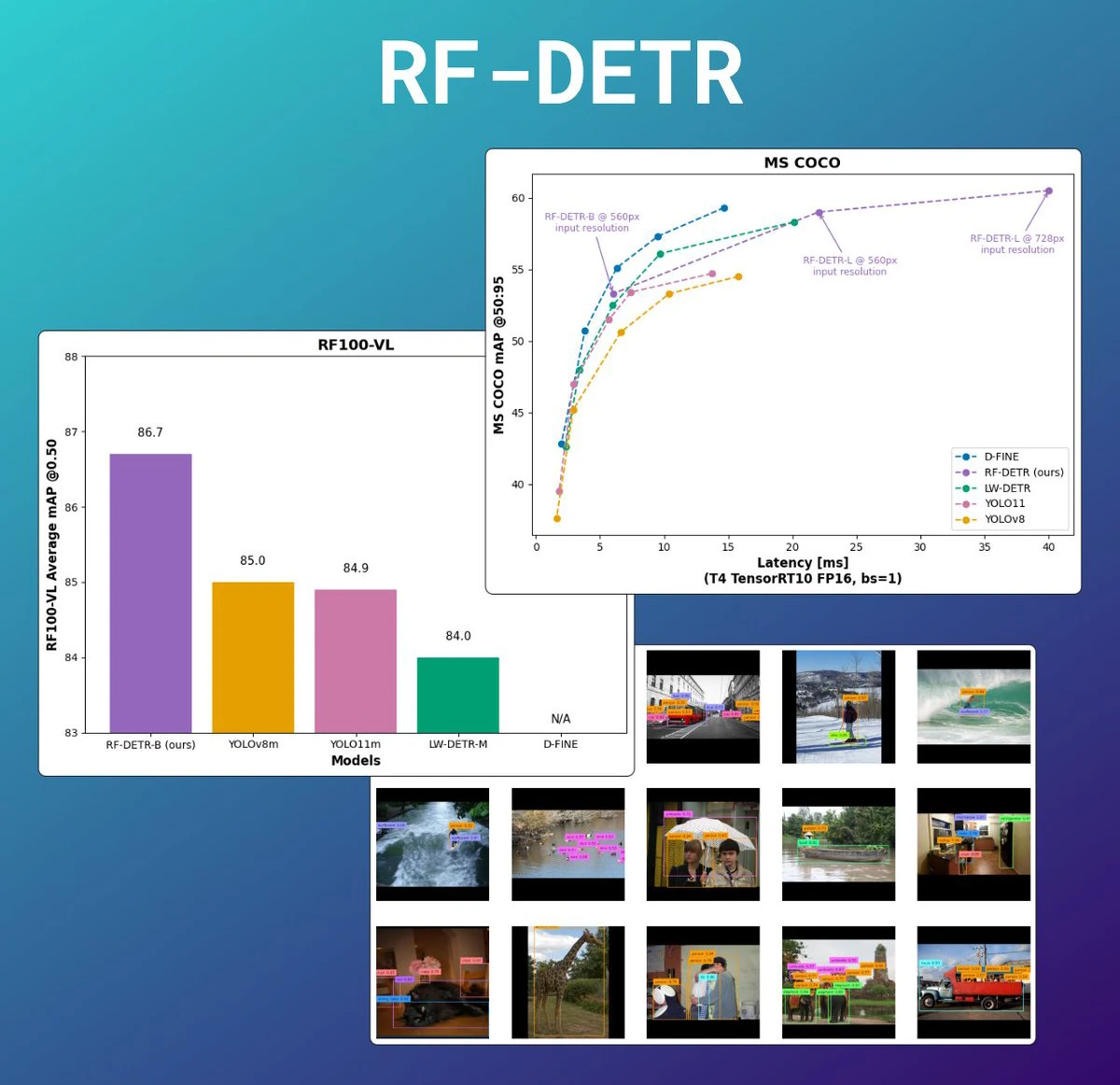
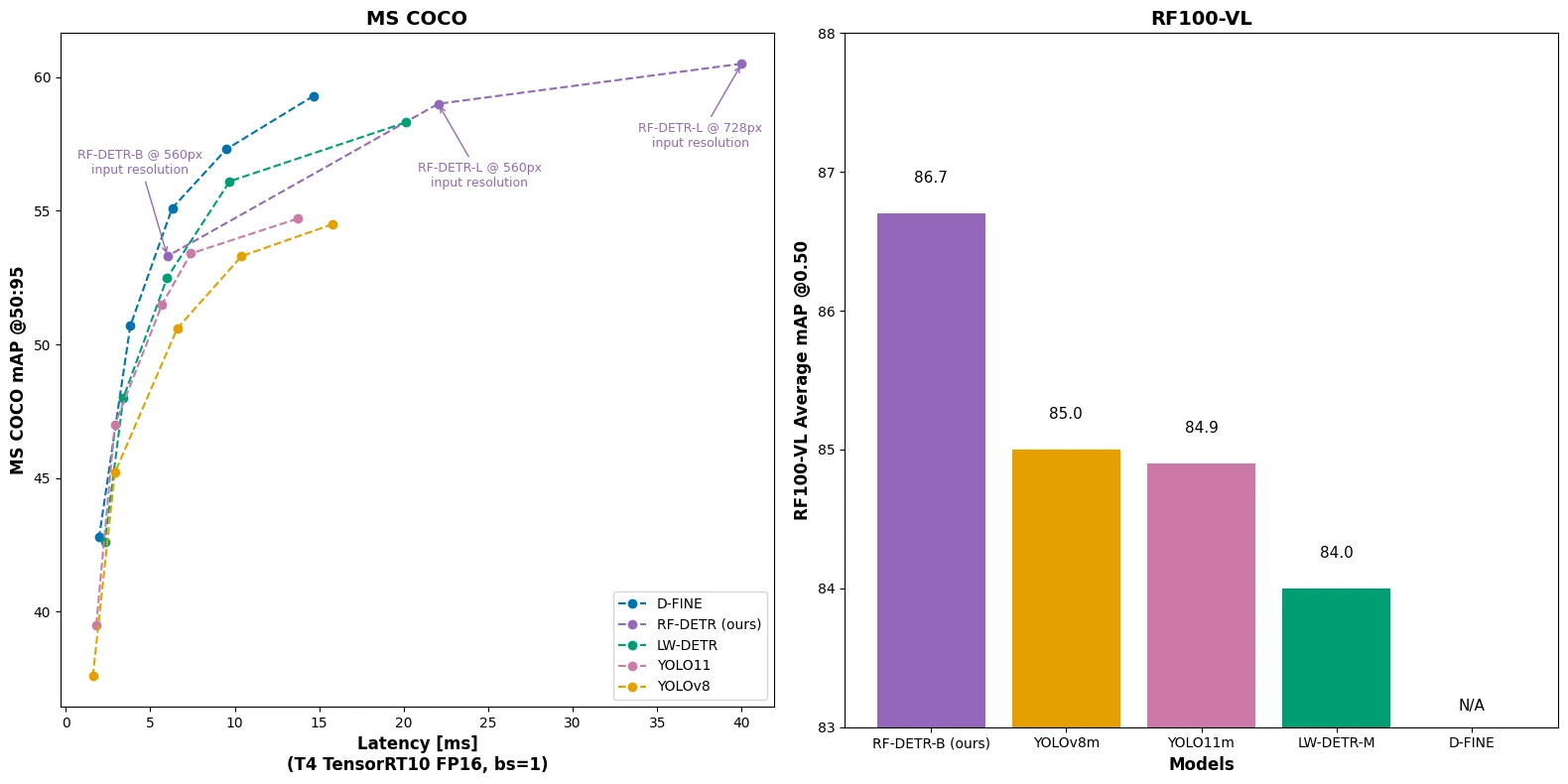
RF-DETR is a Transformer-based real-time object detection model architecture developed by Roboflow, designed to achieve high accuracy and low latency in object detection while being capable of running on edge devices. It is the first real-time model to surpass 60 AP on the Microsoft COCO benchmark, and it also performs exceptionally well on the RF100-VL benchmark.
Features of RF-DETR
High-Accuracy Object Detection: RF-DETR achieves an mAP (mean Average Precision) of 60.5 on the COCO dataset and an average mAP of 86.7 on the RF100-VL benchmark.
Real-Time Performance: RF-DETR has low latency; for example, RF-DETR-Base can reach 160 FPS on an NVIDIA T4 GPU.
Strong Adaptability: RF-DETR adapts well to a variety of domains and datasets of different sizes.
Multi-Device Support: RF-DETR is not only suitable for high-performance GPU devices, but can also run on edge devices.
Technical Architecture of RF-DETR
Backbone: RF-DETR uses a pre-trained DINOv2 backbone, which excels at image feature extraction and provides the model with powerful feature representation capabilities.
Deformable DETR Architecture: RF-DETR adopts the Deformable DETR architecture, enhancing the model's target localization capability through Deformable Attention. This mechanism allows the model to adaptively sample on feature maps, thereby better capturing the shape and position information of targets.
Single-Scale Feature Map: Unlike some object detection models that use multi-scale feature maps, RF-DETR uses a single-scale feature map for object detection. This design simplifies the model structure while improving computational efficiency.
Lightweight Detection Head (LW-DETR): RF-DETR incorporates LW-DETR's lightweight detection head design, further optimizing the real-time performance of the model.
Application Scenarios of RF-DETR
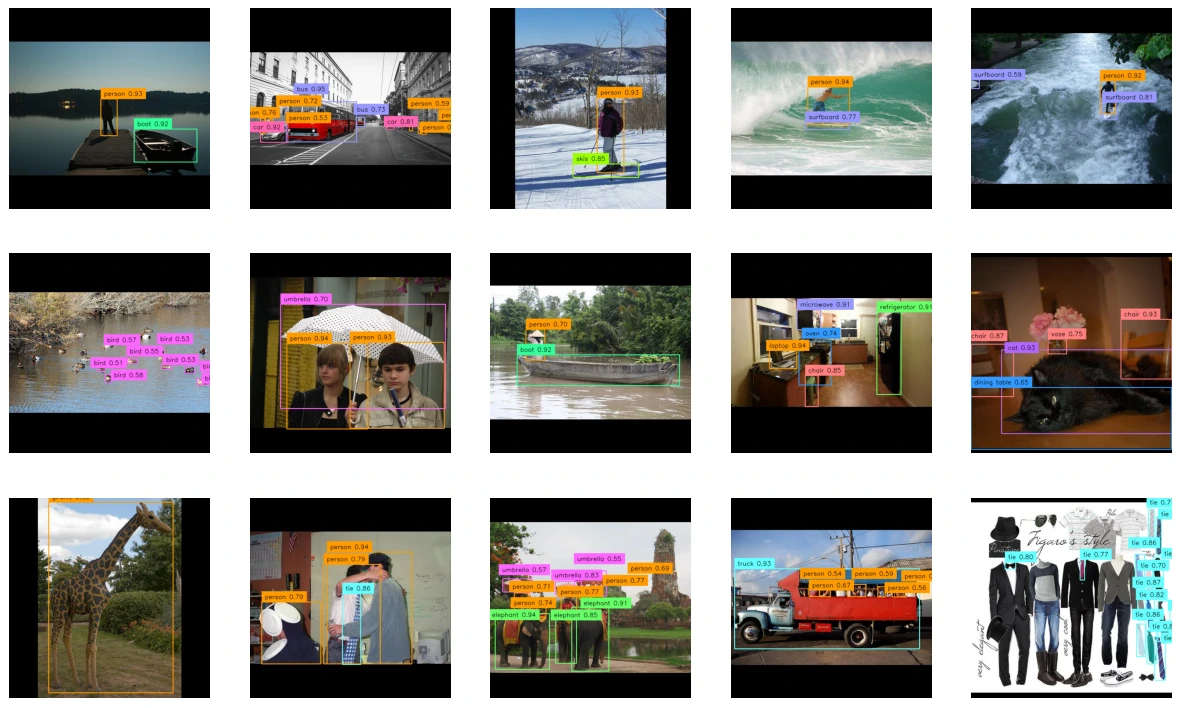
Security Surveillance: Real-time detection of people, vehicles, animals, and other targets in surveillance video for security monitoring and abnormal behavior analysis.
Autonomous Driving: In autonomous driving systems, RF-DETR can quickly and accurately detect pedestrians, vehicles, and other obstacles on the road, providing support for autonomous driving decision-making.
Industrial Automation: In industrial production environments, RF-DETR can be used for tasks such as detecting parts on production lines and defect detection, improving production efficiency and quality control.
Wildlife Conservation: In wildlife conservation projects, RF-DETR can be used to monitor wildlife activity, helping researchers better understand animal behavior and protect the ecological environment.
Edge Device Applications: RF-DETR can run on edge devices (such as smart cameras and mobile devices), enabling low-latency object detection, suitable for IoT and intelligent edge computing scenarios.
How to Use RF-DETR
1. Install Dependencies: First, you need to install the dependency libraries for RF-DETR. You can install them with the following command:
pip install rf-detr
2. Load the Pre-trained Model: RF-DETR provides pre-trained weights that can be loaded and used directly. For example:
from rf_detr import RFDetr
model = RFDetr.from_pretrained("rf_detr_base")
3. Image Preprocessing: Resize the input image to the size required by the model and perform normalization. For example:
from PIL import Image
import numpy as np
image = Image.open("example.jpg").convert("RGB")
image = image.resize((model.input_size, model.input_size))
image = np.array(image) / 255.0
4. Object Detection: Feed the preprocessed image into the model to perform object detection. For example:
detections = model.predict(image)
5. Result Parsing: Parse the detection results to obtain the target's class, confidence, and bounding box information. For example:
for detection in detections:
    class_id = detection["class_id"]
    confidence = detection["confidence"]
    bbox = detection["bbox"]
    print(f"Class: {class_id}, Confidence: {confidence}, BBox: {bbox}")
6. Fine-Tune the Model: If you need to use RF-DETR on a custom dataset, you can fine-tune the model. The fine-tuning process includes preparing the dataset, configuring training parameters, training the model, and evaluating model performance.
GitHub Repository: https://github.com/roboflow/rf-detr









