
 Script Planner Assistant▸
 AI Apps
 AI News
Fin-R1: A Financial Reasoning LLM Based on Qwen2.5
小编 ·

Fin-R1: A Financial Reasoning LLM Based on Qwen2.5
What is Fin-R1?
Fin-R1 is a reasoning large language model for the financial domain, jointly developed by Professor Zhang Liwen's team at the School of Statistics and Data Science, Shanghai University of Finance and Economics (SUFE-aiFLM-Lab) together with Caiyue Xingchen. Fin-R1 is built on Qwen2.5-7B-Instruct as the base model and leverages the DeepSeek-R1 framework for "data distillation" and "two-round quality filtering." Through supervised fine-tuning and reinforcement learning on high-quality chain-of-thought data, it effectively addresses the challenges of data fragmentation, uncontrollable reasoning logic, and insufficient business generalization in the financial domain, providing strong support for the intelligent transformation of the financial industry.

Model Architecture
Fin-R1 employs a two-stage architecture for training:
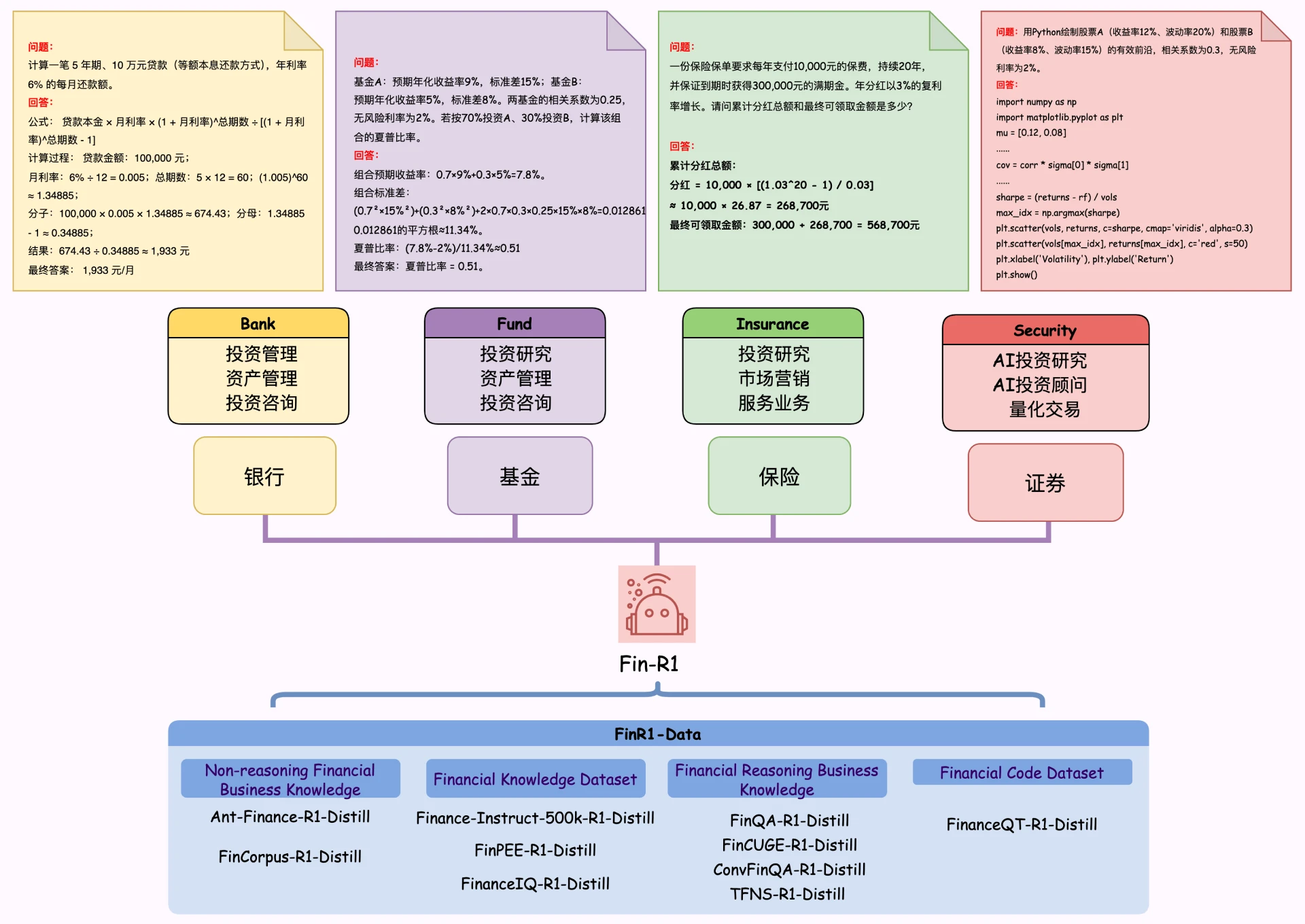
Data Generation Stage: Through data distillation and filtering methods, a high-quality financial reasoning dataset called Fin-R1-Data is constructed from multiple authoritative data sources.
Model Training Stage: Based on the Qwen2.5-7B-Instruct model, training is performed through supervised fine-tuning (SFT) and reinforcement learning (RL).
Features of the Fin-R1 Dataset
Scale and Quality: Fin-R1-Data contains approximately 60,091 complete chains of thought (CoT), covering multi-dimensional professional knowledge in the Chinese and English financial vertical domains.
Modular Design: The dataset is divided into four major modules: financial code, financial professional knowledge, financial non-reasoning business knowledge, and financial reasoning business knowledge.
Core Features of Fin-R1
Specialized Domain: Focuses on financial reasoning, covering multiple dimensions including financial code, professional knowledge, and business knowledge.
Data-Driven: Trained on the high-quality financial reasoning dataset Fin-R1-Data, which contains approximately 60,091 complete chains of thought.
Training Approach: Combines supervised fine-tuning (SFT) and reinforcement learning (RL) to ensure accuracy and reliability in financial reasoning tasks.
Lightweight Design: With only 7 billion parameters, it delivers outstanding performance.
Performance
Authoritative Evaluation: In authoritative financial domain evaluations, it achieved an average score of 75.2, ranking second.
Task Performance: It obtained scores of 76.0 and 85.0 on the FinQA and ConvFinQA tasks respectively, ranking first among the evaluated models.
Generalization Capability: It also demonstrates strong cross-task generalization on other financial benchmarks.
Applications of Fin-R1
Financial Code: Programming code used to implement financial models, algorithms, and analytical tasks.
Financial Calculation: Performs quantitative analysis and computation to provide a basis for financial decision-making.
Financial Security and Compliance: Prevents financial crime and ensures business operations comply with regulatory requirements.
Intelligent Risk Control: Leverages AI and big data technologies to identify and manage financial risks.
ESG Analysis: Evaluates corporate performance in Environmental, Social, and Governance aspects.
Steps to Use Fin-R1
Download the Model: Download the model weights from the Hugging Face page.
Launch the Service: Use the vllm tool to launch the model service.
Run Inference: Invoke the model for inference through the OpenAI API format.
Related Links to Fin-R1
Model Download:https://huggingface.co/SUFE-AIFLM-Lab/Fin-R1
Paper:https://arxiv.org/pdf/2503.16252









