
 Script Planner Assistant▸
 AI Apps
 AI News
PocketFlow: An Ultra-Minimalist LLM Framework with Only 100 Lines of Core Code
小编 ·

PocketFlow: An Ultra-Minimalist LLM Framework with Only 100 Lines of Core Code
What is PocketFlow?
PocketFlow is a minimalist LLM framework with only 100 lines of core code, focused on providing a lightweight, efficient, and flexible development experience for LLM applications. It supports a variety of design patterns and features, including multi-agent, workflow, retrieval-augmented generation, and more, while avoiding dependencies and vendor lock-in, offering a high degree of flexibility and extensibility. This framework is suitable for those who want to quickly get started with ai application development, for rapidly validating ideas.
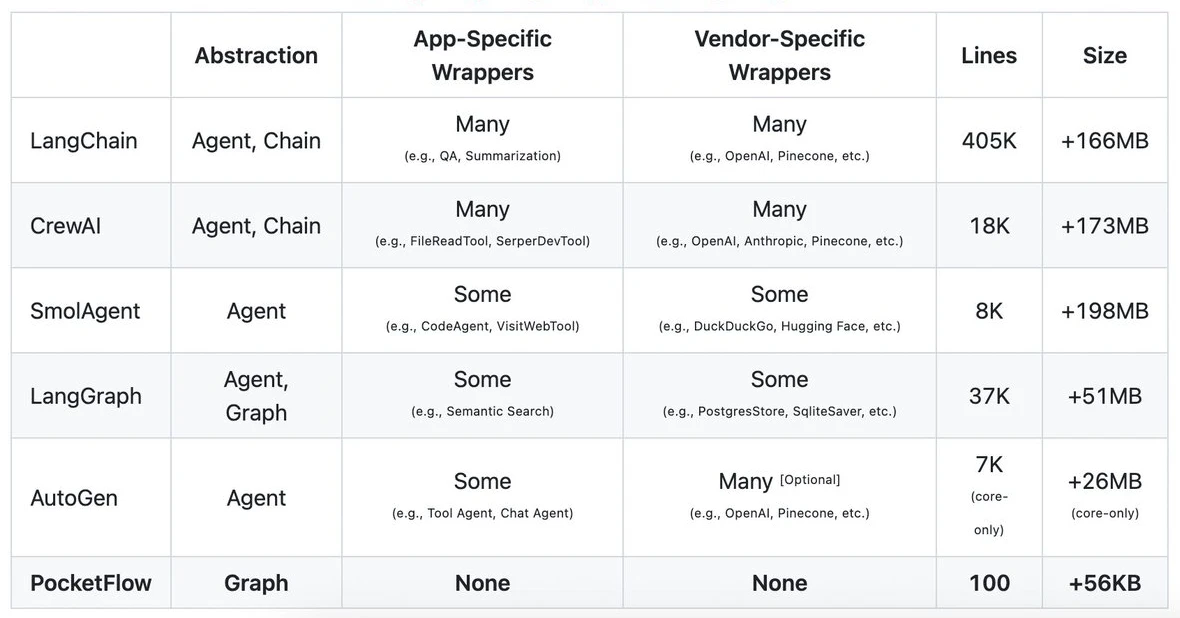
PocketFlow Core Features
Lightweight: Core functionality is implemented in just 100 lines of code, with no dependencies, avoiding vendor lock-in.
Expressive: Supports multi-agent, workflow, retrieval-augmented generation, and more.
Agent coding friendly: Intuitive and easy to use, making it convenient for AI agents to help humans build complex LLM applications.
PocketFlow Core Abstractions
PocketFlow models an LLM workflow as a Graph + Shared Store:
Node: Handles simple LLM tasks.
Flow: Connects nodes through Actions (i.e., labeled edges).
Shared Store: The communication mechanism between nodes within a flow.
Batch Node/Flow: Used for data-intensive tasks.
Async Node/Flow: Used for waiting on asynchronous tasks.
Parallel Node/Flow: Handles I/O-intensive tasks.
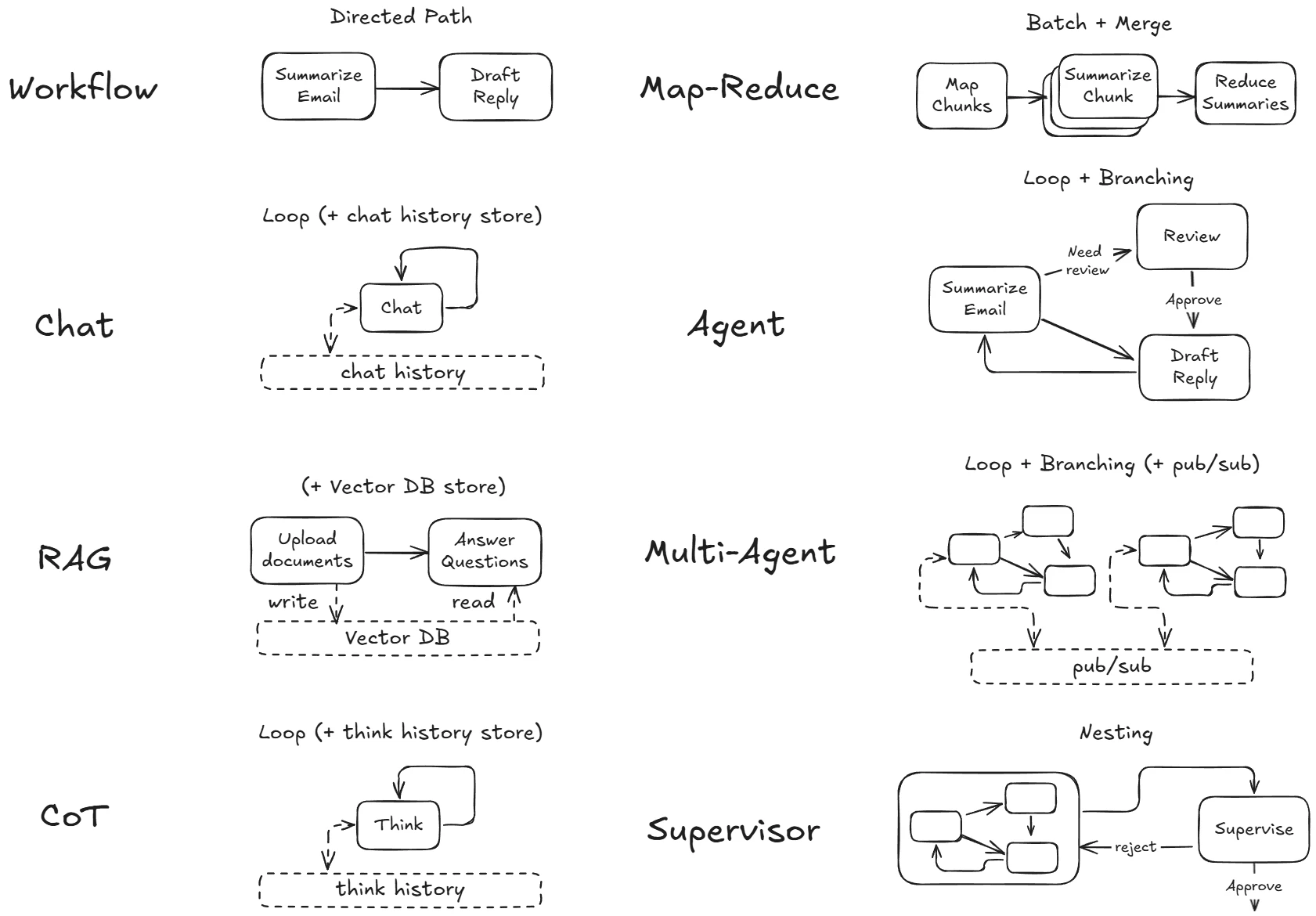
PocketFlow Design Patterns
Agent: Autonomous decision-making.
Workflow: Chains multiple tasks into a pipeline.
Retrieval-Augmented Generation (RAG): Integrates data retrieval with generation.
MapReduce: Splits data tasks into Map and Reduce steps.
Structured Output: Consistently formatted output.
Multi-Agent: Coordinates multiple agents.
PocketFlow Practical Features
LLM Wrappers
Visualization & Debugging
Web Search
Data Chunking
Embeddings
Vector Database
Text-to-Speech
Why No Built-in Tools?
API Instability: Vendor-specific APIs change frequently, leading to high maintenance costs.
Flexibility: Users may need to switch vendors, use fine-tuned models, or run locally.
Optimization: Without vendor lock-in, it's easier to implement optimizations such as prompt caching, batching, and streaming.
Related Links
GitHub Repository: https://github.com/the-pocket/PocketFlow, where you can find the PocketFlow source code, documentation, and examples.
Official Website: https://the-pocket.github.io/PocketFlow/, the official documentation and introduction page, providing the framework's core concepts, design patterns, and development guides.










