
 Script Planner Assistant▸
 AI Apps
 AI News
SmolDocling: A Lightweight Vision-Language Model for Converting Complex Documents into Structured Text
小编 ·

SmolDocling: A Lightweight Vision-Language Model for Converting Complex Documents into Structured Text
What is SmolDocling?
SmolDocling is a lightweight vision-language model jointly developed by IBM Research and Hugging Face, designed for end-to-end multimodal document conversion. It contains only 256M parameters and can quickly process documents on consumer-grade GPUs, with a processing time of just 0.35 seconds per page. The core mission of SmolDocling is to convert complex content from any image into editable, structured data.
SmolDocling Features
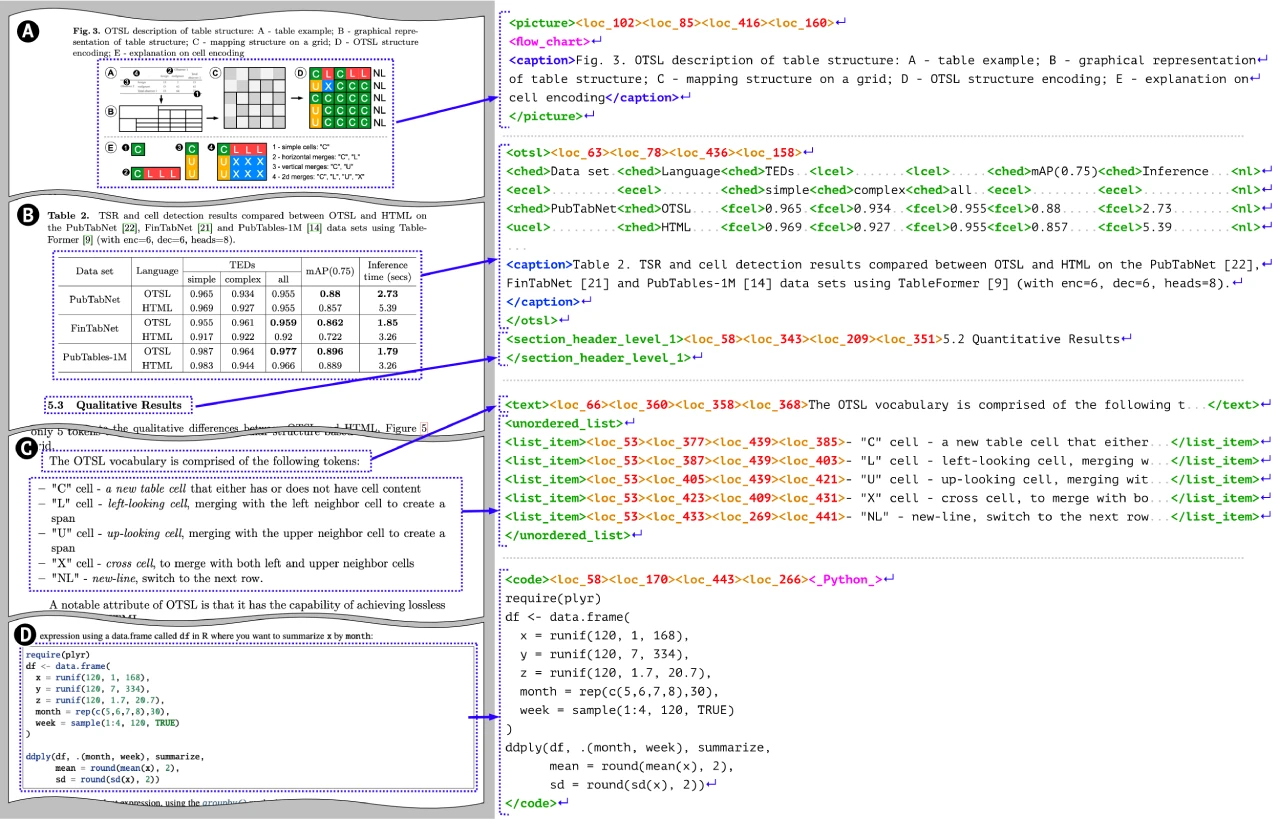
DocTags for Efficient Markup: Introduces DocTags, an efficient and compact document representation fully compatible with DoclingDocuments.
OCR (Optical Character Recognition): Accurately extracts text from images.
Layout and Localization: Preserves document structure and bounding boxes of document elements.
Code Recognition: Detects and formats code blocks, including indentation.
Formula Recognition: Identifies and processes mathematical expressions.
Chart Recognition: Extracts and interprets chart data.
Table Recognition: Supports structured table extraction with column headers and row headers.
Figure Classification: Distinguishes between figures and figure elements.
Caption Correspondence: Links captions to related images and figures.
List Grouping: Correctly organizes and structures list elements.
Full-page Conversion: Processes entire pages, including all elements on the page (code, equations, tables, charts, etc.).
OCR with Bounding Boxes: OCR region recognition using bounding boxes.
General Document Processing: Trained on both scientific and non-scientific documents.
Seamless Docling Integration: Can be imported into Docling and exported in multiple formats (such as HTML, Markdown, etc.).
Fast Inference: Average processing time of 0.35 seconds per page on an A100 GPU.
Model Expansion and Optimization
Support for Multiple Instructions: Supports a variety of instructions, such as converting pages to DocTags, converting charts to tables, converting formulas to LaTeX, and more.
Multilingual Support: Although primarily supporting English, it may be extended to support more languages.
Continuous Improvement: Improved chart recognition, support for multi-page inference, chemical recognition, and more.
SmolDocling Use Cases
Academic Research: Quickly convert academic papers and research reports into structured formats for easy extraction of key information.
Business Document Processing: Automatically convert business contracts, reports, and forms to facilitate document storage, retrieval, and analysis for enterprises.
Technical Document Management: Convert technical manuals, code documentation, and more into editable formats, supporting accurate recognition and formatting of code snippets.
Education Sector: Extract content from textbooks and lecture notes (such as formulas, charts) and convert it into easy-to-understand formats.
Medical Document Processing: Process medical reports and research papers to extract key information and assist in medical decision-making.
Mobile and Low-resource Device Support: Can run on mobile devices or resource-constrained environments.
How to Use SmolDocling
Model Download: SmolDocling can be downloaded from the Hugging Face model repository.
Local Deployment: Due to its small size, it can run on ordinary laptops or mobile devices.
API Calls: SmolDocling can be invoked through API interfaces provided by Hugging Face.
Fine-tuning the Model: Developers can fine-tune the model to adapt to specific scenarios, such as medical report parsing or financial form recognition.
Hugging Face Model Repository:https://huggingface.co/ds4sd/SmolDocling-256M-preview
DEMO:https://huggingface.co/spaces/ds4sd/SmolDocling-256M-Demo









