
 Script Planner Assistant▸
 AI Apps
 AI News
LBM: Efficient Image-to-Image Translation for Relighting, Object Removal, and Inpainting
小编 ·

LBM: Efficient Image-to-Image Translation for Relighting, Object Removal, and Inpainting
What is LBM?
LBM is an image-to-image translation method based on Latent Bridge Matching. It is capable of achieving high-quality image translation in a single inference step, reaching performance comparable to existing state-of-the-art methods. The core idea of this approach is to encode the source image and target image into a latent space and construct a stochastic path between them, estimating the drift via a stochastic differential equation to enable translation from the source distribution to the target distribution.
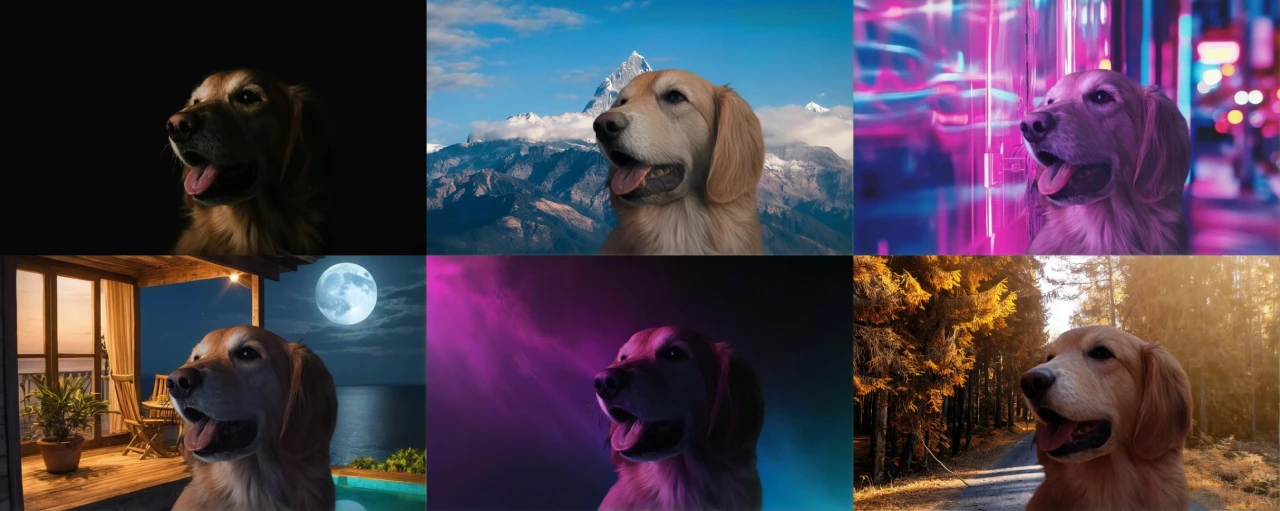
Core Features of the LBM Method
Image-to-image translation: Quickly translates source images into target images with only a single inference step.
Object relighting: Adjusts the lighting of foreground objects based on background illumination to enhance image realism.
Object removal: Removes objects and their shadows from an image while keeping the background natural.
Image restoration: Translates degraded images into high-quality images, repairing damage or noise.
Depth and normal estimation: Converts images into depth maps or normal maps, suitable for tasks such as 3D reconstruction.
Controllable lighting and shadow generation: Generates shadows or adjusts lighting effects based on lighting conditions.
Multi-task versatility: Applicable to a variety of image processing tasks, demonstrating strong adaptability.
Efficient training and inference: Reduces memory usage through optimization strategies, improving training and inference efficiency.
Characteristics of the LBM Method
Efficiency: LBM completes image translation in just a single inference step, significantly improving the feasibility of real-time applications.
Flexibility: The method is applicable to a variety of image translation tasks, including object removal, depth and surface normal estimation, object relighting, and shadow generation.
Scalability: LBM can handle high-resolution images and performs excellently on large-scale datasets.
Applications of the LBM Method
Object removal: LBM can remove specified objects and their shadows from an image while maintaining the naturalness and consistency of the background.
Object relighting: Relights foreground objects based on the background image or lighting conditions, producing realistic lighting effects.
Shadow generation: Generates shadows for objects based on lighting conditions, enhancing image realism.
Image restoration: Translates the distribution of degraded images into that of clear images.
GitHub Repository:https://github.com/gojasper/LBM
Project Page:https://gojasper.github.io/latent-bridge-matching/









