
 Script Planner Assistant▸
 AI Apps
 AI News
How to Implement the Labeling Requirements of the AI-Generated Synthetic Content Regulation
小编 ·

How to Implement the Labeling Requirements of the AI-Generated Synthetic Content Regulation
What is the "Measures for the Labeling of AI-Generated Synthetic Content"?
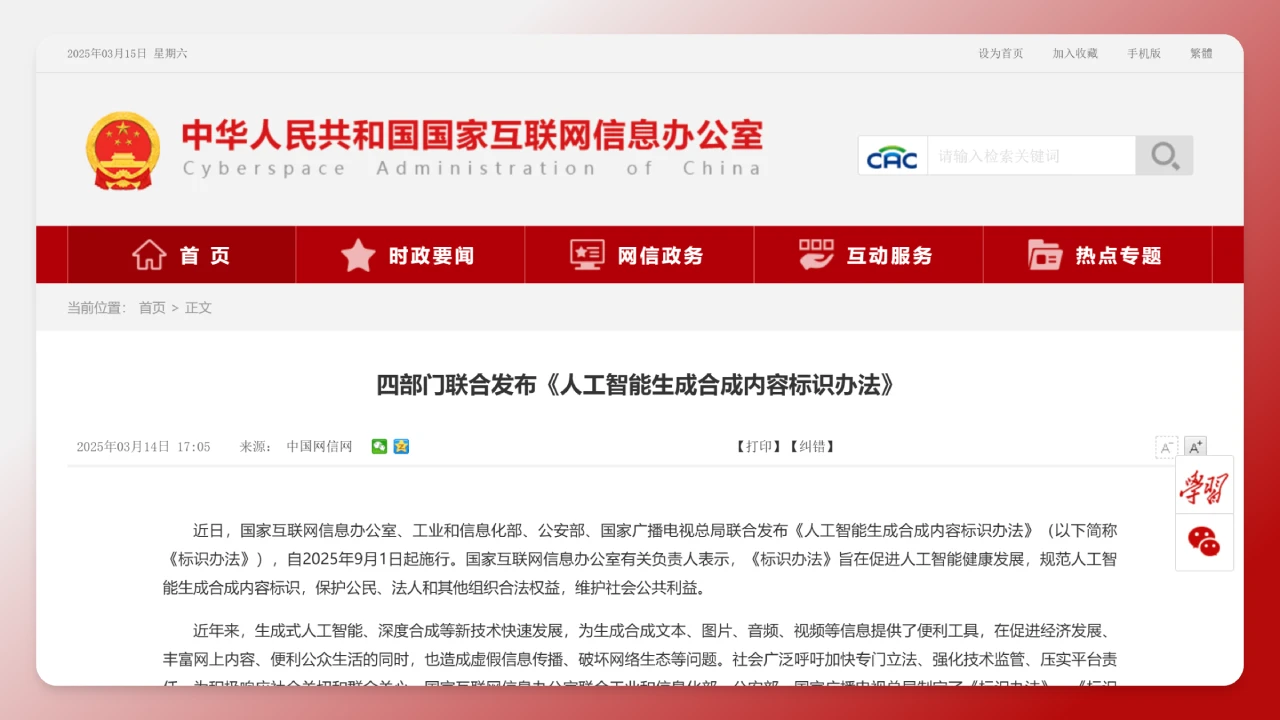
The "Measures for the Labeling of AI-Generated Synthetic Content" were jointly issued by the Cyberspace Administration of China, the Ministry of Industry and Information Technology, the Ministry of Public Security, and the National Radio and Television Administration, and will take effect on September 1, 2025. The measures aim to regulate the labeling of AI-generated synthetic content, protect the legitimate rights and interests of citizens, legal persons, and other organizations, and safeguard social public interests.
How to Label?
Explicit Labeling:
Presented in the generated synthetic content or interactive scenario interface through text, sound, graphics, etc., allowing users to clearly perceive it. For example:
Text content needs to add text prompts or common symbols at the beginning, end, or appropriate positions in the middle;
Audio needs to add voice prompts or audio rhythm cues at the beginning, end, or in the middle;
Images need to add prominent prompt labels at appropriate positions;
Videos need to add prominent prompt labels at the opening frame, around the playback area, or at appropriate positions in the middle.
Implicit Labeling:
Added through technical measures into the file data of generated synthetic content, not easily perceived by users. File metadata needs to include attribute information of the generated synthetic content, the name or code of the service provider, content number, etc., used to record the file's source, attributes, and purposes.
Generated synthetic label: indicates whether the content is generated synthetic content.
Service provider information: includes the name or code of the generated synthetic service provider.
Content number: the unique number assigned by the generated synthetic service provider to the content.
Reserved fields: can be used to record security protection information such as label integrity and content consistency.
Distribution Regulations
Distribution service providers need to verify the implicit labels in file metadata and add prominent prompt labels around the published content.
For content where implicit labels are not verified but the user declares it as generated synthetic content, prompt labels also need to be added.
For suspected generated synthetic content, appropriate measures need to be taken to remind the public.
User Responsibilities
When users use online information content distribution services to publish generated synthetic content, they need to proactively declare and use the labeling function to label it.
No organization or individual may maliciously delete, tamper with, forge, or conceal labels.
Platform Responsibilities
Internet application distribution platforms need to verify the labeling-related materials of AI-generated synthetic services.
Service providers need to clearly specify labeling methods and regulatory content in user service agreements.
Handling of Violations
Violations of these measures will be handled by competent departments such as those for cyberspace, telecommunications, public security, and radio and television in accordance with their respective duties.
In addition, to support the implementation of these measures, the State Administration for Market Regulation and the Standardization Administration of China have issued the mandatory national standard "Cybersecurity Technology - Methods for the Labeling of AI-Generated Synthetic Content," and developed relevant practice guidelines.
The "Measures for the Labeling of AI-Generated Synthetic Content" will take effect on September 1, 2025.
Details: https://www.cac.gov.cn/2025-03/14/c_1743654685899683.htm









