
 Script Planner Assistant▸
 AI Apps
 AI News
VACE: A Unified Model for Video Generation and Editing by Alibaba Tongyi Wan Team
小编 ·

VACE: A Unified Model for Video Generation and Editing by Alibaba Tongyi Wan Team
What is VACE?
VACE (Video Creation and Editing) is a one-stop unified ai video generation and editing model launched by Alibaba Tongyi Lab. It can perform a variety of video creation and editing tasks through a unified model architecture. It can generate videos from a piece of text or an image, and can also perform style transfer, restoration, or extension on existing videos. It integrates multiple functions into a single model, making it easy to operate and suitable for creating creative videos or restoring old videos.
VACE Core Features
Text-to-Video Generation: Generate videos based on text prompts.
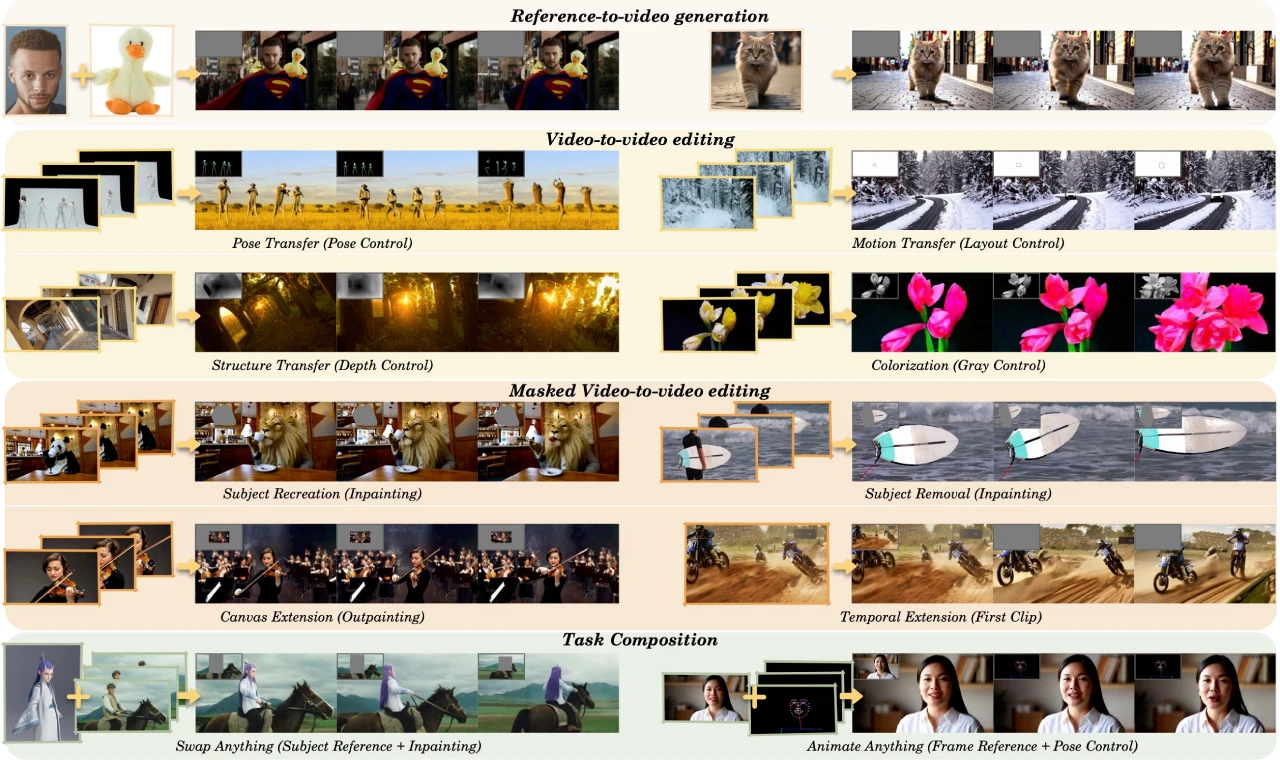
Reference-to-Video Generation: Generate videos by combining text and reference images.
Video Expansion: Generate new openings or endings based on existing video clips.
Video Editing:
Video-to-Video Editing: Perform overall style transfer on input videos (such as colorization and stylization).
Masked Video Editing: Perform editing in specified areas, such as Inpainting and Outpainting.
Subject Removal and Reconstruction: Remove specific subjects from the video and fill in the background.
Task Combination:
Supports flexible combinations of multiple tasks, such as reference generation + subject replacement, pose control + video expansion.
VACE Technical Principles
Video Condition Unit (VCU): Integrates text, image, video, mask, and other multimodal inputs into a unified conditioning unit, supporting flexible combinations of multiple tasks.
Context Adapter Structure: Injects the concepts of different tasks into the model through formalized representations in temporal and spatial dimensions, enabling it to adapt to different task requirements.
Diffusion Model: Built on top of a diffusion model (such as the Diffusion Transformer), it generates high-quality video content through step-by-step denoising.
VACE Advantages
Unified Framework: Integrates video generation and editing tasks into a single model, reducing the complexity of switching between tasks.
High Efficiency: Achieves performance comparable to task-specific models across a variety of tasks.
Diversity: Supports multiple task combinations, providing broader application possibilities for video content creation.
VACE Application Scenarios
Creative Video Generation: Quickly generate creative video content such as advertisements and animations based on text or images.
Video Restoration and Enhancement: Restore old videos, fill in missing parts of the picture, or enhance video styles.
Efficient Video Editing: Perform complex editing tasks such as subject replacement and animation addition.
Video Expansion: Generate new clips for short videos to extend the video content.
Interactive Video Creation: Generate personalized videos based on user input (such as poses or sketches).
Project Resources
Project Website:https://ali-vilab.github.io/VACE-Page/
GitHub Repository:https://github.com/ali-vilab/VACE
Technical Paper:https://arxiv.org/pdf/2503.07598









