
 Script Planner Assistant▸
 AI Apps
 AI News
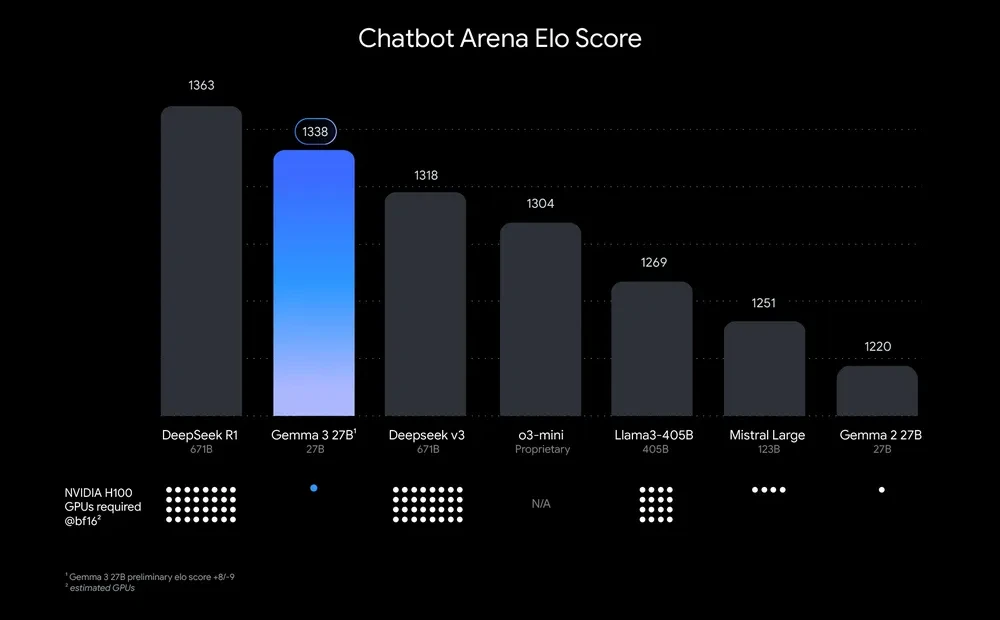
Google Launches Gemma 3: Outperforming DeepSeek V3 and o3-mini, the World's Second-Best Open Model
小编 ·

Google Launches Gemma 3: Outperforming DeepSeek V3 and o3-mini, the World's Second-Best Open Model
What is Gemma 3?
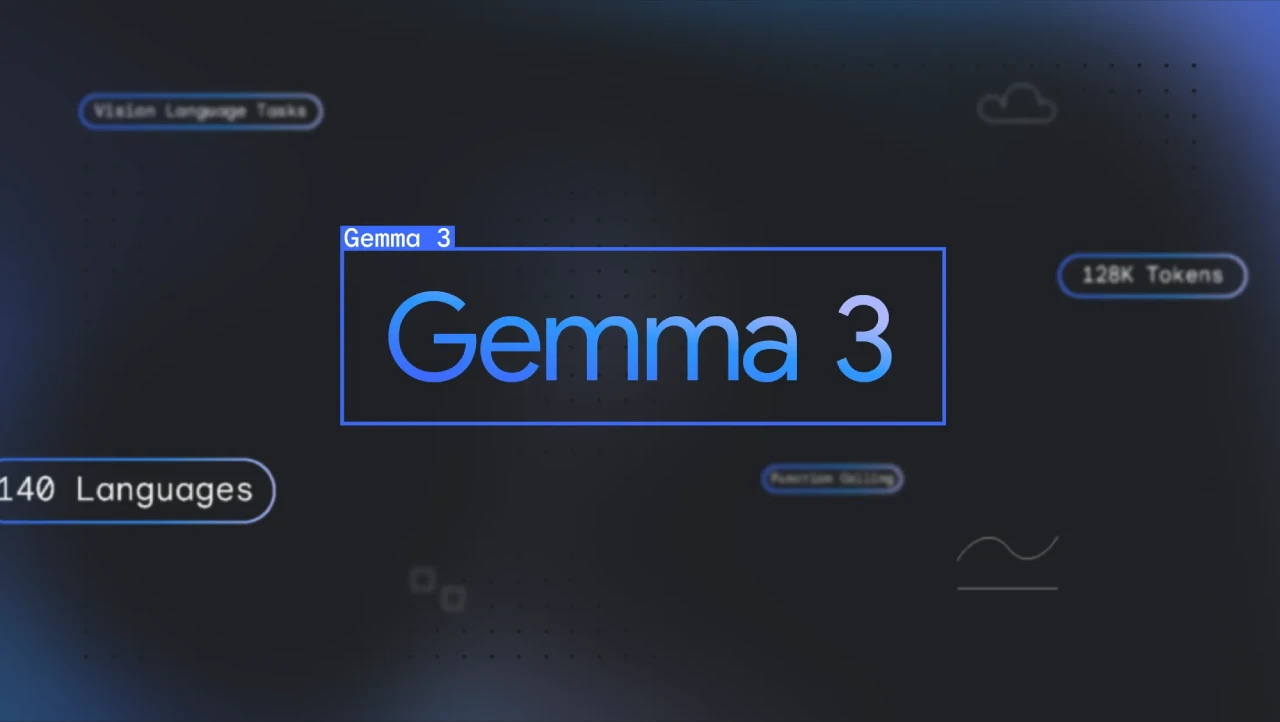
Gemma 3 is Google's latest open-source model, surpassing DeepSeek V3 and o3mini to become the world's second most powerful open-source model. Gemma 3 features powerful multimodal capabilities, able to understand text, images, and short videos, while also being pretrained on over 140 languages with direct support for more than 35 languages. It comes with a 128K token context window, capable of handling large amounts of information, and supports function calling and ai agent development for automating complex tasks. Gemma 3 is available in four different model sizes (1B, 4B, 12B, and 27B) to meet various hardware and performance needs, and can run efficiently on a wide range of devices from phones to computers, supporting broad deployment from mobile devices to workstations.
Gemma 3 Features
Multimodal Capability: Supports mixed input of text, images, and short videos, capable of handling complex multimodal tasks.
Strong Language Support: Pretrained on over 140 languages, with direct support for more than 35 languages.
Large Context Window: Supports a 128k token context window, capable of processing large amounts of information, such as 30 high-resolution images or 1 hour of video.
High Performance: Outperforms other comparable models like Llama, DeepSeek, and OpenAI's o3-mini on a single GPU or TPU.
Optimization and Quantization: Offers official quantized versions that reduce model size and computational requirements while maintaining high accuracy.
Security: Equipped with the ShieldGemma 2 image safety classifier to detect and flag dangerous content.
Characteristics of Gemma 3's Four Model Sizes
1B: Lightweight, suitable for running on resource-constrained devices such as phones or laptops.
4B: Suitable for multimodal tasks, with stronger image and text processing capabilities.
12B: More powerful performance, suitable for complex image and video analysis.
27B: The largest version with the strongest performance, suitable for high-performance computing scenarios.
Gemma 3 Use Cases
Natural Language Processing: Used for chat bots, intelligent assistants, text classification, sentiment analysis, and machine translation.
Image Recognition and Analysis: Supports face recognition, object detection, image Q&A, and image comparison.
Video Analysis: Capable of processing short video content, suitable for video content analysis and generation.
Intelligent Customer Service: Combines multimodal input to provide smarter customer service.
Industrial Quality Inspection: Uses image analysis capabilities to detect product quality issues.
Code Generation and programming Assistance: Supports code generation and automatic code repair.
How to Use Gemma 3
Quick Experimentation: Use Gemma 3 directly in the browser through Google AI Studio, no setup required.
Download and Fine-tune: Download the model from Hugging Face, Ollama, or Kaggle, and fine-tune using Hugging Face Transformers or other tools.
Deployment Options: Supports multiple deployment methods, including Vertex AI, Cloud Run, Google GenAI API, local environments, and NVIDIA GPUs.
Development Tool Support: Compatible with various development tools such as Hugging Face Transformers, Ollama, JAX, Keras, and PyTorch.
Gemma 3 Technology
Underlying Architecture: Based on the same technical architecture as Gemini.
Training and Optimization: Employs techniques such as knowledge distillation, reinforcement learning (including human feedback and machine feedback), and model merging to enhance performance.
Visual Processing: Uses dynamic image cropping techniques combined with frame sampling and optical flow analysis to support high-resolution and non-square images.
Hardware Optimization: Deeply optimized for NVIDIA GPUs and Google Cloud TPUs to ensure efficient operation.
What improvements does Gemma 3 have over Gemma 2?
Multimodal Capability: Adds support for mixed input of text, images, and short videos, capable of handling complex tasks like image Q&A and video analysis.
Performance Improvement: Stronger single GPU performance, with inference speed increased by 47%.
Language Support: Pretrained on over 140 languages, with direct support for 35 languages, providing enhanced language processing capabilities.
Expanded Context Window: Supports 128k tokens, capable of handling larger-scale information.
Visual Processing Capability: Supports high-resolution image and video parsing, with keyframe extraction time for 1-hour video reduced to 20 seconds.
Enhanced Security: Equipped with the ShieldGemma 2 image safety classifier to detect dangerous content.
Hardware Optimization: Deeply optimized for GPUs and TPUs, supporting multiple deployment options.
Training and Fine-tuning: Uses reinforcement learning and other techniques, providing more flexible fine-tuning tools.
Read more:https://blog.google/technology/developers/gemma-3/









