
 Script Planner Assistant▸
 AI Apps
 AI News
R1-Reasoning-RAG: Combining DeepSeek-R1 Reasoning with Tavily Search for Recursive RAG Workflows
小编 ·

R1-Reasoning-RAG: Combining DeepSeek-R1 Reasoning with Tavily Search for Recursive RAG Workflows
What is R1-Reasoning-RAG?
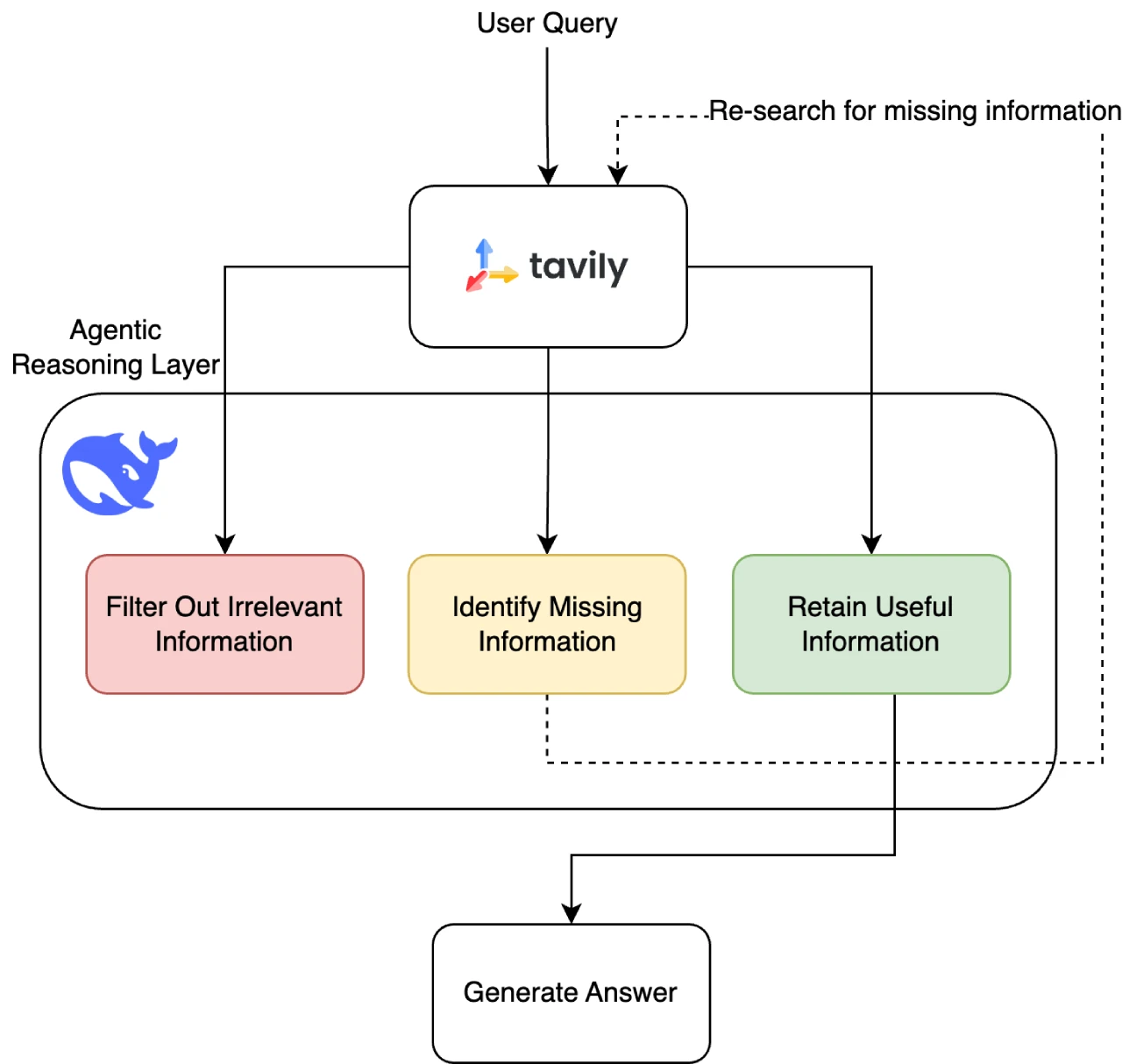
R1-Reasoning-RAG is a framework built on LangGraph that combines the DeepSeek R1 reasoning model with Tavily search to implement a recursive RAG workflow. This framework can intelligently retrieve, filter, and integrate information from a knowledge base to comprehensively answer complex questions.
Core Features of R1-Reasoning-RAG
Combination of Deep Reasoning and Knowledge Retrieval: DeepSeek R1 has strong reasoning capabilities. It uses chain-of-thought to process queries and retrieved information, enabling more accurate and contextually relevant answers. Meanwhile, the RAG framework can pull the latest data from external knowledge bases, ensuring both accuracy and timeliness.
Recursive RAG: This framework supports a recursive RAG process. When faced with complex questions, the model can retrieve and filter information multiple times, gradually building up a complete answer.
No Additional Reranking Step Required: During reasoning, DeepSeek R1 can directly score and prioritize the retrieved information, eliminating the need for an additional reranking operation.
Efficient Knowledge Base Construction: When building the knowledge base, documents need to be chunked, with their semantics represented as embeddings, and these embedding vectors stored in an efficient vector database, such as FaiSS or ChromaDB.
Application Scenarios for R1-Reasoning-RAG
Complex Question Answering: It can be used in scenarios that require deep reasoning and synthesis of multi-source information, such as legal document retrieval, acting as a research assistant, and providing complex decision support.
Agent Systems: It is very helpful for agent systems that require reasoning and evaluation steps, enhancing their decision-making capabilities when handling complex tasks.
Tech Stack and Open Source
Open Source Implementation: The code for R1-Reasoning-RAG has been open-sourced. It is built on LangChain and includes three scripts: LLM, Prompts, and Agent.
Tech Stack: It uses open-source tools like FAISS and Hugging Face models, enabling fast inference and efficient deployment.
Advantages of R1-Reasoning-RAG
Precise Reasoning: The reasoning capabilities of DeepSeek R1 allow the RAG framework to handle complex questions with both accuracy and depth.
Efficient Performance: The optimized retrieval and reasoning process reduces the time needed to generate answers and lowers computational costs.
R1-Reasoning-RAG combines the reasoning capabilities of DeepSeek R1 with the retrieval capabilities of RAG, delivering both efficiency and precision when answering complex questions. It holds significant application potential in fields such as law, scientific research, and intelligent agents.
GitHub Repository:https://github.com/deansaco/r1-reasoning-rag









