
 Script Planner Assistant▸
 AI Apps
 AI News
ViDoRAG: A Retrieval-Augmented Generation (RAG) System for Visual Document Understanding
小编 ·

ViDoRAG: A Retrieval-Augmented Generation (RAG) System for Visual Document Understanding
What is ViDoRAG?
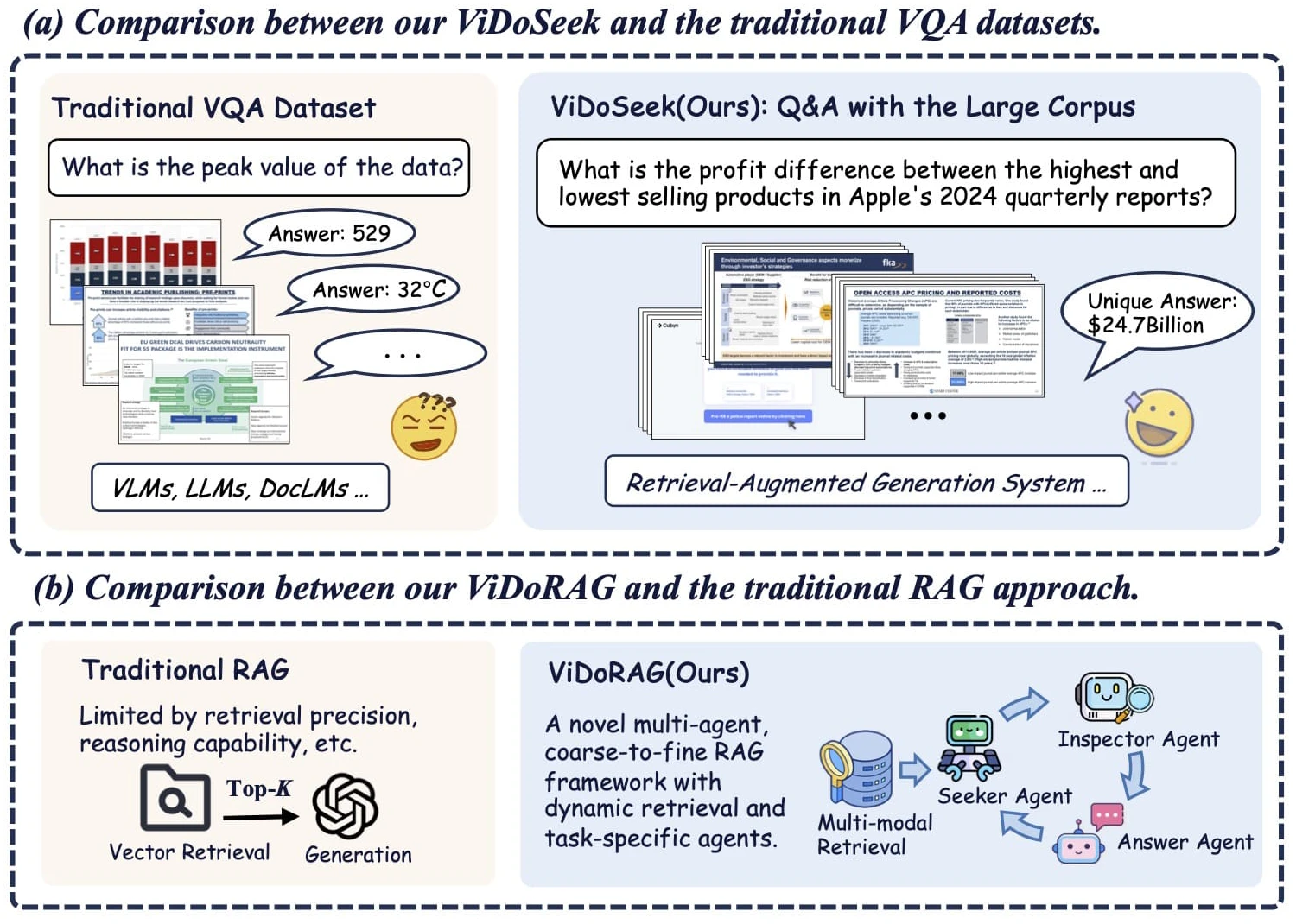
ViDoRAG is a visual document understanding Retrieval-Augmented Generation (RAG) system jointly released by Alibaba's Tongyi Lab, the University of Science and Technology of China, and Shanghai Jiao Tong University. It leverages multimodal hybrid retrieval and a multi-agent iterative reasoning mechanism, significantly improving both the accuracy and efficiency of visual document processing. In plain language, it supports retrieval from image-based documents, allowing you to find information among a bunch of image-containing documents, such as "what color is this product" or "what does this article talk about?".
ViDoRAG Framework
The ViDoRAG framework focuses on multi-agent collaboration and dynamic iterative reasoning, with the following key components:
Multimodal Hybrid Retrieval: Combines visual and textual features, and uses a Gaussian Mixture Model (GMM) to dynamically adjust the retrieval strategy for more accurate identification of key information.
Multi-Agent Collaboration:
Seeker Agent: Quickly filters out relevant images or document snippets to provide global clues.
Inspector Agent: Performs detailed inspection on the filtered results and generates preliminary answers.
Answer Agent: Integrates the preliminary answers, checks their accuracy and consistency, and generates the final answer.
Dynamic Retrieval Strategy: Uses GMM to dynamically adjust the number of retrieval results, reducing computation and improving retrieval efficiency.
Features
1. Multimodal Hybrid Retrieval:
Dual-Channel Visual and Textual Retrieval: ViDoRAG can simultaneously process visual (image) and textual information for retrieval, enabling a more comprehensive understanding of document content.
Gaussian Mixture Model (GMM) Fusion: Uses GMM to dynamically adjust the weights of visual and textual retrieval results, selecting the optimal retrieval strategy based on query characteristics, reducing noise and computation.
2. Multi-Agent Collaborative Reasoning:
Seeker Agent: Quickly filters relevant documents or image snippets to narrow down the search scope.
Inspector Agent: Performs detailed inspection on the filtered snippets, extracts key information, and generates preliminary answers.
Answer Agent: Integrates the preliminary answers and verifies them to generate the final answer.
Dynamic Iterative Reasoning: Multiple agents continuously collaborate and iterate, making the answers progressively better.
3. Dynamic Retrieval Strategy:
Adaptive Retrieval Quantity: ViDoRAG uses GMM to dynamically adjust the number of retrieval results, avoiding the issues caused by fixed-quantity retrieval.
Efficient Retrieval Workflow: Automatically optimizes the retrieval strategy based on the similarity distribution between queries and the document collection, improving retrieval efficiency.
4. Complex Document Understanding Capability:
Support for Visually Rich Documents: Can process documents containing text, charts, tables, and complex layouts.
Multi-Hop Reasoning Capability: Can handle both single-hop and multi-hop reasoning tasks, addressing complex queries that require cross-document understanding.
5. High Accuracy and Performance:
High Accuracy: Achieves an accuracy of 79.4% on the ViDoSeek benchmark dataset, significantly outperforming other baseline methods.
Robustness: Multi-agent collaboration and dynamic retrieval strategies enable ViDoRAG to perform stably when handling noisy data and complex scenarios.
Application Scenarios
Visual Document Processing: Suitable for scenarios involving visually rich documents such as academic papers, reports, and manuals.
Question Answering Systems: Can serve as a core module in QA systems to answer questions quickly and accurately.
Smart Office: Helps users quickly extract key information from documents and improve work efficiency.
GitHub Repository: https://github.com/Alibaba-NLP/ViDoRAG









