
 Script Planner Assistant▸
 AI Apps
 AI News
UniTok: ByteDance's Open-Source Visual Tokenizer for Generation and Understanding Tasks
小编 ·

UniTok: ByteDance's Open-Source Visual Tokenizer for Generation and Understanding Tasks
What is UniTok?
UniTok is an open-source visual tokenizer by ByteDance designed for both generation and understanding tasks. It efficiently converts visual information into tokens and is suitable for a variety of autoregressive generation models and multimodal understanding models. Through innovative visual tokenization techniques, it achieves high-quality visual content generation—such as reconstruction of images and videos—using an extremely low number of tokens (e.g., 256 tokens).
Core Features of UniTok
Efficient Visual Encoding: UniTok can decompose complex visual information (such as images and videos) into discrete tokens, making it easier for models to process.
Multimodal Support: It applies not only to images but also to video content, supporting both continuous and discrete tokenization.
Low Resource Requirements: UniTok maintains high reconstruction quality even with a low number of tokens—for example, the reconstruction error at 256 tokens is only 0.39.
Flexible Compression Ratio: Users can adjust the number of tokens based on their needs to balance generation quality and computational efficiency.
Application Areas of UniTok
Visual Generation Tasks: Such as image and video reconstruction, and language-model-driven visual synthesis.
Multimodal Understanding: Combining textual and visual information to enable more efficient training of multimodal models.
Diffusion Models: Integrated with diffusion models such as DiT and Latte to generate high-quality visual content.
Technical Implementation of UniTok
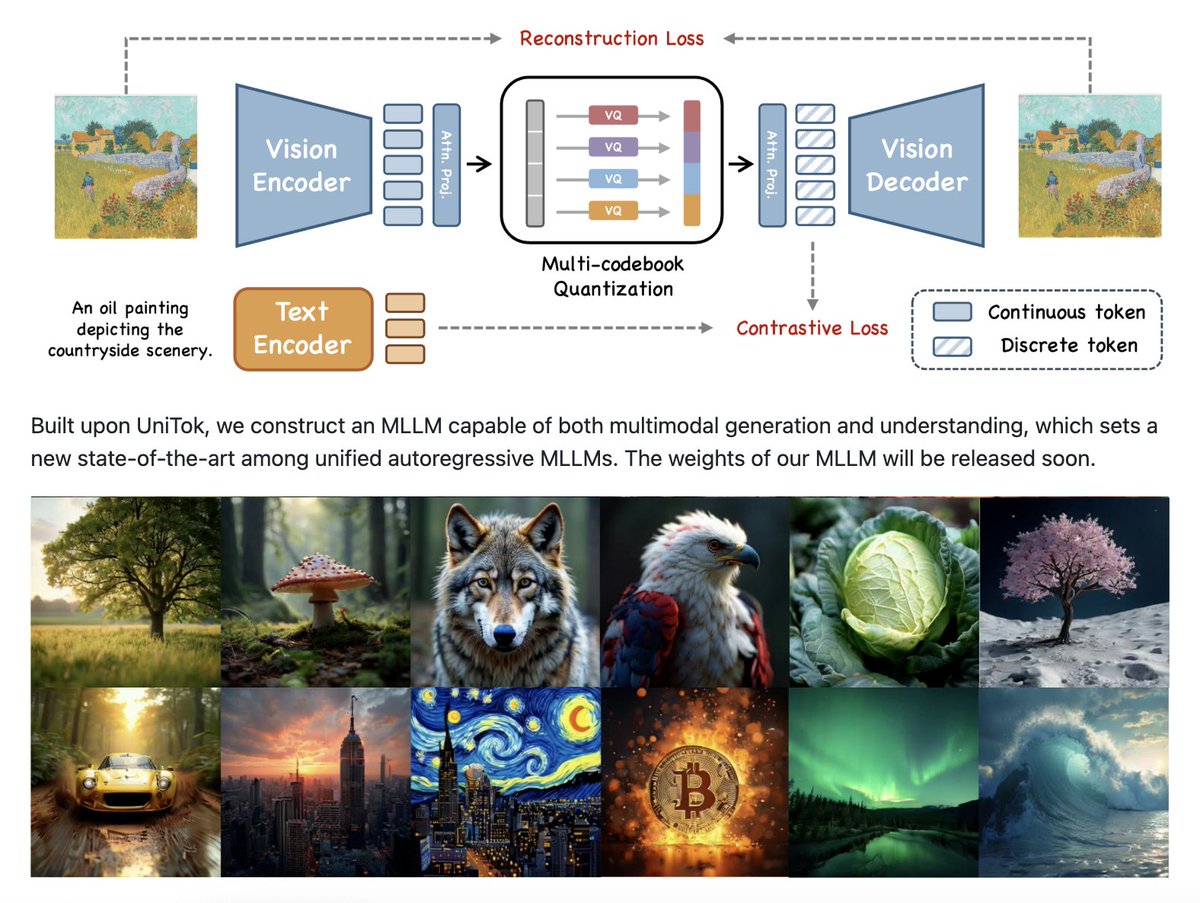
UniTok is built upon VQVAE (Variational Quantized Autoencoder) and VAE (Variational Autoencoder) technologies, achieving efficient visual encoding through a two-stage training process. Its training process includes:
Single-resolution Image Training: Image training performed at a fixed resolution.
Joint Multi-resolution Image-Video Training: Joint training of images and videos across multiple resolutions.
VAE Fine-tuning: Fine-tuning the VQVAE model with KL loss to obtain the VAE model.
Advantages of UniTok
Single Model and Weights: UniTok handles image and video tokenization with a single model and set of weights, simplifying model management and deployment.
High Adaptability: Supports high-resolution inputs and long videos, adapting to a wide range of application scenarios.
Strong Compatibility: Compatible with language models and diffusion models, enabling diverse visual generation.
By leveraging multi-codebook quantization techniques, UniTok addresses the bottlenecks of traditional tokenizers in generation and understanding tasks, providing a more efficient solution for multimodal large language models (MLLMs).
Project Page: https://foundationvision.github.io/UniTok/
GitHub Repository: https://github.com/FoundationVision/UniTok









