
 Script Planner Assistant▸
 AI Apps
 AI News
Mercury: The First Commercial-Grade Diffusion Large Language Model (dLLM)
小编 ·

Mercury: The First Commercial-Grade Diffusion Large Language Model (dLLM)
What is Mercury?
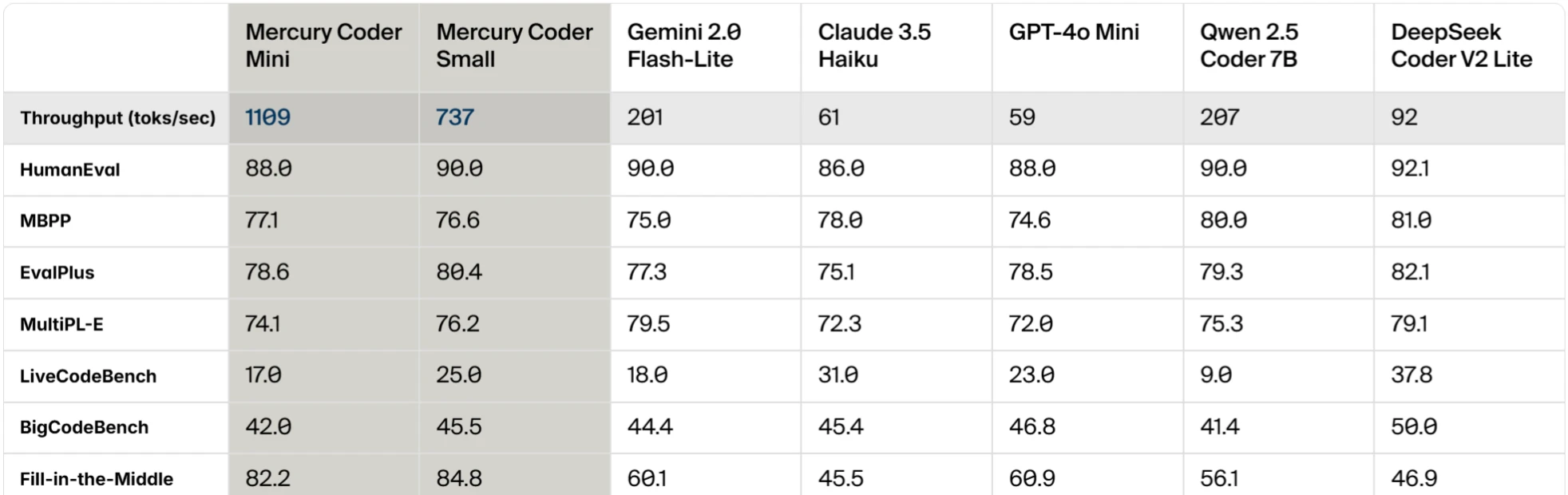
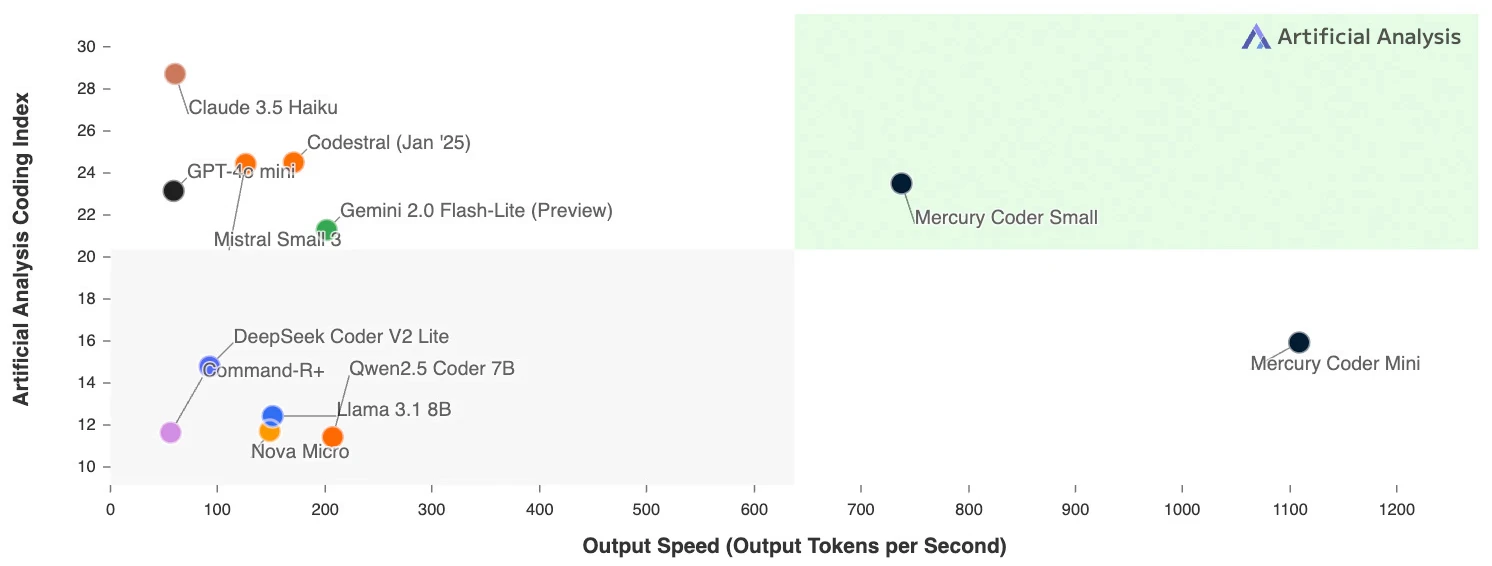
Mercury is the first commercial-grade diffusion large language model (dLLM) launched by the startup Inception Labs. In the Copilot Arena benchmark, Mercury Coder's speed surpasses many existing models including GPT-4o Mini and Claude 3.5 Haiku. In practical applications, Mercury Coder is able to generate high-quality code at extremely high speed.
Technical Principles
Diffusion Model: Mercury adopts diffusion model technology, which differs from traditional autoregressive models. It uses a "coarse-to-fine" generation process, starting from pure noise and gradually generating meaningful text through multiple denoising steps.
Parallel Generation: Leveraging GPU's parallel generation mechanism, Mercury is able to modify multiple tokens simultaneously when generating text, thereby significantly improving generation speed and efficiency.
Innovations
Speed Advantage: Mercury can run at over 1000 tokens per second on NVIDIA H100, 5 to 10 times faster than existing speed-optimized LLMs.
Cost Efficiency: Through a new language generation approach, Mercury reduces inference costs by 10 times while maintaining performance comparable to frontier models.
Error Correction Capability: The characteristics of diffusion models enable Mercury to continuously improve outputs during generation, correcting errors and hallucinations.
Mercury Features
Diffusion Model Technology: Mercury adopts a diffusion model, using a "coarse-to-fine" generation process, starting from pure noise and gradually generating meaningful text.
Parallel Generation: Leveraging GPU's parallel generation mechanism, Mercury is able to modify multiple tokens simultaneously when generating text, significantly improving generation speed and efficiency.
Speed Advantage: It can run at over 1000 tokens per second on NVIDIA H100, 5 to 10 times faster than existing speed-optimized LLMs.
Cost Efficiency: Through a new language generation approach, Mercury reduces inference costs by 10 times while maintaining performance comparable to frontier models.
Error Correction Capability: The characteristics of diffusion models enable Mercury to continuously improve outputs during generation, correcting errors and hallucinations.
Mercury Applications
Programming and Code Generation: Mercury Coder is specifically optimized for code generation, performing excellently on standard coding benchmarks, with speeds over 10 times faster than traditional models.
Agent Applications: Mercury's high speed and efficiency make it perform excellently in applications requiring extensive planning and long-form generation, such as intelligent customer service and code assistants.
Edge Applications: Due to its high efficiency, Mercury also performs excellently in resource-constrained environments, such as applications on phones or laptops.
Advanced Reasoning: Mercury can leverage error correction to fix hallucinations and improve answer quality, suitable for tasks requiring deep reasoning.
Controllable Generation: Mercury can edit output content and generate words in any order, suitable for scenarios requiring flexible content generation.
How to Use Mercury?
Installation and Configuration: Mercury Coder is now live and available for public trial. Users can experience its features through the playground provided by Inception Labs, or use it for enterprise-level applications through APIs and on-premise deployment services.
Experience and Testing: Users can experience the powerful capabilities of Mercury Coder on Inception Labs' official website by entering code requirements and instantly generating high-quality code.
Online Experience:https://chat.inceptionlabs.ai/
Official Introduction:https://www.inceptionlabs.ai/news









