
 Script Planner Assistant▸
 AI Apps
 AI News
The Ultimate LLM Training Guide: Training Large Language Models on Massive GPU Clusters (Chinese Edition)
小编 ·

The Ultimate LLM Training Guide: Training Large Language Models on Massive GPU Clusters (Chinese Edition)
Hugging Face has released the Ultra-Scale Playbook guide, with the Chinese title "LLM Ultimate Training Guide: Training Large Language Models on Large-Scale GPU Clusters". It starts from the basics and provides direction for users seeking to scale training of large language models (LLMs) on large-scale GPU clusters. This guide offers comprehensive instructions for training on clusters ranging from 1 to over 1000 GPUs, and also presents scaling experiment results on up to 512 GPUs, providing a detailed analysis of metrics such as throughput and GPU utilization.
Original title: The Ultra-Scale Playbook: Training LLMs on GPU Clusters
Translation tools: o1, o3-mini
Proofreader: @Ki_Seki_here
URL for the Chinese version of the LLM Ultimate Training Guide:https://huggingface.co/spaces/Ki-Seki/ultrascale-playbook-zh-cn
Still being proofread...

Background of the Research
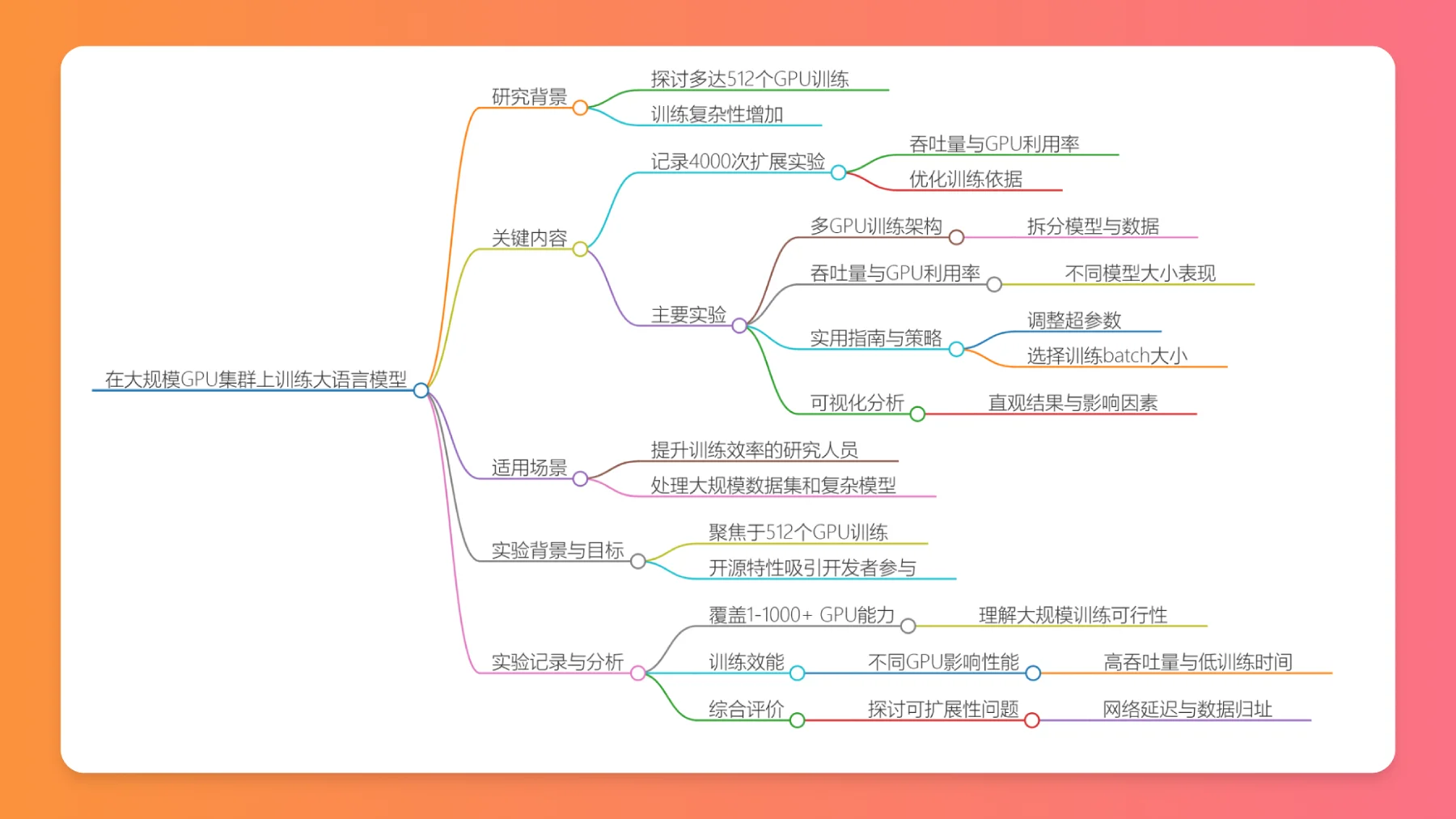
As language models continue to scale up, the demand for compute resources during training grows, and the strategies become increasingly complex. Therefore, this document primarily focuses on how to carry out large-scale language model (LLM) training on clusters with up to 512 GPUs.

Key Content
Massive Experiment Records
The document meticulously records 4,000 scaling experiments. In these experiments, throughput (marker size) and GPU utilization (marker color) serve as the core measurement indicators. These data provide reliable support for optimizing the training process.
Main Experiment Content
Multi-GPU training architecture: The adopted architecture can effectively split both models and data, allowing multiple GPUs to process related tasks in parallel, providing the architectural foundation for efficient training.
Throughput and GPU utilization: Through actual experimental data analysis, performance varies across different model sizes. Such analysis helps developers understand how to maximize resource utilization and find a training approach that suits their needs.
Practical guides and strategies: The document summarizes practical training strategies, such as how to tune hyperparameters and select an appropriate training batch size—these are all important factors for achieving optimal performance.
Visualization analysis: The document contains a wealth of visualization results. These results make it easy for users to intuitively understand the outcomes of the scaling experiments and the underlying influencing factors, making complex experimental results easier to interpret.
Target Audience
This guide is especially suited for researchers and engineers who want to improve the efficiency of LLM training, particularly when they are dealing with large-scale datasets and complex models.
Considerations Related to the Experiments
Document Features and Goals
This document goes beyond merely explaining how to train on 512 GPUs; it also emphasizes its open-source nature. This enables more developers to participate and apply these training methods.
Scope of Experiment Records
The experiment records span scaling capabilities from 1 GPU all the way to over 1000 GPUs. This forms a comprehensive framework that helps people understand whether training LLMs on large-scale clusters is feasible and how efficient it can be.
Analysis of Training Effectiveness
When observing the impact of different GPU counts on training performance, the authors found that some models can achieve higher throughput and lower training time during scaling. This finding can provide developers with more targeted recommendations when choosing GPU counts and configurations.
Comprehensive Considerations
Beyond focusing on performance metrics, these experiments also delve into scalability issues in practical applications. At the same time, they explore some challenges that may be encountered in real-world environments, such as complex factors like network latency and data sharding—these are aspects that cannot be ignored when conducting large-scale training.









