
 Script Planner Assistant▸
 AI Apps
 AI News
DeepSeek Usage Guide: Basic Commands, Advanced Tips, and Real-World Examples
小编 ·

DeepSeek Usage Guide: Basic Commands, Advanced Tips, and Real-World Examples
Regarding the recently popular DeepSeek, we've put together some tutorials and guides about DeepSeek to share with everyone. We will walk you through four sections—from the ground up—getting to know DeepSeek, how to use DeepSeek, the basic usage of DeepSeek, and a guide to DeepSeek prompting—so that you can quickly master DeepSeek's foundational operations, advanced techniques, and real-world applications. Whether you are a developer or a researcher focused on algorithm optimization, we hope you'll find the key to boosting your efficiency in this guide.
1. Getting to Know DeepSeek
What is DeepSeek?
DeepSeek (深度求索) is a tech company focused on fundamental artificial intelligence technology research. It is dedicated to exploring the path toward AGI (Artificial General Intelligence), concentrating on the R&D and application of large models, and providing efficient, secure, and controllable AI technology solutions.
Company Background
Founded: 2023
Headquarters: Hangzhou, China
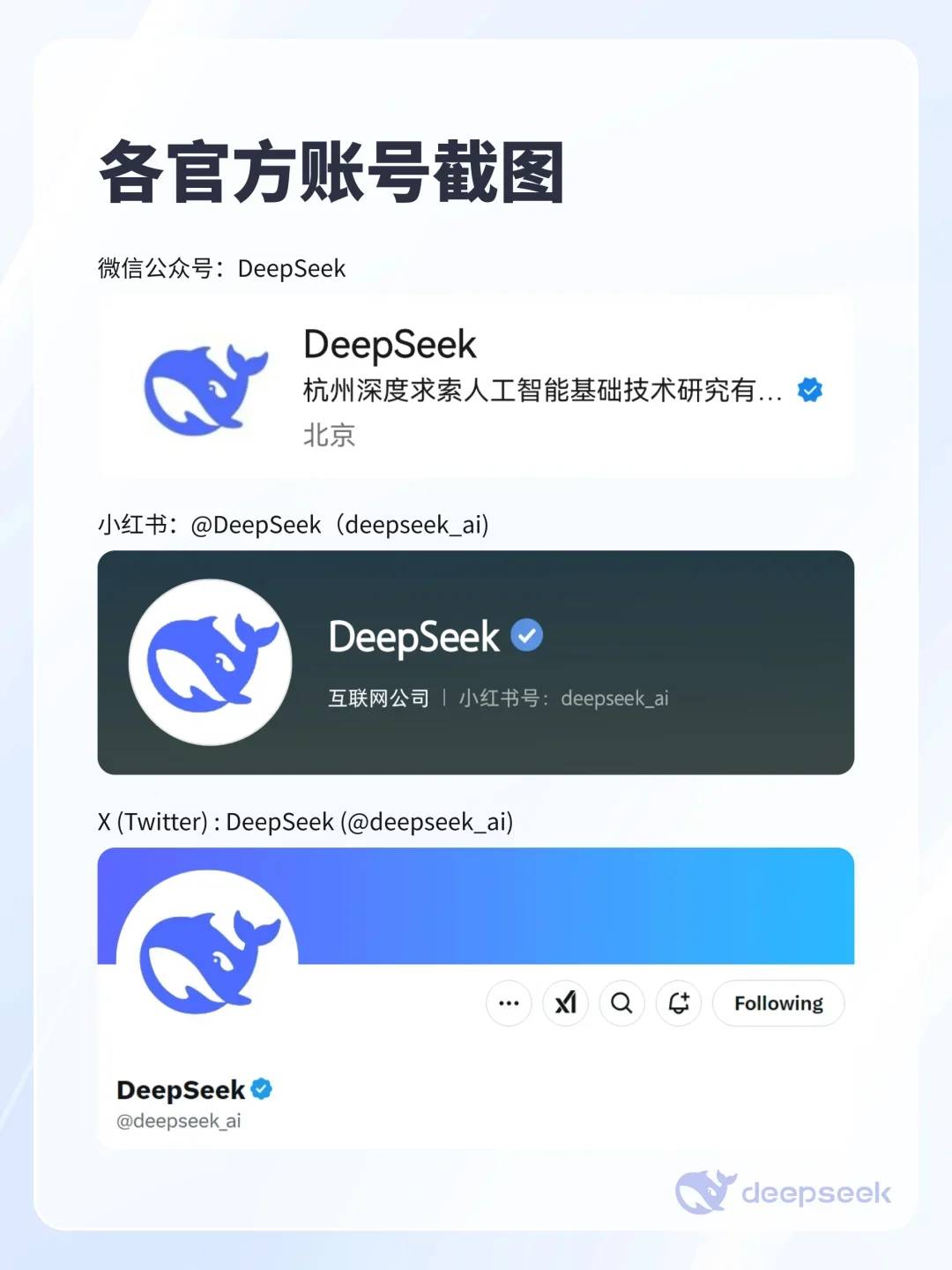
WeChat Official Account: DeepSeek
Xiaohongshu: @DeepSeek (deepseek_ai)
X (Twitter) : DeepSeek (@deepseek_ai)
What Can DeepSeek Do?
Directly serving end users or supporting developers, it offers application scenarios such as intelligent conversations, text generation, semantic understanding, computational reasoning, and code generation/completion. It supports web search and deep thinking modes, as well as file uploads, and can scan and read text content from various files and images to provide answers.
2. How to Use DeepSeek
1. Official Platforms
Web version: chat.deepseek.com
App: Android and iOS versions are both available. Go to your phone's app store, search, and install it. Be sure to use the official app—see the image below:
2. Third-Party Platforms (To address the issue of busy official servers)
The DeepSeek official platform currently has heavy traffic and has even been attacked, making it quite unstable. We've put together a few third-party platforms for you. They connect to the full-version DeepSeek model, and the results are basically the same as the official one.
Benefits of local deployment: no lag and no "server busy" errors.
Local deployment has high hardware requirements. To deploy a high-performance large model—or one aligned with the official platform's offering—your computer must have a discrete graphics card with at least 128GB of RAM. Such a computer typically costs upwards of 15,000 RMB, and the full-version requirement is even higher. We don't recommend following the trend to set this up—just stick with a third-party platform to achieve the same results.
3. Basic Usage of DeepSeek
Before using it, you should know that DeepSeek is a text-based large model. It currently only supports the creation and output of textual content and does not support AI image generation. If you need AI image generation, you can use Janus-Pro, which is also from DeepSeek.
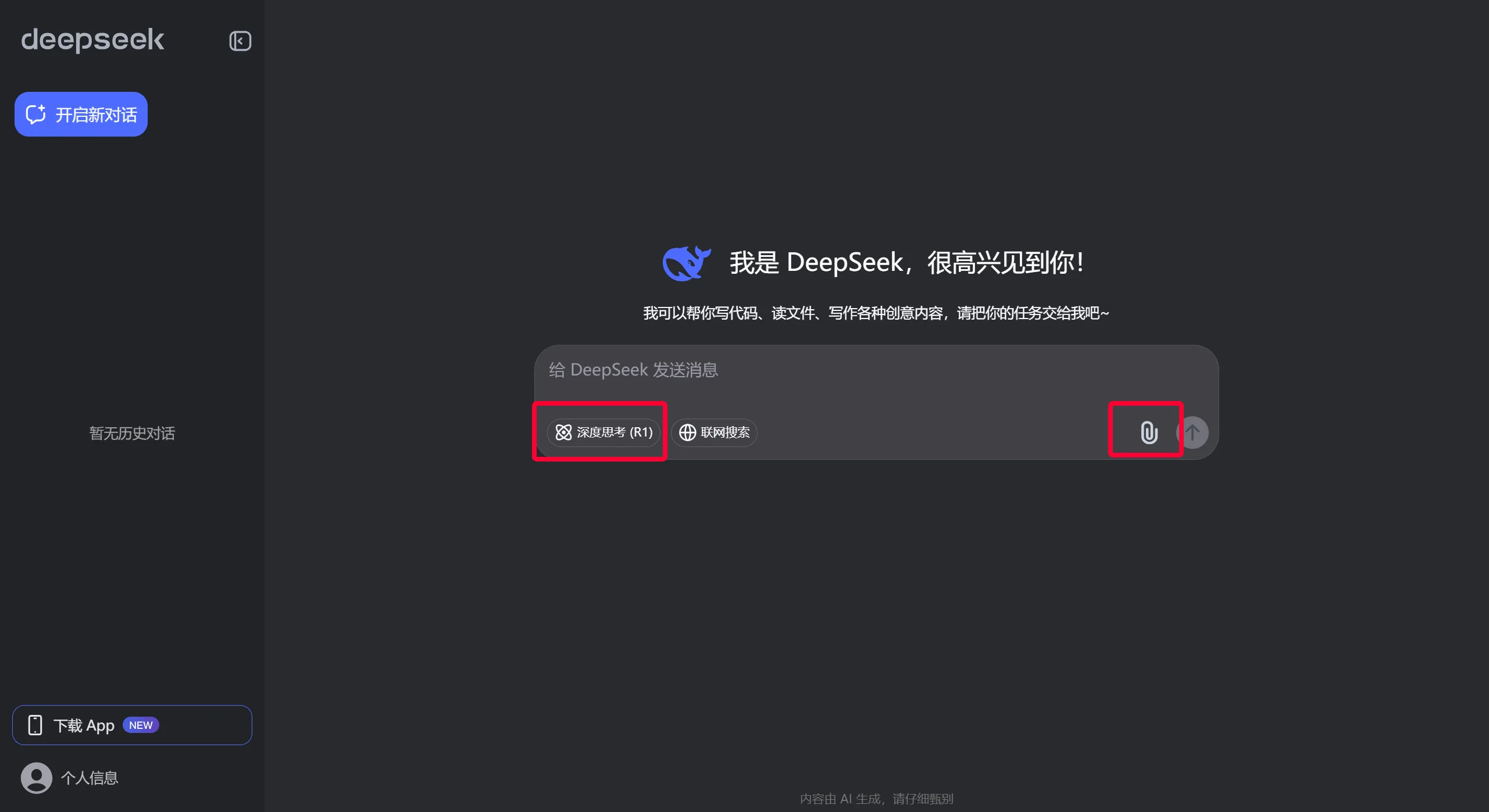
Using DeepSeek is very simple. Just click "New Chat" in the left navigation to get started.
By default, conversations use the DeepSeek-V3 model. Click "DeepThink" to switch to the DeepSeek-R1 model. To learn about the differences between the V3 and R1 models, click here.
The web search feature allows DeepSeek to query information online in real time.
You can upload documents, up to 50 at a time. After uploading, you can ask questions, such as asking it to summarize the document.
It supports uploading images, but it does not actually understand the image's content—it only performs basic OCR (text recognition) on images.
4. DeepSeek Prompting Guide
At its core, DeepSeek is a reasoning-based large model. Unlike instruction-based models, it doesn't require users to provide detailed step-by-step instructions—instead, it provides answers by understanding the user's actual needs and context.
1. Prompt Usage Steps:
Clarify the scenario and task
Choose the model type (V3 or R1)
Write the prompt
| Scenario/Task | Usage Scenarios & Tips |
|---|---|
| Reasoning Model |
|
| Base Model |
|
Below is a structured tutorial for DeepSeek's prompt system, covering basic operations, advanced techniques, and real-world examples.
2. Basic Prompt Templates
(1) If you're unsure how to express what you need, you can directly apply the following prompt template:
[Role] As a ____ expert
[Task] Need to complete ____
[Requirements] Output format should be ____, including ____ elements
[Additional Info] Relevant background: ____, constraints: ____
Example:
As a nutrition consultant, I need to design a one-week meal plan for a diabetic patient.
Requirements: output in table format, including calorie counts for breakfast/lunch/dinner.
Relevant background: the patient is 65 years old
Constraints: daily total calories <1800 kcal
(2) Format Control Syntax
Enforced structure: Use ``` to wrap format requirements
Placeholder markers: use {{}} to mark content that needs to be filled in
Priority symbols: > indicates a key requirement, ! indicates a prohibited item
> Output JSON format:
{
  "plot": "{{story outline}}",
  "characters": ["{{character 1}}", "{{character 2}}"],
  "!note": "avoid violent scenes"
}
3. Advanced Techniques
(1) Chain-of-thought prompting
Step-by-step marking method: Please think step by step: 1. Problem analysis → 2. Solution design → 3. Risk assessment
Socratic questioning: Before reaching the final conclusion, please first list three possible cognitive biases
(2) Knowledge base invocation
Domain-specific instruction: Based on the 2023 edition of the Chinese Pharmacopoeia, explain the incompatibility of cephalosporin drugs
Literature citation pattern: Referencing a paper published in Nature in 2022, explain the latest breakthroughs in CRISPR-Cas9
(3) Multimodal output
# Code generation example
'''Use Python to generate a COVID-19 transmission trend animation, requirements:
1. Use matplotlib for dynamic visualization
2. Integrate WHO data from 2020-2023
3. Add an exponential growth curve for comparison'''
(4) Iterative optimization
First-round generation: obtain the basic content
Feature enhancement: please strengthen the technical detail description in the third paragraph
Style adjustment: switch to the tone of an academic conference report, and add a conclusion section
Final verification: check the consistency of the timeline, and list possible factual errors
| Task type | Applicable model | Prompt focus | Example (effective prompt) | Prompt strategies to avoid |
|---|---|---|---|---|
| Mathematical proof | Reasoning model | Ask directly, no step-by-step guidance needed | "Prove the Pythagorean theorem" | Redundant breakdown (e.g., "first draw a diagram, then list the formula") |
| Mathematical proof | General model | Explicitly require step-by-step thinking, provide examples | "Please derive the Pythagorean theorem in three steps, reference: 1. Draw a right triangle..." | Asking directly (easily skips key steps) |
| Creative writing | Reasoning model | Encourage divergent thinking, set a role/style | "Write an adventure story in the style of Hemingway" | Over-constraining logic (e.g., "list in chronological order") |
| Creative writing | General model | Clearly constrained goals are needed to avoid free-form creation | "Write a short story containing 'quantum' and 'desert', no more than 200 words" | Open-ended instructions (e.g., "freely create") |
| Code generation | Reasoning model | Concise requirements, trust the model's logic | "Implement quicksort in Python" | Step-by-step guidance (e.g., "first write the recursive function") |
4. Industry Practical Cases
(1) Technical development scenario
As a full-stack development engineer, you need to design an e-commerce system with a microservices architecture. Requirements:
1. Draw an architecture diagram (mermaid syntax)
2. List a comparison table of technology choices for each module
3. Provide a containerized deployment plan
Constraints: budget limited to 20 cloud servers, support required for tens of thousands of QPS
(2) Business analysis scenario
Act as a McKinsey analyst and conduct a market entry strategy analysis for a new energy vehicle company. Required:
1. PESTEL model framework
2. Porter's Five Forces competitive analysis
3. Data visualization (in chart form)
Focus: Southeast Asian market, time range 2024-2026
Through the basic usage tutorial and instruction guide above, you should now have a fundamental understanding of DeepSeek. Next, you can practice using more instructions and master more DeepSeek prompt techniques to fully unleash DeepSeek's potential and boost your own work efficiency.









