
 Script Planner Assistant▸
 AI Apps
 AI News
OpenAI Announces GPT-4.5 (Codename Orion) Coming Soon; GPT-5 in Coming Months
小编 ·

OpenAI Announces GPT-4.5 (Codename Orion) Coming Soon; GPT-5 in Coming Months
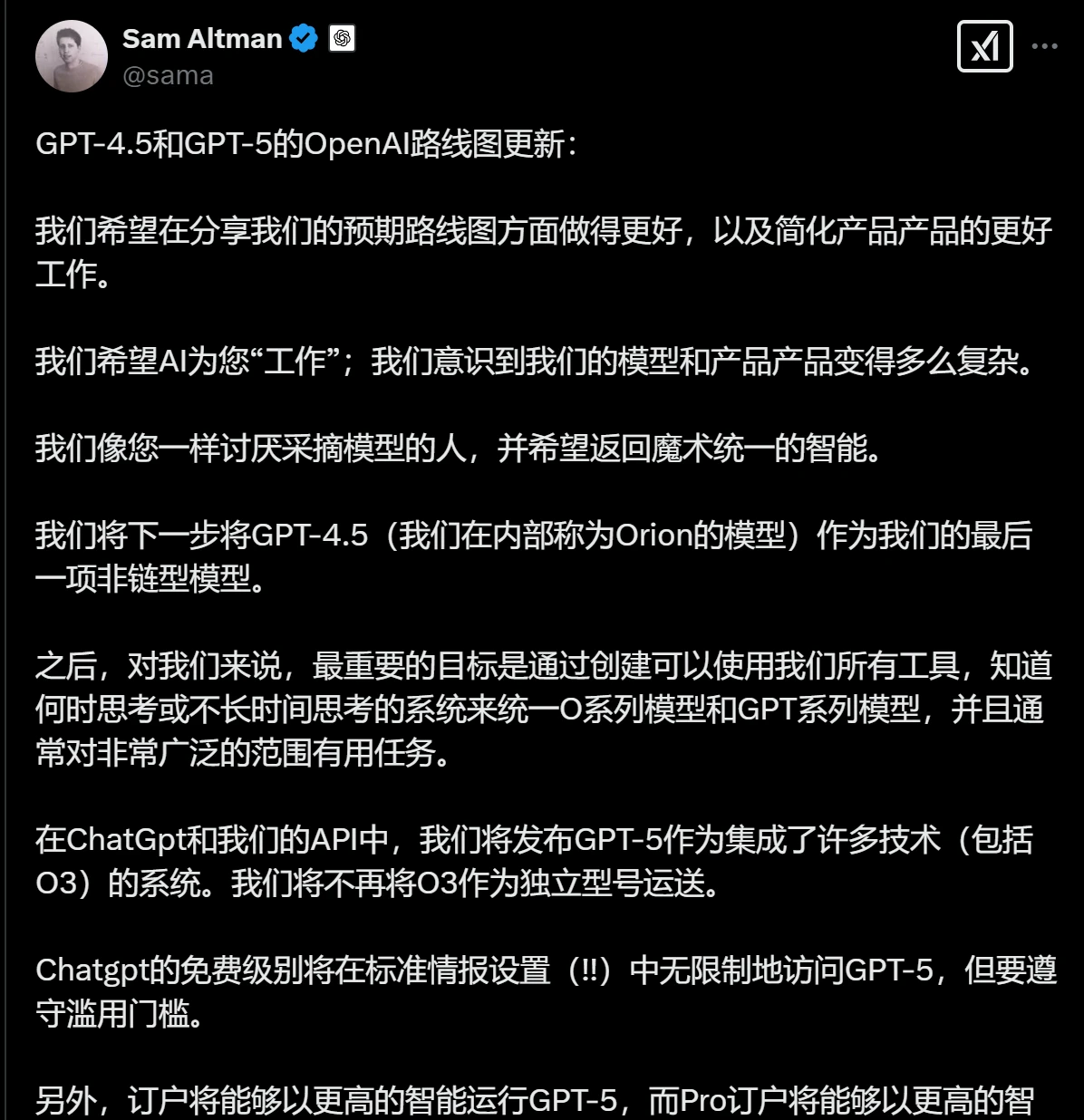
(Comprehensive report, February 13, 2025) Sam Altman, CEO of Openai, announced via Twitter in the early hours of Pacific Time that the company's technology roadmap is undergoing a major adjustment: the GPT-4.5 model, codenamed "Orion," will be released in the coming weeks, while GPT-5, which integrates multiple innovative technologies, will launch in the coming months. This marks a leap-forward development in artificial intelligence systems in terms of logical reasoning and complex task processing capabilities.
Paradigm Shift in Technical Architecture
As OpenAI's last non-chain-of-thought model, the launch of GPT-4.5 is of epoch-making significance. The model expands the context window to 256,000 tokens (approximately 200,000 words), significantly enhancing long-text processing capabilities. The upcoming GPT-5 will achieve technical system integration, building an intelligent system capable of autonomously judging the depth of thinking by incorporating innovations such as the o3 reasoning engine. It is worth noting that the o3 model, originally planned for independent release, will be built into GPT-5 as a core component and will no longer be released separately.
Building a Tiered Service System
According to the latest disclosed operational strategy, GPT-5 will adopt a differentiated service model: free users can invoke basic functions without limit in standard intelligence mode (subject to abuse monitoring mechanisms), while ChatGPT Plus and Pro subscribers can unlock higher intelligence tiers and enjoy value-added services such as voice interaction, graphics creation, and in-depth research. This tiered system ensures both technological inclusivity and value extension for professional users.
Underlying Drivers of the Strategic Adjustment
Behind this technology roadmap adjustment, OpenAI's dual considerations of addressing industry competition and user demand are reflected:
Need for technology integration: By unifying the GPT series and o-series models, the system complexity of running multiple models in parallel is resolved, and an intelligent agent that adapts to task requirements is built.
Market competition pressure: Technological breakthroughs by competitors such as Chinese AI lab DeepSeek (DeepSeek), particularly the performance catch-up of its R1 model, have prompted OpenAI to accelerate technological iteration.
Business ecosystem construction: The tiered service system will drive user conversion to paid subscriptions, and combined with deep integration of the API platform, will form a technological moat and business closed loop.
Industry Impact and Future Outlook
According to internal test data, GPT-5 has improved mathematical derivation accuracy by 37% compared to its predecessor, and physics problem-solving efficiency has increased by 42%. Altman emphasized that the new model will redefine the boundaries of human-machine collaboration, particularly its application potential in professional scenarios such as scientific research assistance and business decision-making. Notably, OpenAI simultaneously announced a developer migration plan, pledging to reduce technology switching costs through a unified API interface.
This strategic upgrade comes at a critical turning point in the field of artificial intelligence. With the full implementation of the EU AI Act and the intensifying global scramble for computing power, whether OpenAI can consolidate its technological leadership through GPT-5 will profoundly impact the industry landscape over the next five years. As an expert from the Stanford Institute for Human-Centered Artificial Intelligence commented: "This is not merely an iteration of model versions, but a revolutionary leap in the paradigm of intelligent systems."









