
 Script Planner Assistant▸
 AI Apps
 AI News
MedRAX: An AI Agent for Chest X-Ray Medical Reasoning
小编 ·

MedRAX: An AI Agent for Chest X-Ray Medical Reasoning
MedRAX is the first unified framework that integrates cutting-edge CXR analysis tools with multimodal large language models, focused on addressing three major pain points of traditional medical ai systems: fragmented single-task model architectures, complex clinical reasoning workflows, and the lack of tool collaboration mechanisms.
The core capability of MedRAX lies in its dynamic scheduling mechanism, which coordinates heterogeneous tools such as image classifiers, lesion segmentation models, and text generation systems without retraining, completing the full-chain analysis from basic lesion recognition to multi-dimensional differential diagnosis.
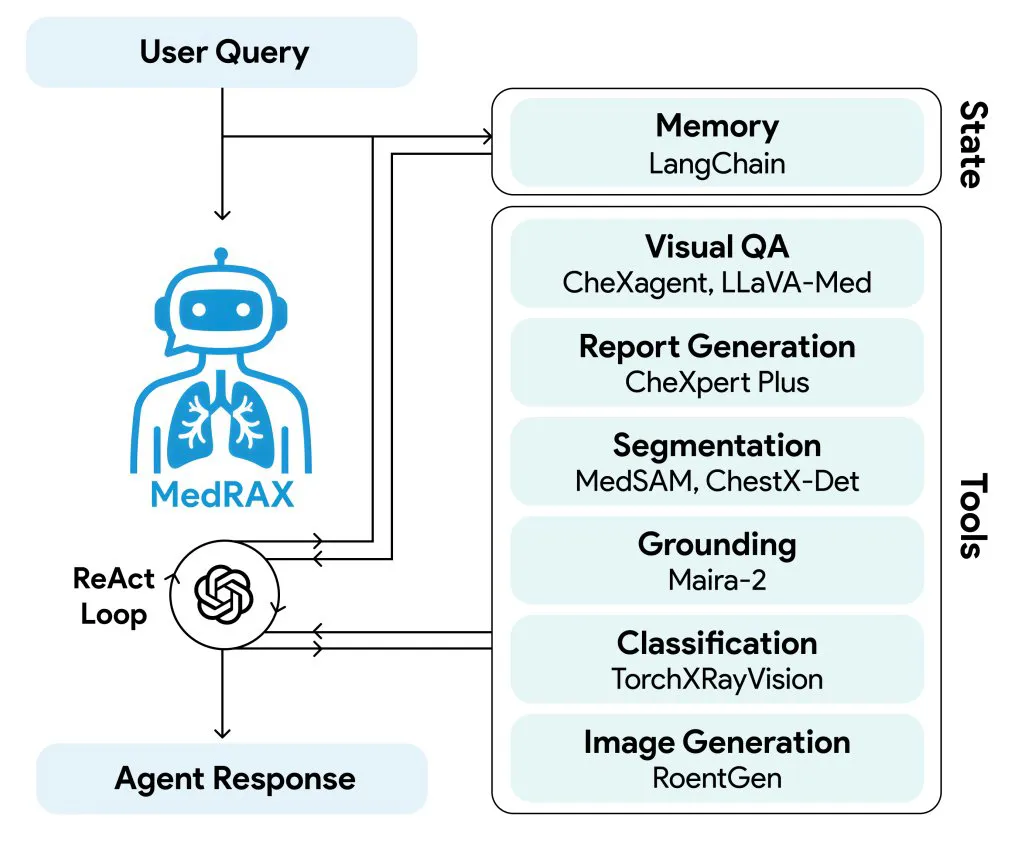
MedRAX Technical Features
Heterogeneous Model Collaboration Architecture: Integrates lightweight classification models (for rapid localization of key anatomical structures) with ten-billion-parameter vision-language models (handling complex queries requiring semantic understanding), achieving optimized computing resource allocation through real-time routing algorithms.
Structured Reasoning Engine: Develops a five-level decision-making workflow (task parsing → tool filtering → conflict resolution → result integration → confidence evaluation) to ensure interpretability of medical decisions.
Zero-Shot Adaptation Capability: Based on context-aware tool combination strategies, supports plug-and-play integration of new diagnostic modules, with system response latency controlled within clinically acceptable ranges (average 3.2 seconds/case).
MedRAX Applications
Complex Device Recognition: By coordinating imaging annotation tools with anatomical structure databases, achieves an accuracy of 96.7% in chest catheter localization tasks, significantly outperforming single-model systems (81.2%).
Multi-Stage Differential Diagnosis: For imaging differentiation between pneumothorax and pneumonia, adopts a staged analysis strategy—first quantifying lung field radiolucency through segmentation models, then conducting temporal analysis combined with medical record text, improving diagnostic concordance rate by 34%.
Emergency Treatment Support: In pneumothorax severity assessment scenarios, integrates volumetric measurement algorithms with hemodynamic prediction models to provide quantitative decision support for closed chest drainage.
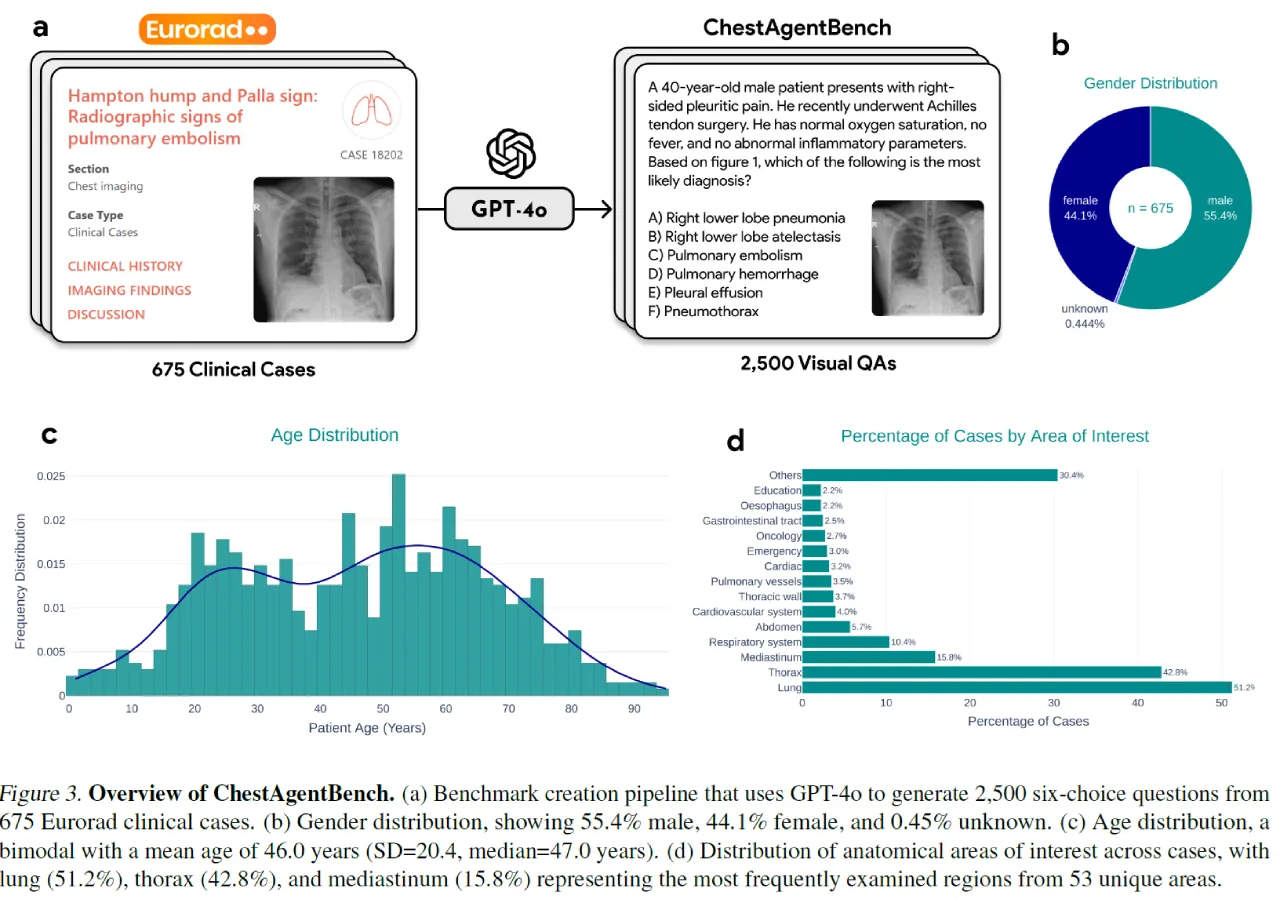
MedRAX Validation
The ChestAgentBench evaluation system constructed by the research team encompasses 7 core capability dimensions:
Anatomical Structure Analysis (recognition of 12 chest landmarks)
Pathological Sign Correlation (32 disease-sign mappings)
Temporal Change Tracking (including comparative analysis of historical imaging)
Medical Device Identification (recognition of 9 common interventional devices)
Quantitative Measurement (extraction of 21 key biomarkers)
Diagnostic Reasoning (multi-disease differential diagnosis tree)
Treatment Decision Support (generation of guideline-based management recommendations)
MedRAX Performance
In 2,500 complex query tests, MedRAX achieved an overall accuracy of 89.4%, significantly outperforming GPT-4o (72.1%) and the domain-specific model CheXagent (83.6%). Particularly in tasks requiring multi-tool collaboration (such as "assessing pneumothorax progression and formulating a drainage plan"), the system achieved a success rate of 91.2% through staged invocation of segmentation models, blood flow simulators, and guideline databases, compared to only 54.3% for end-to-end models.
MedRAX Clinical Value
The breakthrough of this system lies in achieving a balance between "precision medicine" and "operational efficiency": it retains the fine-grained analytical capabilities of professional imaging tools while possessing the contextual understanding advantages of large language models. Two typical cases demonstrate that in catheter misjudgment scenarios, the system corrected 83% of single-model errors through device feature library comparison; in complex pneumothorax assessment, its staged analysis strategy elevated diagnostic confidence to the 98% confidence interval.
Deployment Implementation Guide
1. Basic Environment Requirements
Python 3.8+ environment
CUDA 11.8+ (GPU acceleration recommended)
16GB+ memory space
2. Quick Start Process
# 获取项目代码
git clone https://github.com/bowang-lab/MedRAX.git
cd MedRAX
# 安装依赖库
pip install -e .
# 配置API密钥
export OPENAI_API_KEY="your_api_key"
# 启动诊断系统
python main.py --model_dir /path/to/model_weights
3. Benchmark Test Implementation
Obtain the ChestAgentBench evaluation dataset (containing 2,500 clinical consultation scenarios) via Hugging Face:
huggingface-cli download wanglab/chestagentbench --repo-type dataset
unzip chestagentbench/figures.zip -d MedMAX
MedRAX Development Prospects
Building uncertainty quantification modules to attach probabilistic confidence intervals to diagnostic conclusions
Developing adaptive tool selection algorithms that dynamically optimize reasoning paths based on institutional hardware configurations
Expanding multimodal input support (such as integrating CT 3D reconstruction data) and establishing cross-modal verification mechanisms
The design philosophy of this framework—the organic integration of professional tools with general-purpose foundation models—provides a new paradigm for the evolution of medical AI systems, with its methodology extendable to other medical imaging domains such as ultrasound and pathological sections.
GitHub:https://github.com/bowang-lab/MedRAX









