
 Script Planner Assistant▸
 AI Apps
 AI News
RAG-FiT: A Framework for Enhancing LLM RAG Capabilities Through Fine-Tuning
小编 ·

RAG-FiT: A Framework for Enhancing LLM RAG Capabilities Through Fine-Tuning
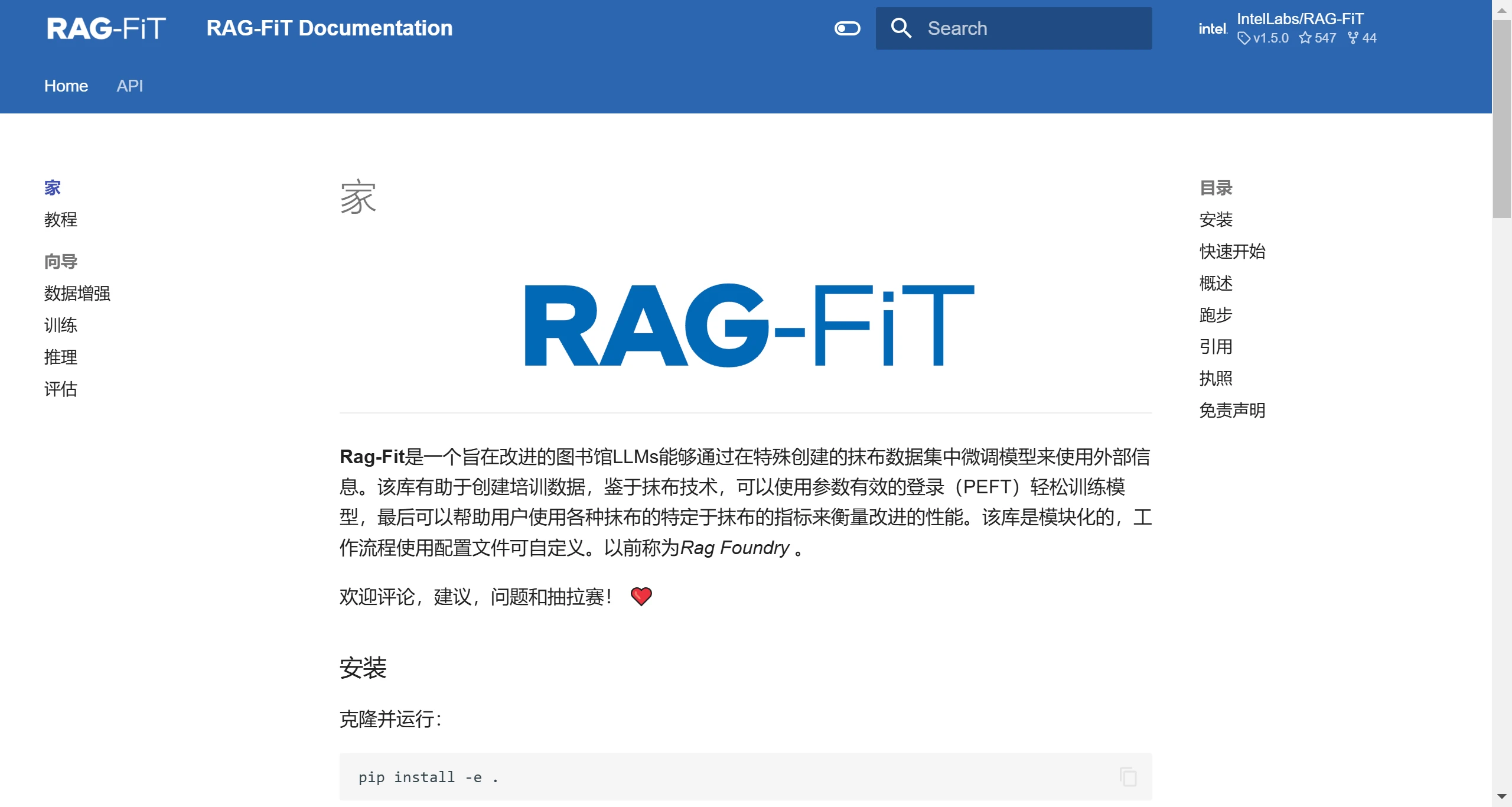
RAG-FiT is a library that enhances the ability of large language models (LLMs) to use external information by fine-tuning on specially created RAG-augmented datasets. It helps models better retrieve information from external data sources through data augmentation techniques, thereby generating more accurate and contextually relevant content.
The purpose of RAG-FiT is to address several key issues in traditional LLM+RAG systems, such as retrieving a large number of irrelevant documents, the impact of overly long input information on efficiency, and unnecessary waste of computational resources.
Core Features
Data Augmentation and Fine-tuning: RAG-FiT provides a pipeline to create specialized datasets designed to optimize how models utilize retrieved information. Through parameter-efficient fine-tuning (PEFT), models can learn to better leverage external information without significantly increasing their size.
Optimized Retrieval Process: It includes a similarity retriever capable of efficiently recalling documents relevant to the query from large corpora, reducing the interference of noisy information.
Dual-Label Document Scoring: It introduces a classifier that not only determines whether a document contains the answer (factual information judgment) but also evaluates whether the document is beneficial for generating the answer (model preference), thereby improving the relevance and quality of retrieved information.
Self-Knowledge Recognition: By analyzing whether a query requires additional retrieved information, it reduces unnecessary retrieval operations, which helps improve efficiency and reduce the number of input tokens.
Sub-Document-Level Token Reduction: It further optimizes retrieved information by selectively combining and compressing document fragments, ensuring that the information fed to the LLM is more refined and relevant.
Role of RAG-FiT:
Personalized Recommendations: By analyzing users' historical data and preferences, RAG-FiT can provide personalized content recommendations, enhancing the user experience.
Multimodal Learning: RAG-FiT can combine multiple data types such as text and images, enhancing the model's capabilities when handling complex tasks.
Real-Time Information Updates: In dynamic environments, RAG-FiT can retrieve and integrate the latest information in real time, ensuring that generated content always remains current and relevant.
Cross-Domain Applications: The flexibility of RAG-FiT enables it to be applied across multiple domains, such as healthcare, finance, and education, helping professionals in different fields access the information and support they need.
Applications of RAG-FiT:
Knowledge Q&A: By integrating external knowledge bases, RAG-FiT can provide more accurate information when answering user questions, especially in specialized domains.
Text Generation: When generating text, RAG-FiT can retrieve relevant information from external data sources to enhance the accuracy and relevance of the generated content.
Data Augmentation: RAG-FiT can be used to create augmented datasets, expanding existing data to improve model training effectiveness.
Experimental Research: RAG-FiT can also be used in academic research, helping researchers explore and validate the effectiveness of different RAG architectures and methods.
GitHub:https://github.com/IntelLabs/RAG-FiT









