
 Script Planner Assistant▸
 AI Apps
 AI News
MILS: Meta's Training-Free Method to Give LLMs Multimodal Abilities
小编 ·

MILS: Meta's Training-Free Method to Give LLMs Multimodal Abilities
MILS (Meta Interpretive Learning System), an open-source AI model released by Meta that enables LLMs to acquire multimodal capabilities without training. Unlike traditional training methods, MILS is designed to empower Large Language Models (LLMs) to handle visual and auditory tasks without additional task-specific training. It can understand images and videos, comprehend sounds, and perform zero-shot learning.
MILS combines the strengths of deep learning and interpretive learning, delivering excellent performance across a wide range of tasks—particularly in complex scenarios that require understanding and reasoning.
MILS consists of two main modules: a generator, responsible for producing candidate solutions; and a scorer, used to evaluate the quality of the candidates produced by the generator. Through an iterative process, MILS solves multimodal tasks without any additional training.
Key features of MILS include support for multiple languages and multimodal inputs, enabling it to process text, image, and audio data. MILS can be applied to a variety of multimodal tasks, such as image/video/audio captioning, image generation enhancement, and style transfer.
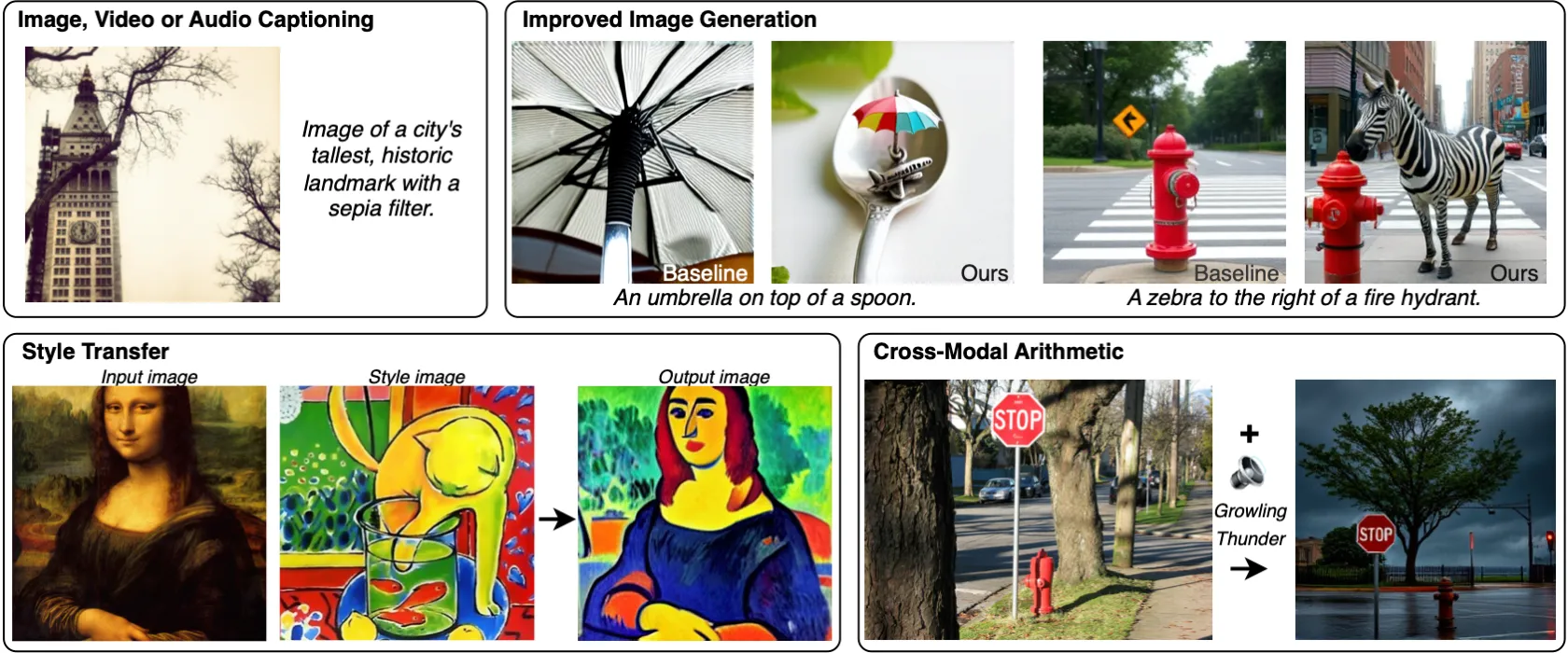
Key Features and Working Principles of MILS
Zero-Shot Generation: The core of MILS lies in its zero-shot learning capability, meaning the model can solve multimodal problems without being directly trained on specific modality tasks. Through an iterative feedback mechanism, it progressively refines generated outputs, ultimately achieving high-quality multimodal descriptions or generations.
Iterative Feedback Loop: During generation, MILS first has the language model produce an initial multimodal output based on a text prompt (such as an image caption). This output is then fed back as input, and the model attempts to generate or refine again. Through continuous self-feedback and correction, a satisfactory solution is ultimately reached.
Leveraging the Potential of Pre-trained Models: MILS relies on the pre-trained knowledge of large language models, which have already learned from massive amounts of text data and can therefore understand complex semantics and context. In this way, MILS leverages the inherent capabilities of these models to extend to understanding and generating non-text data such as images and sounds.
Paper: https://arxiv.org/pdf/2501.18096
Github: https://github.com/facebookresearch/MILS









