
 Script Planner Assistant▸
 AI Apps
 AI News
Deep Research: OpenAI's Agent for In-Depth Information Mining and Analysis
小编 ·

Deep Research: OpenAI's Agent for In-Depth Information Mining and Analysis
Openai's newly launched Deep Research is an intelligent agent product designed for the field of in-depth research, aimed at helping users conduct complex information queries and analysis. Deep Research can independently discover, reason about, and integrate insights from the web, providing comprehensive research reports and key findings.
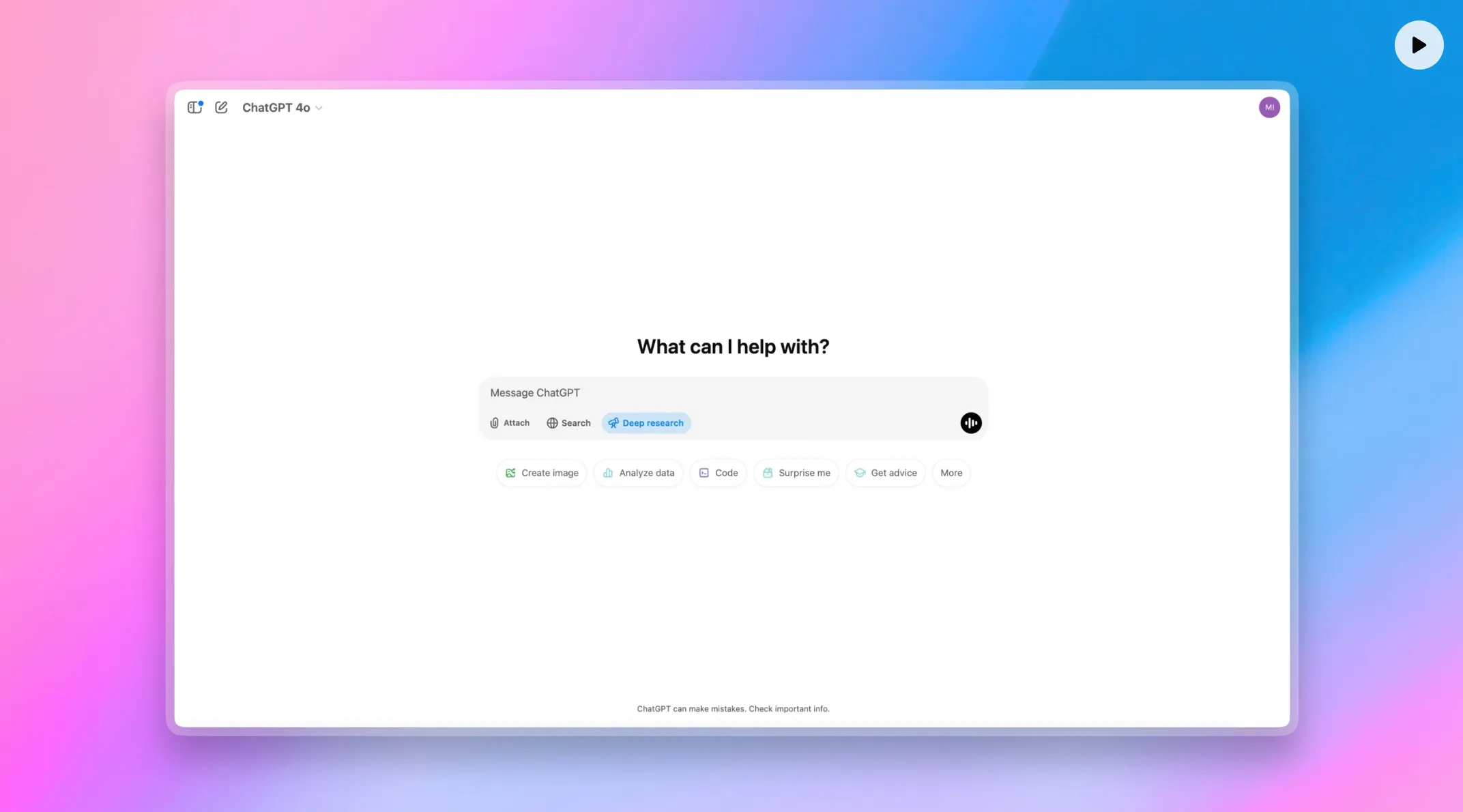
Deep Research Features and Applications
Information Integration: Capable of gathering information from multiple sources and integrating it into easily understandable reports.
Real-Time Analysis: Users can conduct real-time thematic research to obtain the latest information and data.
Multi-Domain Applicability: This tool is applicable across multiple fields such as finance, science, policy, and engineering, making it especially suitable for professionals who need to perform in-depth knowledge work.
Deep Research Technical Features
End-to-End Reinforcement Learning
Deep Research uses end-to-end reinforcement learning techniques, allowing the model to be optimized holistically from input to output.
By interacting with the environment, the model can plan and execute multi-step research trajectories, and backtrack to adjust its strategy when deviations are discovered, ensuring the accuracy of results.
Multi-Step Reasoning and Dynamic Adjustment
Deep Research can formulate research plans like a human researcher, gradually breaking down complex tasks.
For example, when handling market trend analysis, the model will obtain preliminary information through keyword searches, further look up industry reports, statistical data, etc., and compare and analyze information from different sources to ultimately generate a comprehensive report.
As more information is discovered, the model will adjust its plan to ensure the comprehensiveness and accuracy of the results.
Breaking Response Time Limitations
Unlike traditional models that pursue rapid responses, Deep Research allows the model to spend 5 to 30 minutes or even longer processing questions.
This delay is not a drawback but rather a sign of the model maturing. By deeply analyzing massive amounts of information, the model can output more comprehensive and accurate research results.
Modular Design
Deep Research consists of multiple modules, including information discovery, information synthesis, reasoning, and output modules.
The information discovery module can quickly locate academic databases, research institution websites, etc., providing rich material for subsequent analysis.
The information synthesis module is responsible for integrating information, the reasoning module performs logical reasoning, and the output module generates reports.
Deep Research Application Scenarios
Market Research and Academic Research
Deep Research performs excellently in market research and academic research fields.
For example, it can collect market data from different regions and time periods to predict market trends; in academic research, it can deeply study literature, uncover potential connections between different studies, and provide valuable research ideas for researchers.
Consumer Decision-Making and Personalized Recommendations
For products that require careful research (such as cars, appliances, furniture, etc.), Deep Research can generate highly personalized recommendation reports.
It provides detailed purchasing recommendations by analyzing user needs and market data.
Automated Processing of Complex Tasks
Users only need to provide a prompt, and Deep Research can search, analyze, and integrate hundreds of online resources to generate comprehensive reports at the level of a research analyst.
For example, it can generate competitor and market research reports, or help users find a TV series they've forgotten the name of but remember a specific episode.
Performance and Test Results
"Humanity's Last Exam" Performance
In the "Humanity's Last Exam" released by the AI Safety and Scale Center, Deep Research achieved an accuracy rate of 26.6%, far surpassing other well-known models (such as DeepSeek-R1's 9.4% and o3-mini high's 13%).
This test contains over 3,000 multiple-choice and short-answer questions, covering more than 100 subjects ranging from linguistics to rocket science, and from classical studies to ecology.
GAIA Benchmark Results
In the GAIA benchmark test, Deep Research reached new heights across three difficulty levels, scoring 72.57, surpassing the previous best method (63.64).
These tasks require the model to possess capabilities such as reasoning, multimodal fluency, web browsing, and tool use.
Internal Benchmark Testing and Expert Evaluation
OpenAI's internal tests show that Deep Research can complete tasks that would take experts several hours.
For example, in finance, science, and engineering fields, the model's performance has received high praise from domain experts.
How to Use Deep Research?
User Permissions
Currently, Deep Research is only available to ChatGPT Pro users, with a maximum of 100 queries per month.
Next, Plus and Team users will gain access, followed by enterprise users.
Operating Steps
In ChatGPT, select Deep Research in the "message composer" and enter your query.
Tell ChatGPT what you need, whether it's a competitive analysis of streaming platforms or a personalized report on the best commute options.
You can even attach files or spreadsheets to add context to your question.
Once it starts running, the sidebar will display a summary of the steps taken and sources used.
Deep Research may take 5 to 30 minutes to complete its work. Users can leave or handle other tasks and will be notified when the task is complete.
The final result will appear in the chat as a report. In the coming weeks, OpenAI will also add embedded images, data visualizations, and other analytical outputs to these reports to provide clearer explanations and context.
Comparison with GPT-4o
Real-Time Capability
GPT-4o is better suited for real-time multimodal conversations, while Deep Research requires a longer time to complete in-depth and detailed multi-step research tasks.
Comprehensive Capabilities
Deep Research can conduct extensive exploration and cite each claim, making it suitable for queries across various aspects and specific domains that require depth and detail.
GPT-4o demonstrates impressive capabilities in coding, mathematics, and other technical fields, but many real-world challenges require gathering extensive context and information from various online sources—this is Deep Research's strength.
Details: https://openai.com/index/introducing-deep-research/









