
 Script Planner Assistant▸
 AI Apps
 AI News
OpenAI's Paid Subscribers Reach 15.5 Million
小编 ·

OpenAI's Paid Subscribers Reach 15.5 Million
According to information recently disclosed by Openai to some shareholders, the number of paid ChatGPT subscribers reached 15.5 million by the end of 2024, nearly tripling from 5.8 million users a year earlier. This growth suggests that ChatGPT's annualized revenue around the end of 2024 is likely to reach at least $4 billion, or roughly $333 million per month. This significant growth trend indicates that, despite facing fierce competition from rivals such as Google, Anthropic, and Meta, ChatGPT has continued to maintain strong user growth.
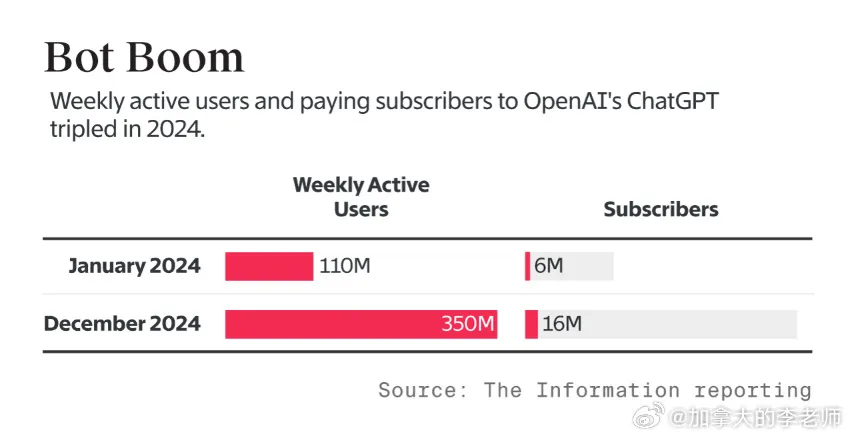
Growth Trend Analysis
This growth not only reflects user recognition of the ChatGPT service, but may also be related to OpenAI's continued improvements in its products and services. For example, OpenAI recently released the o3-mini model, the latest and most cost-efficient model in its reasoning series, which is now available in ChatGPT and the API. This new model has performed excellently on benchmarks such as mathematics and code, and may further attract user attention and subscriptions.
In addition, ChatGPT's annualized revenue is projected to potentially reach $4 billion, which also demonstrates the success of its business model and the strength of market demand. As the user base expands, OpenAI's market position in the artificial intelligence field is also increasingly solid, and it is likely to continue attracting more attention from users and investors in the future.
OpenAI also noted that API call volume has increased sevenfold year-over-year. By the end of the year, OpenAI was processing and generating approximately 1.4 billion tokens per minute through its API, far higher than the roughly 200 million at the beginning of the year. This figure further reflects the broad applicability and practicality of ChatGPT across various industries, especially among enterprises and developers, with more and more people beginning to rely on this tool to improve work efficiency and drive innovation.
Due to competitive pressure brought about by the release of DeepSeek R1 from the Chinese open-source large-model company DeepSeek, Sam Altman stated that steering clear of open-source software has put the company "on the wrong side of history," and that OpenAI is now considering new open-source strategies to respond to changes in market competition—an approach that could affect future product development direction and user acquisition strategy.









