
 Script Planner Assistant▸
 AI Apps
 AI News
Unitree H1 "Fu Xi" Humanoid Robot: AI Art Revolution on the 2025 Spring Festival Gala Stage
小编 ·

Unitree H1 "Fu Xi" Humanoid Robot: AI Art Revolution on the 2025 Spring Festival Gala Stage
At the 2025 Spring Festival Gala (Year of the Snake), Unitree Robotics stunned the stage with its latest robot Unitree H1 "Fuxi" (a homophone for "Fuxi," a legendary Chinese figure), staging a visual feast where technology intertwined with traditional culture. In the performance titled "Yang BOT," the robots wore floral-padded jackets and held red silk handkerchiefs, twisting their bodies in precise rhythm to flawlessly blend traditional Yangge dance with modern AI technology. Showcasing agile movements and cutting-edge tech, the act became one of the most iconic innovations in the history of the Spring Festival Gala.
Unitree's H1 robot not only demonstrated remarkable dance flexibility but also featured a range of technical attributes that allow it to excel in complex environments. Standing roughly 1.8 meters tall and weighing about 47 kilograms, the H1 "Fuxi" robot boasts 19 degrees of freedom, enabling highly agile movements. Its leg-joint motors deliver a peak torque of 360 N·m, and combined with a hollow-shaft design and dual encoders, it offers the highest power performance among robots in its class. Additionally, the H1 can run at a speed of up to 3.3 m/s, setting a world record for full-sized humanoid robot locomotion.
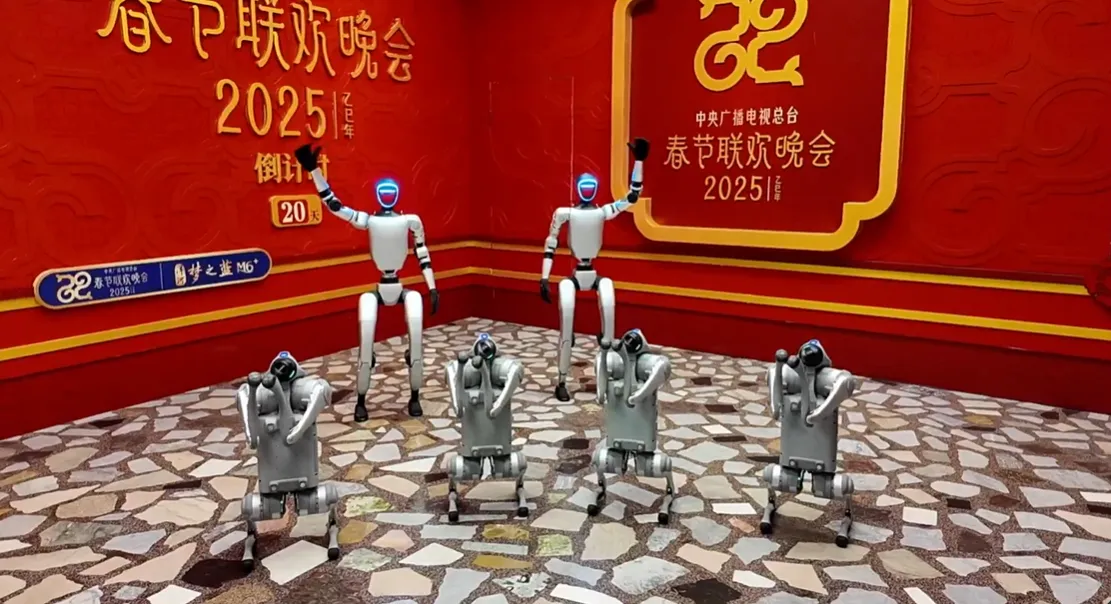
I. Core Functions and Technical Breakthroughs
AI-Driven Dynamic Control
The Unitree H1 is equipped with an AI motion-control algorithm developed in-house by Unitree, enabling real-time analysis of musical rhythm and synchronized adjustment of dance movements. Powered by deep-learning models, the robot can adapt to different musical styles—ranging from lively folk tunes to soothing melodies—and perform highly precise coordination on complex stages, including difficult moves like handkerchief twirling and toss-and-catch routines.
High-Performance Hardware Support
360 N·m joint torque with panoramic perception: The robot's maximum joint torque reaches 360 N·m, combined with a 360° panoramic depth-perception system, ensuring stable obstacle avoidance during dense formation changes while preserving fluid motion.
Swarm coordination and anti-interference capability: Through AI training, the H1 robots execute complex choreography. Relying on 16-unit LiDAR SLAM positioning systems, they perform fully automatic stage positioning and formation changes, achieving millisecond-level coordination among multiple robots. Even amid stage lighting variations or network fluctuations, they maintain overall performance consistency.
Dexterous Operation and Multi-Scenario Adaptability
Taking the Unitree H1 as an example, its hand design has evolved from a spherical shape to a three-finger dexterous hand capable of fine tasks such as unscrewing bottle caps and spinning staffs—moves that can be further extended to higher-difficulty acts like handkerchief toss-and-catch in the future. In addition, the robot supports a modular design, allowing users to customize sensors or tools to meet needs in scientific research, entertainment, and other fields.
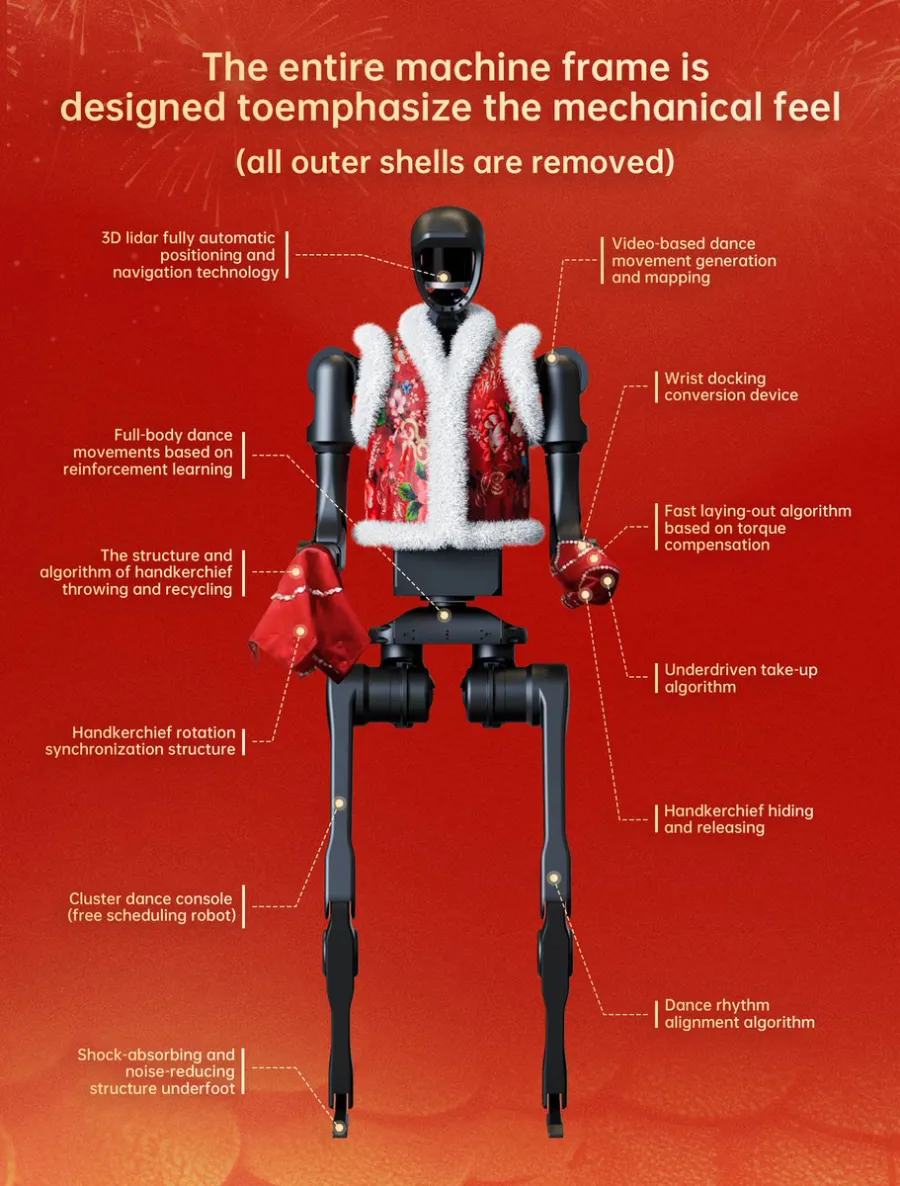
II. Technical Highlights in the Spring Festival Gala Performance
In the "Yang BOT" show, the Unitree H1 robots demonstrated a host of hardcore technologies:
Handkerchief manipulation technology: Through high-precision motion planning and force-control algorithms, the robots can mimic the flexibility of a human wrist, producing natural handkerchief rotations. The handkerchiefs can spin, be tossed, and automatically return to position.
Dynamic environment adaptation: With LiDAR and vision-fused navigation, the robots can maintain precise positioning and avoid collisions even amid stage smoke or rapid lighting changes.
III. Technological Leap from Quadruped to Humanoid
Unitree became famous earlier on for its quadruped robots (such as the "robotic ox" at the 2021 Spring Festival Gala). That accumulated expertise laid the groundwork for developing the H1 humanoid. For instance, the H1—the world's first commercially available humanoid robot capable of a backflip—inherits the high-dynamic-motion capability of the quadrupeds, while further optimizing cost and functionality, priced at USD 90,000.
IV. Future Outlook: Deep Integration of AI and Art
The success of the Unitree H1 robot is not only a triumph of technology but also a breakthrough in cultural expression. By simplifying the robot's appearance (rather than fully anthropomorphizing it) and emphasizing a mechanical aesthetic, Unitree created a striking contrast with dance art, endowing the performance with stronger visual impact. In the future, as large AI models and embodied intelligence continue to converge, robots like "Fuxi" may expand into richer application scenarios across education, service industries, and beyond—continually pushing the boundaries of the "tech-infused Spring Festival Gala."
The Unitree H1 robot offers a fresh perspective on the inheritance and innovation of traditional culture, underpinned by the deep integration of AI algorithms, high-performance hardware, and swarm-control systems. This Spring Festival Gala performance is not only an audiovisual feast but also a harbinger of the limitless possibilities humanoid robots hold in everyday life.









