
 Script Planner Assistant▸
 AI Apps
 AI News
Alibaba Qwen Unveils Next-Gen Vision-Language Model: Qwen2.5-VL
小编 ·

Alibaba Qwen Unveils Next-Gen Vision-Language Model: Qwen2.5-VL
Alibaba's Qwen2.5-VL is a brand-new visual understanding model launched by Alibaba's Tongyi Qianwen team. The model possesses powerful visual understanding, agent, long video comprehension, and event capture capabilities, aiming to promote the application and development of ai across multiple fields.
Main Features of Qwen2.5-VL
Visual Understanding: Qwen2.5-VL can accurately identify common objects in images, such as flowers, birds, fish, and insects, and can analyze text, charts, icons, graphics, and layouts within images. This enables it to perform excellently when processing visual information and provide users with detailed image analysis results.
Video Understanding: The model breakthroughly supports video understanding of more than 1 hour, and can identify and parse specific events within videos. This capability gives Qwen2.5-VL a significant advantage in video content analysis and processing.
Dynamic Reasoning Capability: Qwen2.5-VL possesses dynamic reasoning capabilities, enabling complex decision-making and operations based on visual environments and text instructions. This allows it to serve as an AI visual agent that directly operates devices such as mobile phones and computers.
Multiple Size Versions: Qwen2.5-VL offers three models of different scales—3B, 7B, and 72B—allowing users to choose the appropriate version based on their needs to meet different computing resources and application scenarios.
Key Features
Multiple Size Versions
Provides three versions with different parameter sizes—3B, 7B, and 72B—each suited to different application scenarios and hardware configurations.
3B Version: Suitable for mobile and other resource-constrained environments.
7B Version: Balances performance and resource consumption, suitable for most application scenarios.
72B Version: The highest-performance version, suitable for applications requiring high precision and powerful capabilities.
Advanced Capabilities
Visual Grounding Capability: Accurately identifies objects in images and returns location information in coordinate form.
General Image Recognition: Not only identifies common objects (such as flowers, birds, fish), but also analyzes text, charts, icons, and other elements within images.
Document Parsing: Significantly improved understanding of documents and tables, particularly excelling in academic problem-solving, mathematical capabilities, and document verification.
Video Understanding: Supports understanding of long-duration videos (up to hour-level), with second-level event localization capabilities, enabling summarization of video key points and extraction of critical information.
Visual Agent: Capable of operating computers and mobile phones and executing complex reasoning and decision-making tasks without task-specific fine-tuning.
Text Recognition and Understanding: Enhanced OCR recognition capabilities, supporting text recognition and information extraction across multiple scenarios, languages, and orientations.
Improvements
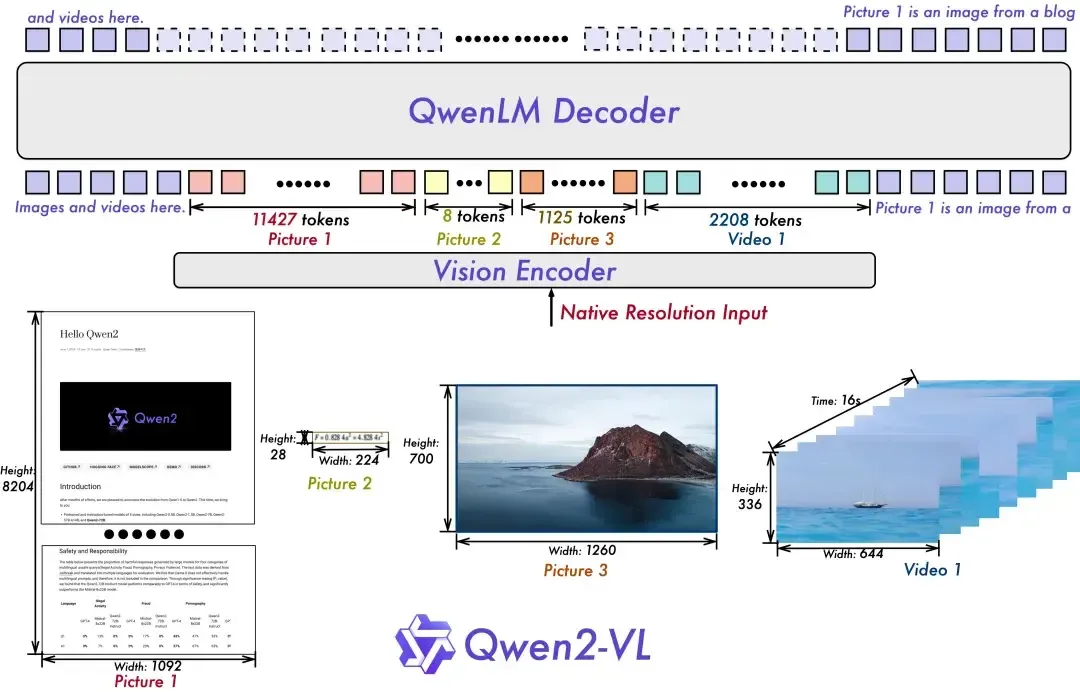
Spatio-Temporal Perception: Enhanced the model's perception of temporal and spatial scales, enabling it to better understand and process different types of data.
Simplified Network Architecture: Introduced a window attention mechanism to reduce computational burden and improve model efficiency.
Dynamic Resolution: Uses a native dynamic-resolution ViT, ensuring the model maintains native resolution while reducing computational pressure.
Performance
Leading in Multiple Benchmarks: Demonstrates excellent performance across benchmark tests in various fields, surpassing competing models in tasks such as document understanding, visual question answering, video understanding, and visual agents.
Specific Cases:
Document Understanding: Performs exceptionally well in tasks such as DocVQA.
Video Understanding: Capable of accurately understanding video content lasting several hours, with rapid localization and summarization of important events.
Visual Agent: Can execute complex automation tasks without additional adjustments, such as controlling devices and software interfaces.
Qwen2.5-VL Application Scenarios
Intelligent Customer Service: Qwen2.5-VL can be applied in video customer service scenarios, analyzing product images or barcodes shown by users in real time, and providing relevant product information.
Finance and Business Fields: The model supports structured output, suitable for processing data such as invoices and forms, particularly well-suited for applications in the finance and business fields.
Education and Training: In the education field, Qwen2.5-VL can be used to analyze instructional videos, helping students understand complex concepts and content.
Medical Image Analysis: The model's visual understanding capabilities can also be applied to medical image analysis, helping doctors better interpret imaging data.
The Qwen2.5-VL model continues the architecture of the previous generation Qwen-VL, adopting a tandem structure of ViT (Vision Transformer) and Qwen2, supporting unified input of images and videos. This design enables the model to better integrate visual and language information, improving understanding of multimodal data. Additionally, Qwen2.5-VL introduces Multimodal Rotary Position Embedding (M-ROPE), which decomposes position encoding into three parts: temporal and spatial (height and width), thereby enhancing the model's multimodal processing and reasoning capabilities. The model also possesses the ability to recognize images of arbitrary resolution, capable of processing images with different resolutions and aspect ratios, ensuring consistency between input and image information.
How to Obtain Qwen2.5-VL:
Open Source Address: Hugging Face
Github: Qwen2.5-VL
Online Experience: Qwen Chat









