
 Script Planner Assistant▸
 AI Apps
 AI News
DeepSeek R1: Open-Source Reasoning Model by DeepSeek, Rivaling OpenAI o1
小编 ·

DeepSeek R1: Open-Source Reasoning Model by DeepSeek, Rivaling OpenAI o1
What is DeepSeek R1?
DeepSeek R1is an open-source reasoning large language model launched by Chinese artificial intelligence company DeepSeek. Through a reinforcement-learning-driven technical approach, it achieves performance comparable to OpenAI's official o1 version in complex tasks such as mathematics, coding, and natural language reasoning, with particularly outstanding performance on reasoning tasks. It employs reinforcement learning techniques that significantly enhance the model's reasoning capabilities and enable highly efficient training with very little labeled data. This approach also gives DeepSeek-R1 a cost advantage, with the company claiming its running cost is only 3% of OpenAI's.
DeepSeek R1 Core Technologies:
1. Reinforcement-Learning-Driven Reasoning Capabilities
Pure Reinforcement Learning (RL) Training: DeepSeek R1-Zero directly applies large-scale reinforcement learning on top of the base model without supervised fine-tuning (SFT), making it the first to verify that pure RL can incentivize reasoning capabilities in LLMs. The model uses the GRPO algorithm (Group Relative Policy Optimization) to reduce training cost, leveraging a rule-based reward system (accuracy reward and format reward) to guide the generation of structured chain-of-thought (CoT).
Cold-Start Data Optimization: To address the readability and language-mixing issues of R1-Zero, DeepSeek R1 introduced a small amount of cold-start data (long CoT examples) and applied multi-stage training (cold-start fine-tuning → reasoning-oriented RL → all-scenario RL) to improve output readability and generalizability.
Long-Chain Reasoning and Model Distillation
Ultra-Long Chain-of-Thought Support: Supports a 128K context window, capable of decomposing complex problems into multi-step reasoning—for example, generating detailed derivations of tens of thousands of words for math problems.
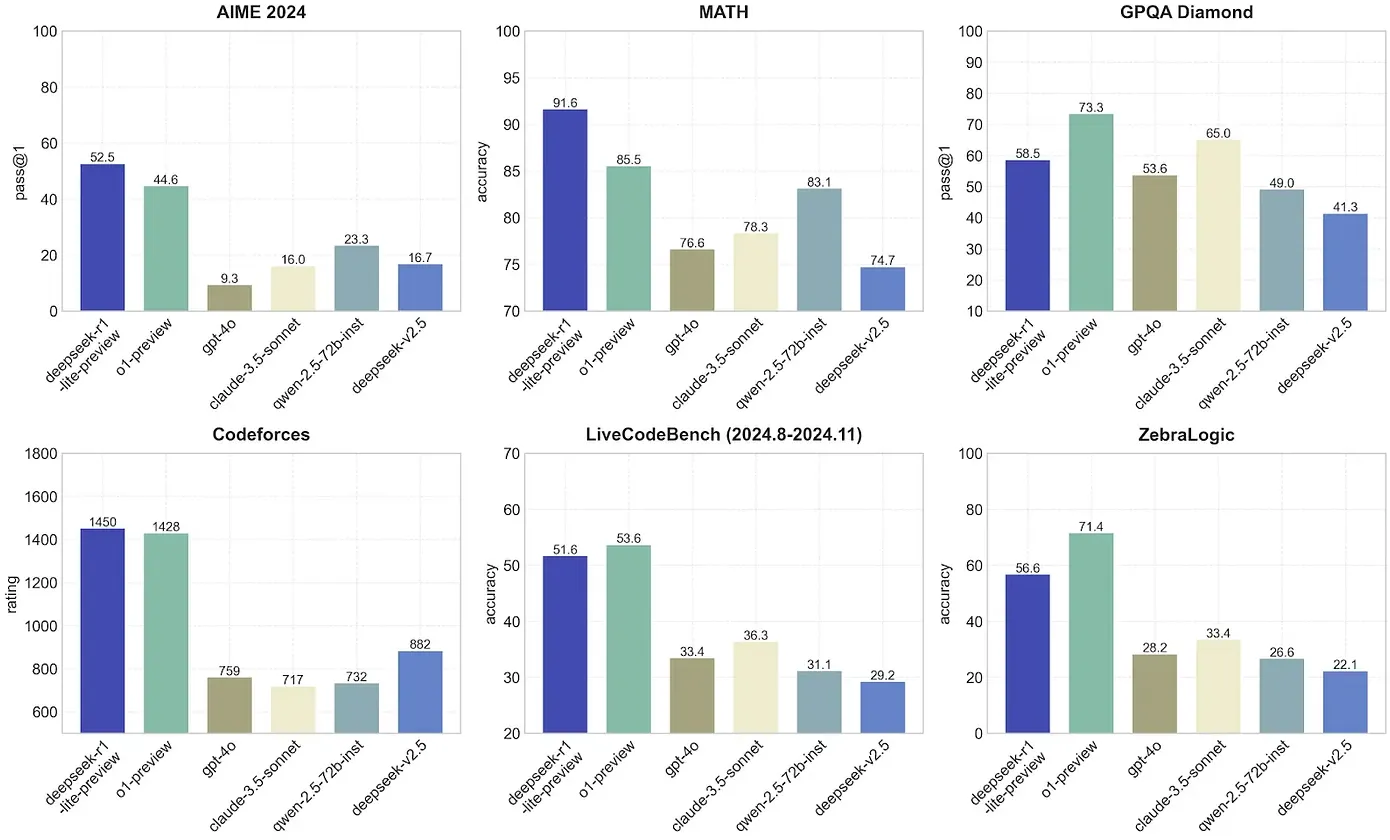
Efficient Distillation Technique: Distills R1's reasoning capabilities into smaller models of the Qwen and Llama series (such as 7B, 32B, 70B) using 800k samples, with the Qwen-32B distilled version achieving 72.6% pass@1 accuracy on the AIME 2024 test, a performance close to o1-mini.
2. Performance and Benchmark Tests
Mathematics and Coding Capabilities
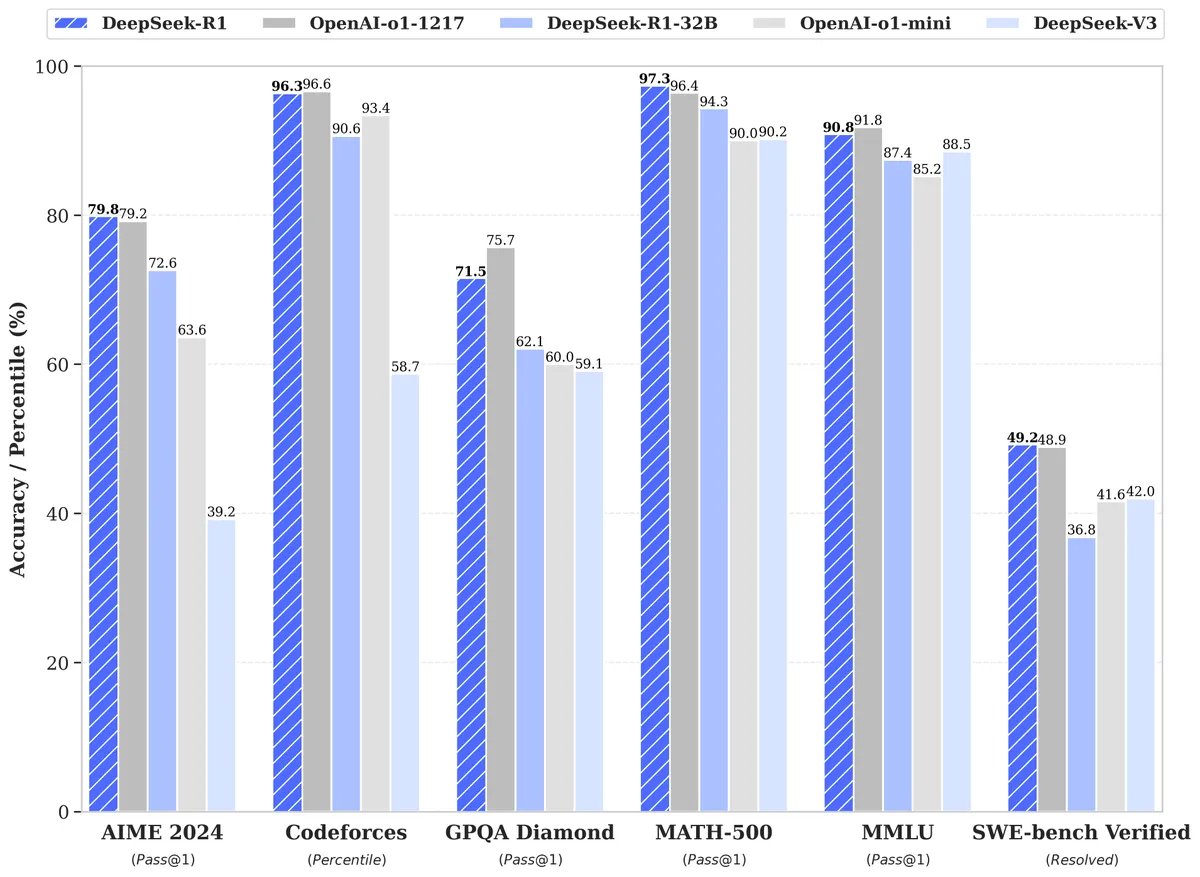
Math Competition-Level Performance: On AIME 2024 (American Invitational Mathematics Examination), R1 achieves a pass@1 accuracy of 79.8%; on the MATH-500 benchmark, it scores 97.3%, surpassing OpenAI-o1-1217. On challenging problems from China's national college entrance exam math section, R1 completes the solution in just 83 seconds, though it sometimes lacks step-by-step rigor.
Expert-Level Code Generation: Achieves a 2029 Elo rating on Codeforces contests (surpassing 96.3% of human participants) and 65.9% pass@1 on the LiveCodeBench test. User tests show that R1 generates runnable quantum mechanics visualization code in only 9 minutes.
General Language and Knowledge Tasks
Comprehensive Multi-Domain Capabilities: Scores 90.8% on MMLU (Massive Multitask Language Understanding), 84% on MMLU-Pro, and 71.5% on GPQA Diamond—significantly outperforming DeepSeek-V3 and approaching OpenAI-o1.
Humanities and Historical Reasoning: Achieves 100% accuracy on Chinese brainteasers and provides logically clear, information-rich answers to complex historical questions about ancient Egypt and African indigenous peoples, surpassing non-reasoning models in richness of detail.
3. Open-Source Ecosystem and Low-Cost Advantages
Open-Source Strategy and Business Friendliness
MIT License Open Source: The full model (671B parameters) and 6 distilled models (1.5B–70B) are all open-sourced, supporting free commercial use, modification, and derivative development. For example, the Qwen-14B distilled version can run on desktop-grade hardware and scores 53.1% on LiveCodeBench.
API Pricing Revolution: Input token cost as low as 1 yuan per million (cache hit); output tokens only 16 yuan per million—approximately 3.7% of OpenAI-o1's price. User tests show a single API call can cost as little as $0.06.
Developer Tools and Integration Support
Multi-Platform Deployment: Supports Hugging Face, the vLLM framework, and Spring AI integration—developers can invoke the model with simple configuration. For example, Spring AI users only need to add dependencies and configure an API key to get connected.
Inference Stability Optimization: The API disables the temperature parameter by default to ensure stable outputs, and returns the chain-of-thought and final answer separately via the reasoning_content and content fields.
4. Application Scenarios
Research and Education: Assists in mathematical modeling, code generation, and historical analysis, providing detailed reasoning processes to support academic research—for example, generating quantum mechanics animation code or solving complex math problems.
Enterprise Intelligence: Integrated into customer service systems, data analytics tools, or automated decision-making platforms to reduce AI deployment costs.
With its open-source strategy and ultra-low cost (training cost of $5.576 million, roughly 1/10 of GPT-4's), R1 is driving a price war across the industry, and companies like Meta have set up dedicated teams to study its technical approach.
Experts such as Yann LeCun believe that R1's success marks a shift of open-source models from being "followers" to becoming "leaders," fostering collaboration and technological innovation among developers worldwide.
With its reinforcement-learning-driven reasoning capabilities and open-source, low-cost strategy, DeepSeek R1 represents a major breakthrough in AI. It not only excels in specialized tasks such as mathematics and coding, but also drives global technological innovation through its open-source ecosystem, providing a new paradigm for the development of AGI.









