
 Script Planner Assistant▸
 AI Apps
 AI News
DeepSeek Overtakes ChatGPT to Top the U.S. App Store Free Charts
小编 ·

DeepSeek Overtakes ChatGPT to Top the U.S. App Store Free Charts
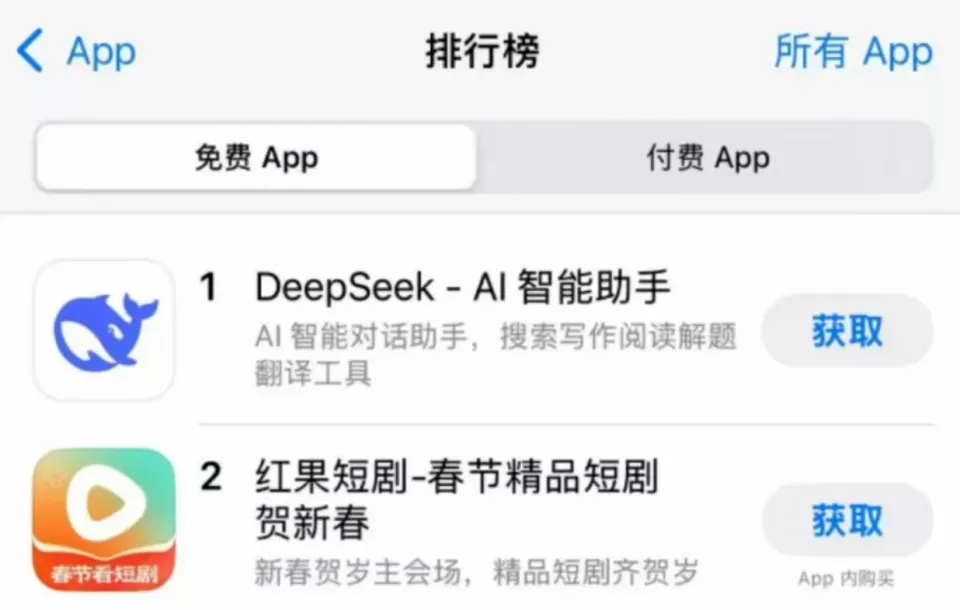
As of January 27, 2025, the app of the same name launched by Chinese large model company DeepSeek (DeepSeek) surpassed ChatGPT and topped the free download chart on the US Apple App Store. This achievement not only marks the first major breakthrough of a Chinese AI product in overseas markets, but also triggers a rethinking of the global AI competitive landscape.
1. Topping Performance and Market Buzz
Download Surge: DeepSeek jumped from sixth place to first on the US free chart within 24 hours, surpassing ChatGPT and Meta's Threads. During the same period, it also ranked first on the China free chart.
Server Pressure: A surge in user traffic caused a brief crash on the web version, with service restored on the evening of the 26th, after which the buzz continued unabated.
2. Technological Breakthrough: Low Cost and High Performance
Ultra-Low Training Cost: The pre-training cost of the R1 model was only $5.576 million, using 2,048 NVIDIA H800 GPUs (a China-market special edition), completed in 55 days—roughly one-tenth of the training cost of GPT-4o.
Reinforcement Learning Driven: Large-scale application of reinforcement learning (RL) during the post-training phase significantly enhanced reasoning capabilities with minimal labeled data, and the complete training technology along with 6 derivative small models were open-sourced.
Performance on Par with Top Models: On the Chatbot Arena overall leaderboard, R1 ranks third, tied with OpenAI's GPT-4o; it performs particularly outstandingly in style control, mathematical reasoning (MATH benchmark accuracy of 77.5%), and code generation.
3. Open-Source Strategy and Industry Impact
Open-Source License: Uses the MIT license, supporting free commercial use, modification, and secondary development, becoming the most-downloaded open-source large model on HuggingFace.
Industry Shock:
Meta's Emergency Response: Meta set up four "war rooms" to study DeepSeek's low-cost technical approach, attempting to reconstruct its own model architecture.
AMD Collaboration: AMD integrates DeepSeek-V3 into its Instinct MI300X GPU, leveraging FP8 low-precision computing to optimize inference efficiency, challenging NVIDIA's dominance in the AI chip space.
4. Market and Capital Reaction
NVIDIA vs. AMD Game: DeepSeek's low-cost training proves that "non-top-tier hardware" can also build high-quality models, sparking discussion on whether demand for NVIDIA GPUs is overestimated. AMD's stock received Wall Street favor due to collaboration expectations, with target price increases exceeding 48%.
Tech Giant Evaluations: Microsoft CEO Nadella called DeepSeek "impressive," while Meta Chief Scientist Yann LeCun believed its success reflects the potential of open-source models rather than a win-loss outcome of "US-China competition."
5. Open-Source Ecosystem and Developer Community
API Pricing Advantage: The first million input tokens cost only 1 yuan (cache hit), far lower than OpenAI, accelerating enterprise-level application deployment.
Developer Participation: The open-source model attracts global developers exploring AI drawing, text generation, and other scenarios, promoting diversification of the technology ecosystem.
DeepSeek's rise breaks the traditional notion that "AI R&D relies on massive investment." Through open source, reinforcement learning, and hardware co-optimization, it achieves a balance between high performance and low cost. Its success not only sets a benchmark for Chinese AI companies, but may also reshape the competitive landscape of the global AI industry chain. In the future, as more developers join the open-source ecosystem, the pace of AI application adoption and innovative scenarios may further accelerate.









