
 Script Planner Assistant▸
 AI Apps
 AI News
Dream Machine vs Sora: What's the Difference and Which Is Better?

Dream Machine vs Sora: What's the Difference and Which Is Better?
Luma ai has launched Dream Machine, a text-to-video model that can generate realistic videos from a few lines of descriptive text.
Dream Machine is now open to the public, allowing anyone to enter a descriptive prompt and have it rendered into a generated high-definition video within minutes.
Dream Machine is likely to have a significant impact on video content creation. Luma AI's Dream Machine will compete with the highly anticipated Sora, which OpenAI is about to release and which can also generate videos from text.
Previously, I wrote about the differences between Kling and Sora and which one is better. So what are the main differences between Luma AI's Dream Machine and OpenAI's Sora? Which one is better?
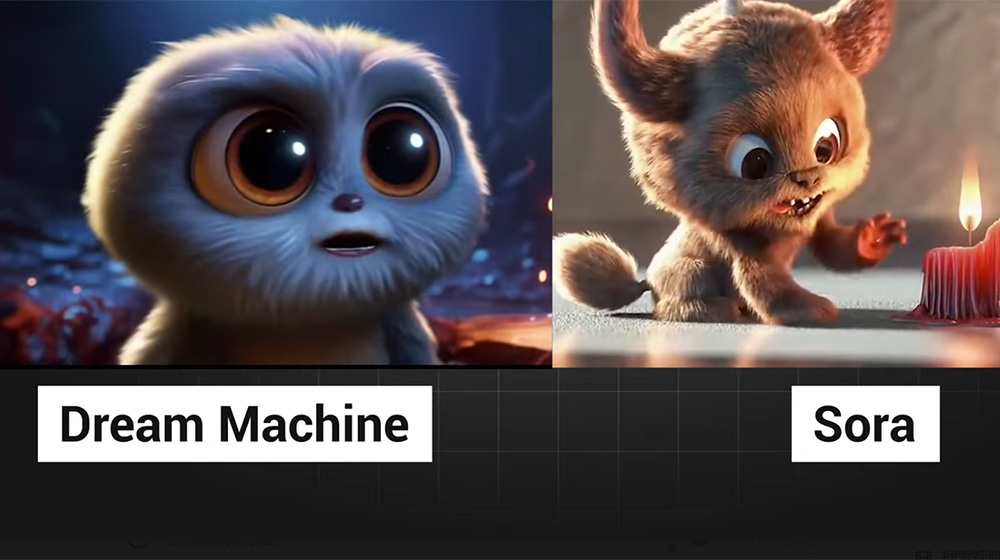
Differences between Dream Machine and OpenAI's Sora:
Accessibility:
Dream Machine has been opened to the public for testing, with 30 free video generations available per day.
Access to Sora is more limited and not as publicly available as Dream Machine; there is still nowhere to test it at this point.
Video Quality and Realism:
Compared with Dream Machine's more cartoonish and less polished look, Sora's videos tend to be more realistic and ultra-detailed.
Sora appears to excel at capturing accurate physics, character consistency, and cinematic camera movements.
Dream Machine can sometimes have issues with elements such as limb animation, static backgrounds, and minor visual glitches.
Generation Time:
Dream Machine's video generation time may exceed the stated 120 seconds and may occasionally fail.
Sora's video generation time is not explicitly mentioned, as it has not been publicly tested, so there is no way to know the generation time.
Video Length:
Dream Machine is limited to generating 5-second video clips.
Sora, on the other hand, can generate videos of 60 seconds or longer that feel more cinematic.
Feature Set:
Dream Machine offers both text-to-video and image-to-video generation capabilities.
Sora does not have a comparable image-to-video capability.
User Feedback:
Users are generally impressed with the capabilities of both models, but some prefer Sora's higher quality and realism.
Dream Machine's public availability and free tier make it easier to experiment with and provide feedback on.
Although both Dream Machine and Sora are excellent AI video generation models, Sora appears to have an advantage in video quality and realism, while Dream Machine offers greater accessibility and a free tier for users to try. The two models appear to be competing in the rapidly evolving field of artificial intelligence video generation.









